A new “local lifeline” for a hillside community
A new mobility trial using Daihatsu Motor’s compact electric wheelchair has begun in Ikoma, Nara Prefecture, offering residents a practical alternative for everyday travel in an aging hillside neighborhood. The initiative is described as the first demonstration project of its kind in Japan involving this next-generation mobility vehicle in a specific residential area.
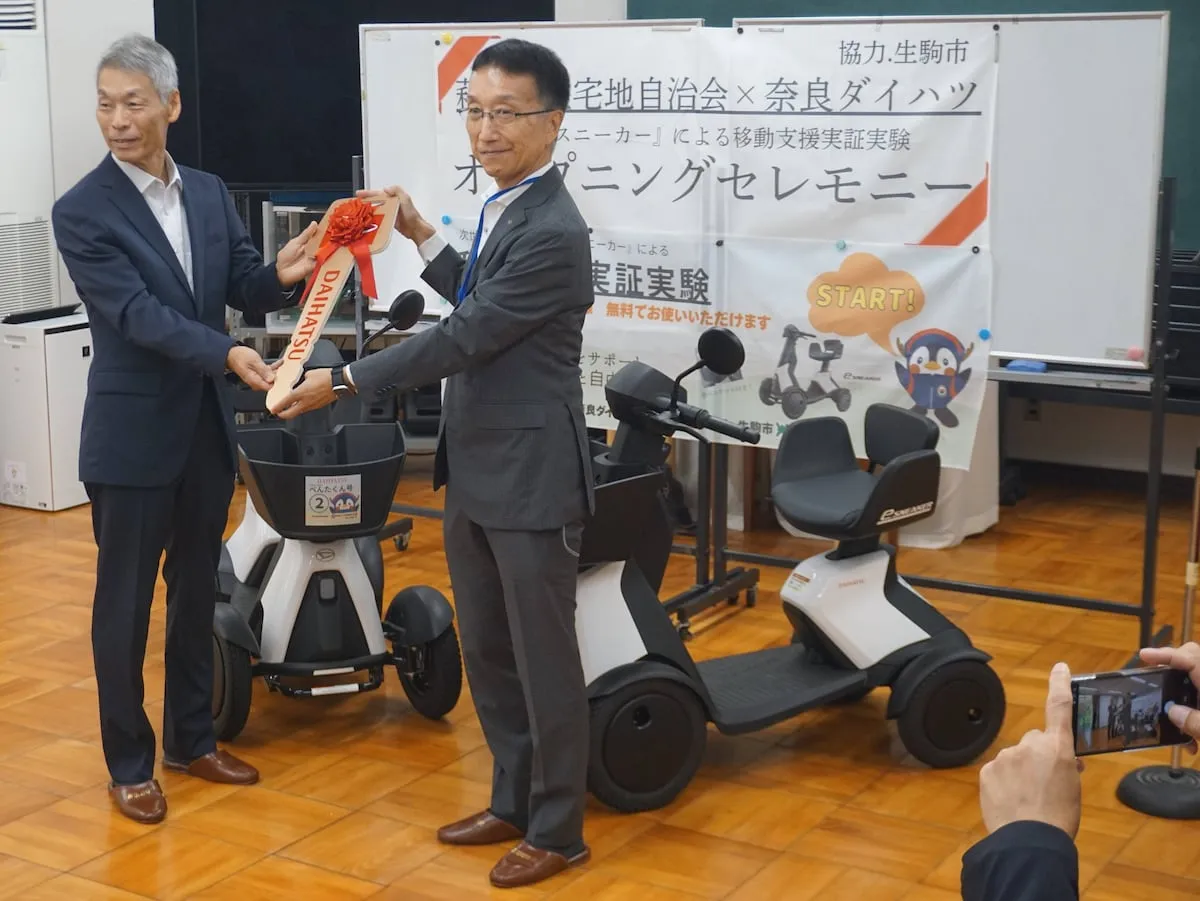
The trial began in October at the Haginodai housing development in southern Ikoma. The electric wheelchair, known as the e-SNEAKER, was previously made available to visitors at the 2025 Osaka-Kansai Expo. It can travel at a maximum speed of 6 kilometers per hour and can be operated without a driving license, making it particularly suitable for older residents and people whose transport options are limited.
Free use for residents through March
The project is being conducted by Nara Daihatsu, a local Daihatsu dealership, together with the Haginodai Housing Association, with the cooperation and understanding of Ikoma City. For approximately six months, through March, residents can borrow the vehicles free of charge from the neighborhood association hall.
They are encouraged to use the e-SNEAKER for ordinary trips, including travel to Haginodai Station on the Kintetsu Ikoma Line, nearby supermarkets, medical facilities and other local destinations. At a departure ceremony held on October 1, residents who tried the vehicle described it as comfortable and helpful for getting around.
Addressing Japan’s aging and transport challenges
Haginodai is a relatively new residential community located on elevated terrain, with numerous slopes and steep roads. Approximately 650 to 700 households, representing around 1,500 people, live in the area. As the population ages, walking to shops, stations and hospitals has become physically demanding for many residents.
For foreign observers, the experiment reflects a wider issue facing communities across Japan. In many suburban and rural areas, older residents rely on private cars, buses or trains for essential errands. However, some people eventually return their driving licenses, while declining populations and labor shortages can lead to reduced public transport services. Small, low-speed mobility devices could help fill the gap between walking and conventional automobiles.
Takeshi Yamaguchi, the 70-year-old chairman of the Haginodai Housing Association, said he had seen Daihatsu’s electric wheelchair at the Expo and believed it could respond to residents’ concerns. In particular, he pointed to the difficulty of carrying shopping bags while walking uphill. His request to Nara Daihatsu helped lead to the current demonstration.
Testing a model for other communities
Rikiya Kaiho, president of Nara Daihatsu, emphasized that Daihatsu has long focused on small vehicles used as an essential means of daily transportation, including kei cars, Japan’s popular category of compact automobiles. He said the company hopes the project will help older people remain active by expanding the area they can comfortably reach.
During the trial, organizers will collect and analyze usage data, including how often the vehicles are used and for which types of trips. The results may guide future projects in other Japanese communities facing similar challenges. While the e-SNEAKER is not intended to replace buses, trains or cars in every situation, the experiment highlights how carefully designed, locally managed mobility services can support independence and quality of life in an aging society.