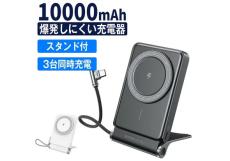
NewsedTech (ニューズドテック) has launched a mobile power bank built for peace of mind in an age of battery anxiety. Announced on February 12, the “Non-Exploding Charger: SH11” leverages a semi‑solid battery architecture to resist combustion even under severe damage, pairs it with a modern battery management system that automatically halts charging during overvoltage or overcurrent, and meets the UN38.3 standard for safe air transport. Priced at 10,800 yen and available via the company’s website and through its Rakuten Ichiba storefront “NewsedPhone” (ニューズドフォン), the SH11 is positioned as a travel-friendly, all-weather companion for Japan and beyond.
Safety-first engineering: why semi-solid matters
Conventional lithium-ion power banks rely on liquid electrolytes that, while energy-dense, can encourage thermal runaway if punctured, overcharged, or exposed to extreme heat. Semi-solid batteries sit between today’s liquid-based cells and the aspirational solid-state future, using a more gel-like or solidified matrix to stabilize ion flow and mechanically isolate components. The practical upside is precisely what NewsedTech is marketing: a strong resistance to ignition and explosion when damaged, and a calmer thermal profile during routine use. In a category where headlines about fires can undermine consumer confidence, the SH11’s core chemistry is a meaningful step toward everyday safety without abandoning portable convenience.
Certified for the skies, designed for the real world
The SH11’s compliance with the UN Manual of Tests and Criteria, Section 38.3 (commonly known as UN38.3), signals it has endured a battery of lab evaluations—ranging from altitude simulation and thermal cycling to vibration, shock, and short-circuit tests—required for air shipment and passenger carry-on. For travelers, that translates into an easy addition to a cabin bag rather than a call to the airline desk. Complementing those credentials, NewsedTech says the power bank operates reliably from −40°C to 60°C, a notably broad envelope that anticipates real-life challenges: icy dawns during Hokkaido winters, trunk temperatures in a Tokyo summer, or exposure during outdoor events and disaster preparedness. It is a sensible fit for Japan’s varied climate and an example of how domestic engineering excels at hardening consumer tech against local conditions.
Longer life, less waste
Beyond first-line safety, longevity is the other pillar of responsible battery design. NewsedTech rates the SH11 for around 1,200 charge–discharge cycles—about 2.4 times the lifespan of a typical mobile battery according to the company’s comparison. Over the life of a device that could be charged every workday, that extra endurance can stretch across years of use. In practical terms, it reduces cost of ownership and helps minimize e-waste, aligning with Japan’s industry-wide push to extend product lifecycles through better materials and controls. A more durable cell means fewer disposals, less resource extraction per unit of service delivered, and a smaller environmental footprint overall.
Everyday features: wireless charging, built-in cable, and a desk-friendly stand
NewsedTech’s focus on safety does not come at the expense of convenience. The SH11 supports wireless charging for compatible devices, allowing quick top-ups without fishing for a cable. A built-in USB Type‑C lead simplifies on-the-go charging, and the unit can power up to three devices at once by combining its wired and wireless options. A simple integrated stand turns the power bank into a dock for video calls, streaming, or keeping your screen visible while your device charges—handy on a train table, a café counter, or a small home office. The unit measures approximately 70 mm (W) × 116 mm (H) × 19 mm (D), weighs about 202 g, and comes in black or white—compact and light enough for a jacket pocket yet substantial enough to feel durable in hand.
Price, availability, and where it fits in the market
At 10,800 yen (roughly US$70–$75 depending on exchange rates), the SH11 arrives at a premium over many entry-level power banks but offers a clear value proposition: a safer cell chemistry, verified transport compliance, expanded temperature tolerance, and a cycle life that outpaces typical rivals by more than double. It is available direct from NewsedTech’s official site and on Rakuten Ichiba via the company’s “NewsedPhone” storefront, channels that make it accessible across Japan and convenient for repeat customers. For professionals who travel frequently, students commuting across cities, and families building emergency-ready kits, the SH11’s blend of safety and practicality should resonate.
Context: a timely Japanese answer to global battery concerns
Incidents involving lithium-ion batteries—from micromobility fires to mishandled chargers—have spurred regulators and airlines worldwide to elevate scrutiny. Japan, a long-time leader in battery materials, manufacturing precision, and quality control, is responding with concrete improvements in consumer-grade products. The SH11 showcases that ethos: not just meeting the letter of international standards but aiming for real-world resilience and user trust. While much of the world anticipates fully solid-state batteries, semi-solid designs like this are a pragmatic bridge, available now and delivering immediate gains in safety and longevity. It is precisely the kind of incremental, user-centered innovation where Japanese firms excel, translating advanced chemistry into daily reliability.
All-weather reliability for a mobile-first lifestyle
Japan’s mobile culture demands dependable power in trains, cafés, stadiums, and disaster drills. A power bank that works from −40°C to 60°C, cuts off intelligently under electrical stress, and keeps serving past a thousand cycles matches that need. The stand feature and wireless charging nod to modern habits—propping up a phone for a Teams call, streaming highlights, or scanning transit QR codes as the battery quietly refuels. By integrating protection and convenience, the SH11 reduces the trade-offs that often plague portable power: if it is safer, it tends to be bulkier; if it is smarter, it may be delicate. Here, the balance is thoughtfully struck.
Looking ahead: from semi-solid to solid-state
Industry watchers expect semi-solid chemistries to filter into more categories—e-bikes and scooters, drones, and certain medical devices—before fully solid-state batteries arrive at scale. As Japanese companies continue to invest in next-generation electrolytes and separator technologies, consumer products like the SH11 serve as proof points, acclimating users to safer batteries while supply chains mature. For now, NewsedTech’s latest release is a welcome, user-facing demonstration of Japan’s strengths: meticulous manufacturing, conservative safety margins, and a bias toward dependable, long-lived devices that quietly make everyday life better.
Specifications at a glance: approximately 70 × 116 × 19 mm; about 202 g; colors in black or white; semi-solid battery design; battery management system with overvoltage/overcurrent auto-stop; UN38.3 compliant and carry-on ready; operating range −40°C to 60°C; wireless charging; built-in USB Type‑C cable; up to three-device simultaneous charging; available via NewsedTech’s official site and Rakuten Ichiba “NewsedPhone.”