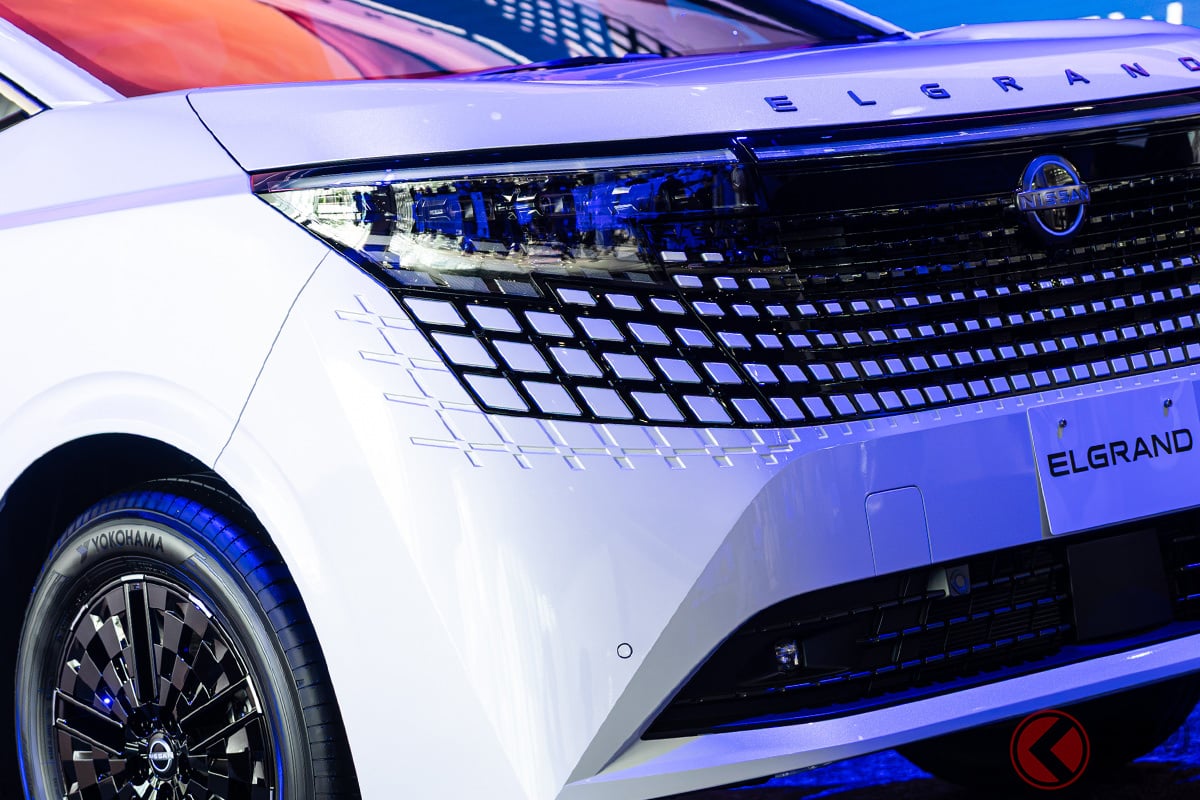
Nissan’s flagship minivan returns—and Japan responds
Nissan’s all-new Elgrand, a large luxury minivan long admired in Japan and across Asia, went on sale on July 16, 2026—and early demand is brisk. Dealers began sharing prices in mid-May and opened factory orders on May 28. By mid-July, without splashy mass advertising, Nissan had already taken around 6,000 orders. That may not sound explosive, but it is significant given the Elgrand’s premium positioning and advanced hybrid all-wheel-drive hardware, with tax-included pricing of 6,897,000 yen for the X e-4ORCE and 7,579,000 yen for the flagship G e-4ORCE. At current exchange rates, that places Nissan’s new people-mover in the mid-to-high US$40,000s—a serious, but competitive, figure for a tech-rich Japanese minivan.
Delivery times: popular grades now 4–7 months out
High demand is already lengthening delivery schedules. According to Nissan dealers in Japan, the X e-4ORCE currently requires roughly four months from order to delivery, while the more popular G e-4ORCE is tracking at about six months. Custom editions—Autech and VIP—are built in smaller volumes and are taking around seven months. If the new Elgrand becomes a more common sight on city streets in the coming weeks, order backlogs could swell further. Anyone considering purchase is being advised to lock in an order early.
Who’s buying: loyalists, step-ups, and switchers
The largest group of early adopters are owners of the previous-generation Elgrand, many of whom have waited years for this full model change. There is also a notable “step-up” flow from Nissan’s Serena, as well as conquest sales from rival minivans—Toyota’s Alphard and Vellfire, Honda’s Odyssey—and even from style-conscious SUV drivers coming out of models like Toyota’s Harrier. As is typical in Japan, right after launch the top trim sees the most traction; over time, dealers expect demand to rebalance toward the best-value specification.
Grade strategy: value vs. luxury—and a smart option play
For cost-conscious buyers, the X e-4ORCE stands out as the value pick: it covers core safety and comfort features at a lower entry price. The G e-4ORCE, however, piles on desirables—Intelligent Distance Control (adaptive distance assist), ProPILOT with hands-off capability in congestion where conditions and regulations permit, ventilated seats for the first and second rows, hands-free sliding doors, a 100V/1500W AC outlet, ETC 2.0, and more. It also upgrades to “TailorFit” upholstery with a Nappa-like feel and moves from a 12.3-inch to a 14.3-inch display. The step from X to G is 682,000 yen, which many buyers will find justified by the extra tech and comfort. Still, Nissan offers a clever middle path: on the X, a 249,700-yen option bundle adds the most sought-after items (including the hands-off ProPILOT function, Intelligent Distance Control, the 14.3-inch display, and ETC 2.0). Spec an X e-4ORCE with this pack and the tally comes to 7,146,700 yen—appealing for those who prioritize key tech but can forgo the full suite of luxury touches.
Rival check: Alphard’s equipment advantage vs. Elgrand’s drive
Benchmarked against Toyota’s category-defining Alphard, Nissan faces a clear challenge on standard equipment. Many features that are optional on the Elgrand—driver-assist functions and the 100V/1500W household-style outlet prized in Japan for disaster readiness—are standard on Toyota models, from compact cars like Aqua to the Alphard itself. The Alphard Hybrid Z E-Four (4WD), roughly analogous to the Elgrand X e-4ORCE, lists at 6,619,800 yen, about 277,200 yen cheaper. Factor in its richer standard kit—AC outlet, assist functions, seat ventilation, ETC 2.0, executive second-row chairs with dual armrests, and even an overhead console with downlights—and the “effective” gap can stretch to around 650,000 yen. On equipment-per-yen alone, Toyota takes the win.
But Nissan’s ace is how it drives
What tips many shoppers toward the Elgrand is the feel behind the wheel. The new model pairs a turbocharged 1.5-liter three-cylinder generator with Nissan’s latest (third-generation) e-POWER electric drive and e-4ORCE all-wheel-control. Dealers and early evaluators say the torque-rich surge and serene refinement rival far larger-displacement engines—“approaching 5.0-liter class” in response—while electronically controlled dampers balance ride comfort with high-speed stability. For a minivan standing over 1,900 mm tall, the Elgrand is unusually composed, more akin to a well-sorted SUV around 1,600–1,700 mm in height. Cabin quietness is another highlight. For buyers who value engaging, confidence-inspiring dynamics in a family hauler, that character can outweigh a nominal price disadvantage.
Why it matters to global readers and expats in Japan
Japan’s large minivans are more than family cars—they anchor airport transfers, hotel fleets, and high-end ride services across Asia. The Elgrand’s return intensifies a uniquely Japanese rivalry that has set global standards for comfort, practicality, and craftsmanship. For expatriate families in Japan, both Alphard and Elgrand offer sliding-door convenience in tight cities, real winter capability with AWD, and the disaster-readiness reassurance of a 1,500W outlet (standard on Toyota, optional or grade-dependent on Nissan). With wait times now reaching half a year, planning ahead is essential—especially for those relocating on fixed timelines or targeting winter delivery in snowy regions like Hokkaido or Tohoku. The bottom line: if you prize lavish standard kit and a softer luxury focus, the Alphard remains a powerhouse choice; if you want a Japanese-built minivan that rewards every mile with poised, quiet, electric-driven thrust, Nissan’s new Elgrand makes a compelling, proudly homegrown case.