A Landmark Step Toward Universal Free Education
In a historic policy breakthrough, Japan’s ruling Liberal Democratic Party (LDP) and the Japan Innovation Party (Ishin no Kai) officially reached an agreement on October 31 to expand the nation’s high school tuition-free program. This marks the first formal consensus under their new coalition framework, signaling a shared commitment to easing the financial burden on families and promoting equal access to education.
Under the new plan, beginning next fiscal year, tuition will effectively be free for all high school students — including those attending private institutions — regardless of household income. The policy represents one of the most significant education reforms in years, removing the long-debated income cap that had previously excluded higher-earning families from tuition support.
Raising the Support Cap for Private High Schools
Currently, all households, regardless of income level, receive a national education support grant equivalent to the annual tuition of public high schools — approximately ¥118,800 (about USD 770). With the new agreement, the upper limit for households with students enrolled in private high schools will rise to ¥457,000 (around USD 3,000) per year. This substantial increase aims to make private education more accessible to families across the country.
However, to prevent “opportunistic” tuition hikes by private institutions, the government will reduce subsidy allocations to prefectures that fail to implement effective countermeasures. This accountability mechanism is intended to ensure that the benefits of the reform go directly to students and families, rather than being absorbed by school operators.
Eligibility and Restrictions
The expanded program will primarily benefit Japanese residents, with eligibility restricted to permanent residents and long-term foreign residents. International students and those attending foreign schools in Japan will be excluded from the tuition-free coverage. For private correspondence (online) high schools, the upper limit for financial support will be capped at ¥337,000 per year.
In addition, the government plans to expand scholarship grants — currently reserved for low-income households exempt from local taxes — to include middle-income families. These grants are aimed at reducing other educational expenses, such as textbooks and school supplies, which often impose hidden financial stress on families even when tuition is covered.
Addressing Balance Between Public and Private Schools
While the reform is expected to benefit private institutions significantly, concerns have been raised about its potential impact on public high schools. Policymakers fear that an influx of students into private schools could lead to a decline in applications to public schools. In response, the central government plans to introduce a comprehensive high school education reform strategy within the current fiscal year. This plan will likely include new grant systems and enhanced funding for public schools to maintain their competitiveness and ensure quality education for all students.
Political Context: Cooperation and Tension Among Coalition Partners
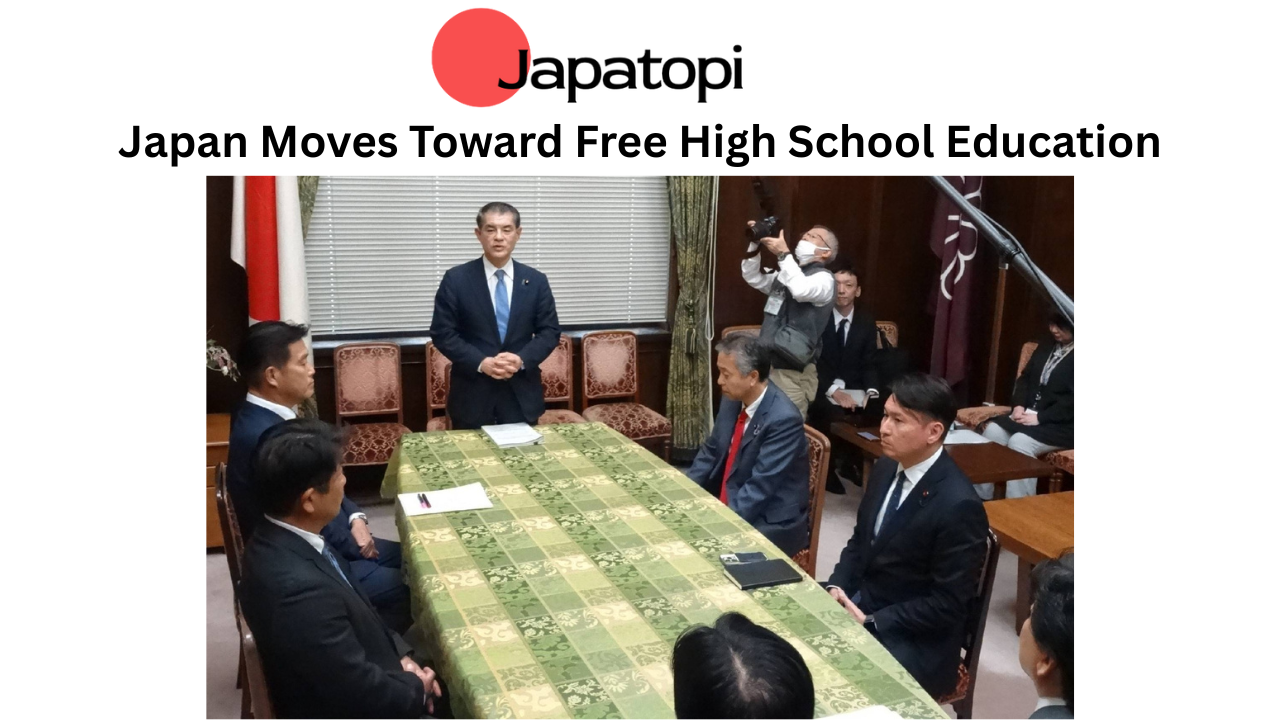
The push for tuition-free high school education has been a shared agenda among the LDP, Ishin, and Komeito since early 2025. However, despite earlier discussions involving all three parties, the latest agreement was finalized without Komeito’s signature. While the LDP and Ishin formalized the agreement at the policy chiefs’ meeting in the National Diet, Komeito opted to delay its endorsement, signaling subtle yet significant political tension within the coalition.
Nonetheless, the agreement represents a crucial step in the evolving alliance between the LDP and Ishin — both of whom are keen to demonstrate their ability to deliver tangible policy results amid Japan’s growing socioeconomic challenges.
A Shift in Japan’s Education Philosophy
Beyond its immediate economic implications, this reform reflects a broader philosophical shift in Japan’s approach to education. By eliminating income-based restrictions and extending benefits to private school students, the government aims to redefine education as a universal right rather than a privilege influenced by family income.
Experts suggest that the move could have ripple effects across multiple policy areas, from demographic revitalization to regional economic equality. As the government finalizes budget and legislative details in the coming months, all eyes will be on how effectively this ambitious initiative can be implemented — and whether it will serve as a model for broader education reforms in Japan’s future.