A Forgotten Tragedy Resurfaces
After 26 years of silence and uncertainty, a brutal murder case from Nagoya’s Nishi Ward has once again captured national attention. On November 2, police arrested 69-year-old part-time worker Kumiko Yasufuku in connection with the 1999 killing of 32-year-old housewife Namiko Takaba. The suspect, now facing charges for repeatedly stabbing the victim in the neck, was sent to prosecutors on the same day.
For many, the arrest brings a sense of closure. But for one man—the victim’s son, who was just two years old when he witnessed his mother’s final moments—the emotional weight of the case has only grown heavier.
“Why Did This Happen?”
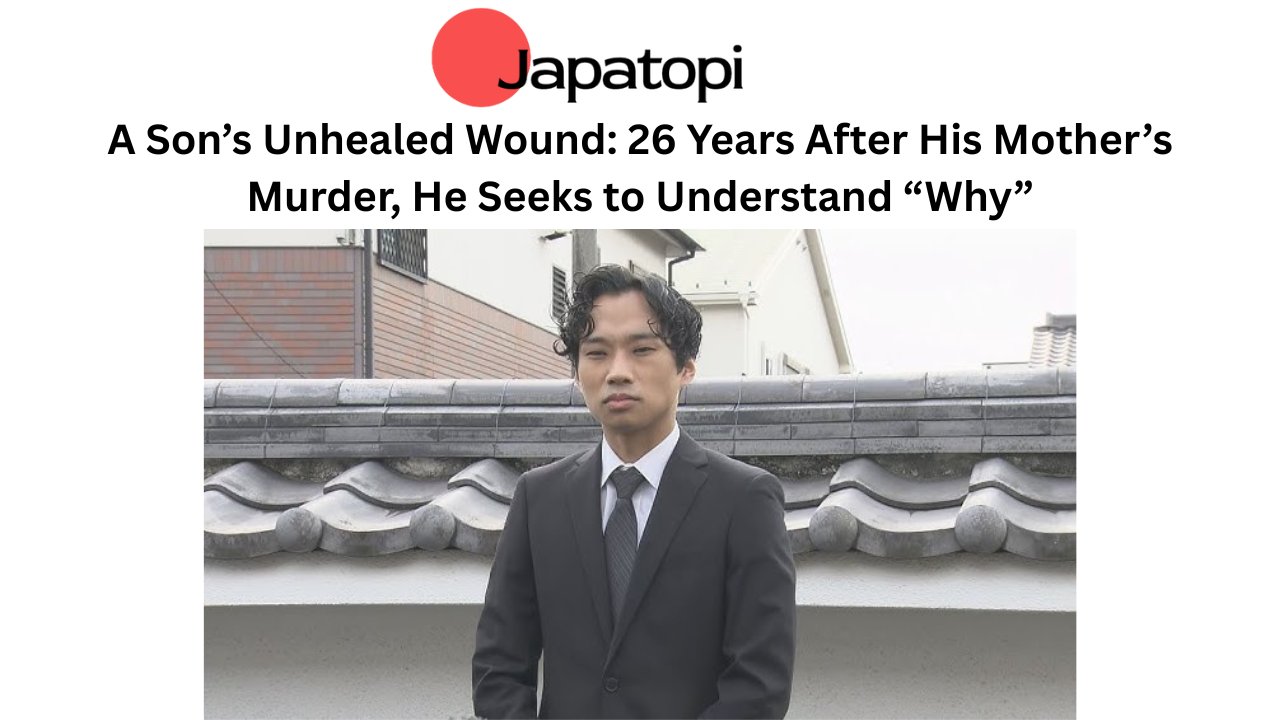
Now 28, Kohei Takaba broke his long silence and spoke publicly for the first time. His words were filled with grief but also a quiet determination to understand the truth.
“Why did she do such a thing? If that reason could be made clear, that alone would help us heal,” he said.
For Kohei, the suspect’s arrest does not mark an end—it marks the beginning of a long-awaited search for meaning. The case may soon move into the courts, but the emotional trial has already lasted nearly three decades for those left behind.
A Case Buried by Time
The murder occurred in November 1999, inside a small apartment in Inaoicho, Nishi Ward. The victim, Namiko Takaba, was a devoted wife and mother, known in her neighborhood as cheerful and kind. Her husband, Satoru Takaba, now 69, was reportedly devastated by the incident, left to raise their young son alone.
For years, the case remained unsolved. Advances in forensic technology and a renewed police investigation appear to have led to the recent breakthrough. While police have not disclosed details about new evidence, they are reportedly pursuing the suspect’s motives and psychological background.
A Connection with No Explanation
Authorities confirmed that Yasufuku and the victim’s husband, Satoru, were classmates in the same high school club, though there was no clear connection between Yasufuku and Namiko herself. Investigators are now examining whether old personal ties or unresolved emotional issues may have played a role in the crime.
The revelation that the suspect had no apparent link to the victim deepens the mystery. If there was no grudge or personal dispute, what drove a woman to commit such a violent act? Was it jealousy, obsession, or something else entirely?
The Long Shadow of Violence
For Kohei, growing up as the child of a murder victim has meant living with questions that no one could answer. The trauma of losing a mother before forming lasting memories, coupled with the stigma surrounding the case, shaped his entire life.
People close to him describe him as calm and introspective—a man who rarely speaks of the past but carries it silently.
His brief public statement reflects not anger, but a deep need for understanding. In a world quick to sensationalize crime, Kohei’s words remind us that behind every headline lies a family struggling to rebuild their lives.
Justice, Memory, and Healing
The Nagoya case has reopened public debate about Japan’s unsolved crimes and the toll they take on surviving families. Many are calling for more consistent psychological and social support for victims’ relatives, who often face decades of emotional isolation.
Criminologists note that such cold cases often reveal not just individual crimes, but the fragility of human connections. “Understanding the motive is crucial,” one expert said. “It’s not about revenge—it’s about closure and the human need to make sense of loss.”
A Son’s Quiet Courage
As the investigation proceeds, Kohei’s statement stands as both a plea and a message. After 26 years, he is not demanding punishment or retribution. He seeks only to understand the truth—to know why his mother was taken from him.
In a society where many crimes fade into anonymity, his voice represents all those who wait in silence for answers.
His simple words—“Why did she do it?”—echo across decades of pain and patience.
And until that question is answered, the tragedy of 1999 will remain not just a case from the past, but a wound still waiting to heal.