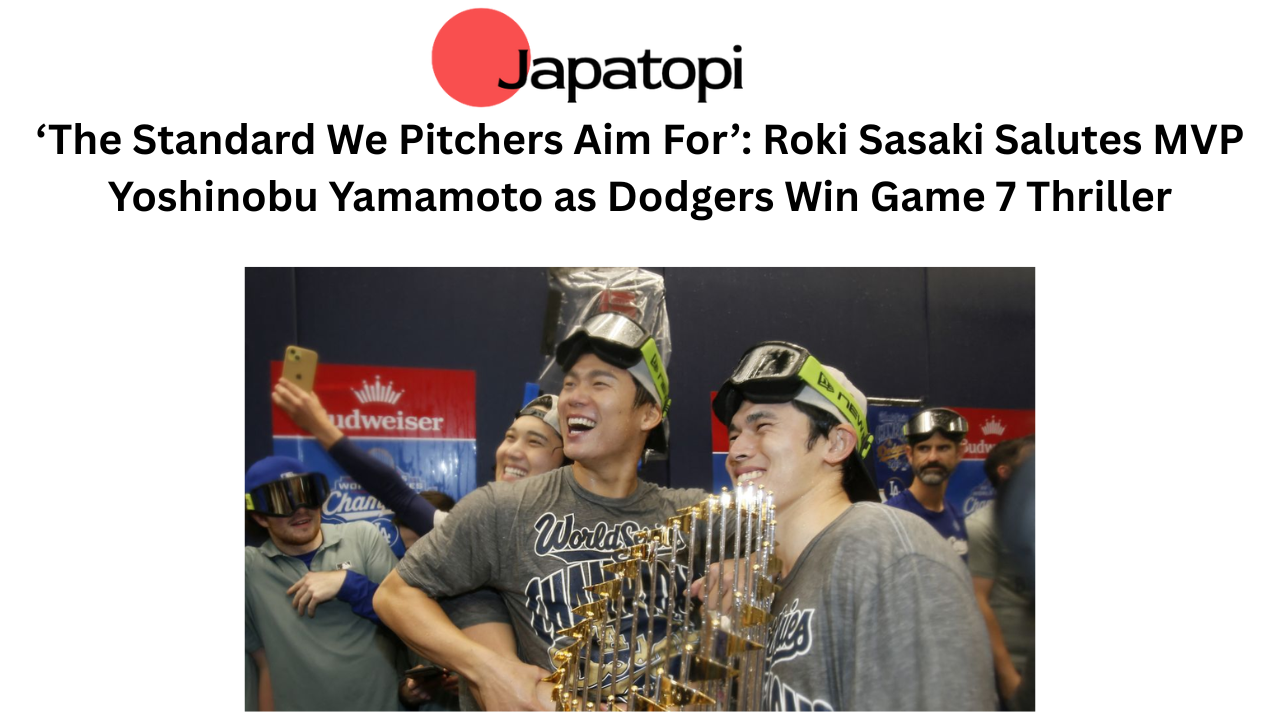
The Los Angeles Dodgers cemented their status as baseball’s modern powerhouse, outlasting the Toronto Blue Jays 5–4 in 11 innings to clinch a second straight World Series title in a nerve-shredding Game 7 at Rogers Centre on November 2, Japan time. And while he never set foot on the mound, rookie right-hander Roki Sasaki stood at the emotional center of the Dodgers’ triumph, describing the winner‑take‑all pressure from the bullpen and reserving his deepest praise for fellow Japanese star and World Series MVP Yoshinobu Yamamoto.
“I was really nervous in the bullpen”: a debut World Series lived at full volume
Sasaki, who was readied to pitch if needed but ultimately did not appear in the game, acknowledged the raw intensity of the night. “I was building up my shoulder in the bullpen, so I was really nervous,” he said afterward, relief and exhilaration mixing as the Dodgers celebrated on the field. “I’m really glad we won.” For the 22-year-old, this postseason run marked his first taste of the Fall Classic, a fast education in just how thin the margins are in October. The Dodgers and Blue Jays slugged through traded blows, strategic chess, and high‑leverage outs until Los Angeles finally pushed across the decisive run in the 11th. Toronto’s dome had vibrated with noise all evening; by the end, it was the traveling Dodgers fans making the noise as the champs spilled from the dugout.
Asked what separated the Dodgers over seven games, Sasaki spread the credit across a starting rotation that kept the team in every contest. “Tonight was another example, but really the starters worked so hard for us all series,” he said. “That’s the biggest thing.” In an era defined by short hooks and bullpenning, the Dodgers leaned on their rotation’s length and edge, and it set the platform for tight, late‑inning wins.
From injury setback to trusted October reliever
Sasaki’s rookie year in the majors was anything but straightforward. He arrived as a highly touted starter and broke in that role, only to be detoured in May by a bout of right shoulder impingement syndrome that sent him to the injured list. After a careful rehab, the Dodgers recalibrated his usage and welcomed him back as a reliever, where his elite velocity and splitter played in short bursts. The trust continued to grow; by October, he was being handed the ball in the game’s most anxious moments as a late‑inning stopper, even working as the club’s closer at times during the postseason.
“It was a frustrating season,” Sasaki admitted, reflecting on the lost months and the lessons that came with them. “But being able to pitch in the postseason was a really good experience for me.” That experience means something bigger now that the team has closed the deal. “The team became world champion—what a fantastic result,” he said, the grin widening as champagne popped in the background.
Yamamoto’s back‑to‑back brilliance seals MVP—and sets the bar
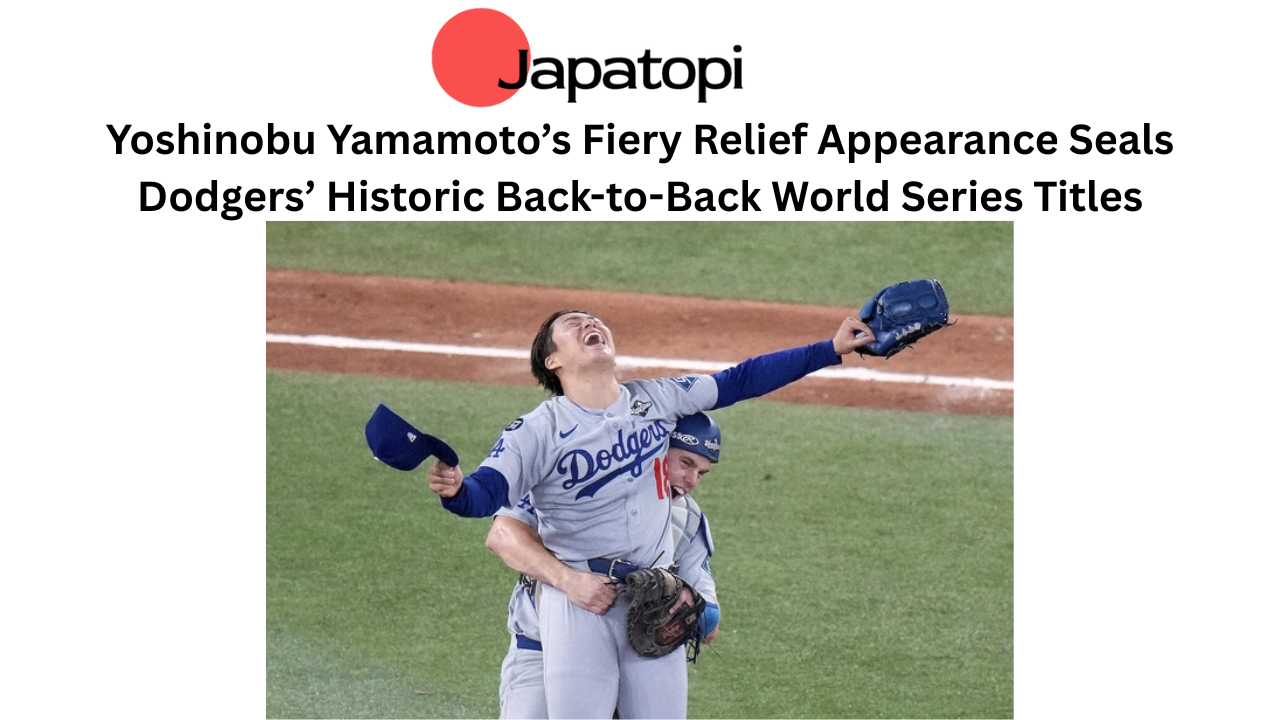
If Sasaki’s autumn was a study in adaptation, Yamamoto’s was an exhibition of endurance and excellence on command. Less than 24 hours after starting Game 6, the right‑hander returned in Game 7 and marched back to the mound in the ninth inning with the championship in the balance. He shut the door—and kept it locked—through the 11th, firing scoreless baseball to give the Dodgers the window they needed to score and finish the job. The performance crowned Yamamoto as World Series MVP and, for many teammates, crystallized what leadership looks like under duress.
Sasaki didn’t hesitate to salute the veteran’s example. “He threw yesterday and threw again today, and the way he pitched was outstanding,” Sasaki said. “It’s the kind of standard we pitchers aim for.” In baseball’s analytics era, back‑to‑back outings for a starter—especially across multiple innings—remain rare. For Yamamoto, it was a statement of resilience and execution, the capstone to a series in which he repeatedly answered the highest‑leverage calls.
The strategic thread: star starters, agile roles, and nerves of steel
Game 7 offered a masterclass in modern October pitching management. Los Angeles prepared layers of contingency: starters on short rest, relievers stretched for extra outs, and young arms like Sasaki ready to bridge choppy waters. The plan required both ambition and restraint—ambition to deploy an ace like Yamamoto on consecutive days, and restraint to hold back Sasaki, even as he warmed intensely, until the exact situation demanded it. In the end, the Dodgers found enough offense late and entrusted Yamamoto with the run prevention that secured the flag.
That Sasaki stayed ready, even in silence, is instructive. Bullpens are the sport’s most isolated amphitheaters—loudest in their quiet. Every phone ring spikes the heart rate; every rush to the mound in the outfield steals a breath. “I was really nervous in the bullpen,” he repeated, almost laughing at how visceral it felt. Nerves, though, are not a flaw—they are evidence of the stage, and the young righty carried them with poise as he waited for a call that never came.
What it means for the Dodgers—and for Sasaki’s next step
A second straight championship confirms the Dodgers’ depth and cultural core, knitted together by stars willing to change roles, rising talents who fit the moment, and a coaching staff that made the right risk at the right time. It also amplifies the influence of Japanese pitching at the pinnacle of the sport: Yamamoto as the MVP closer in a pinch, Sasaki as the power arm who flipped his season’s narrative and earned trust in October. Together, they offered a cross‑Pacific picture of how excellence travels.
Sasaki is already thinking ahead. “Next season I’ll work to contribute from the start of the season,” he said, drawing a straight line from his 2024 turbulence to his 2025 ambitions. “I’ll do my best so we can become world champions again.” The blueprint is clear: get healthy, build workload early, and sharpen the late‑inning weapons that turned him into a postseason force. If this October was his introduction to the sport’s biggest stage, the next one could be his to shape.
For now, though, the night belongs to the Dodgers, who weathered every surge and silence in Toronto before delivering the final blow in extra innings. It belongs to Yamamoto, whose back‑to‑back heroics will echo in franchise lore. And it belongs to Sasaki, who felt every pitch from the bullpen wall and came away with a promise—for himself and his team—that the standard he witnessed is the one he intends to meet.