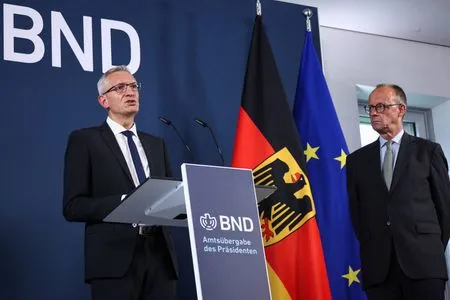
German intelligence chief issues stark warning
BERLIN, Germany — Germany faces a growing risk of being drawn into an armed confrontation with Russia as Moscow allegedly intensifies a “shadow war” against democratic countries in Europe, the head of Germany’s Federal Intelligence Service, or BND, warned on Thursday.
Martin Jaeger delivered the assessment during an annual parliamentary hearing, saying that the confrontation between Russia and Europe had entered a new and more dangerous phase. “The confrontation we are facing with Russia has entered a new, more dangerous phase,” Jaeger said, according to comments reported from Berlin.
He added that Germany was at risk of becoming involved in an armed conflict with Russia. Jaeger cited an alleged attempted attack involving drones at Leipzig Airport in August as one example of the growing security challenge. German authorities have accused Russia of being involved in the incident, although such allegations remain part of an ongoing security and political assessment.
What is a “shadow war”?
The term “shadow war” is increasingly used by European officials to describe activities that fall below the threshold of open military conflict. These may include cyberattacks, sabotage, disinformation campaigns, espionage, threats against critical infrastructure and covert efforts to influence democratic institutions.
Such incidents create a difficult challenge for governments. They can cause disruption and public anxiety while making it harder to determine responsibility and decide how to respond. Airports, railways, energy facilities, communication networks and government systems are considered particularly sensitive targets because disruption in these areas could affect daily life and national security.
Germany is a central member of NATO and one of Europe’s most important political and economic powers. Any serious attack on German infrastructure could therefore have consequences extending beyond Germany, potentially affecting the wider alliance and increasing tensions between Russia and Western countries.
Why the issue matters to Japan
Although the warning was issued in Europe, it is closely watched in Japan. Tokyo is a major partner of European democracies and has strengthened security cooperation with NATO and individual European countries in recent years. Japan has repeatedly expressed concern about unilateral attempts to change the status quo by force and has emphasized the importance of rules-based international order.
Japan also faces its own security pressures in the Indo-Pacific, including concerns about cyber threats, disinformation and the protection of critical infrastructure. Developments in Europe can influence Japan’s defense planning, diplomatic coordination and discussions about economic security. European instability may also affect energy markets, supply chains and international efforts to support Ukraine.
A warning, not a declaration of war
Jaeger’s remarks do not mean that Germany or NATO has declared an imminent war with Russia. Instead, they underline the growing concern among European intelligence and security officials that hostile activity below the level of conventional warfare could escalate through miscalculation or retaliation.
For citizens, the message is both serious and measured: governments are seeking to improve resilience, strengthen intelligence cooperation and protect critical infrastructure while avoiding unnecessary escalation. The Leipzig incident and other suspected operations will likely remain under investigation as Germany assesses the evidence and considers an appropriate response.
The warning also highlights the increasingly interconnected nature of global security. Events in Europe can shape debates in Japan and across the Indo-Pacific, making cooperation among democratic countries more important than ever. For now, Germany’s intelligence chief is urging vigilance as Europe confronts a more uncertain and dangerous security environment.