New security agreement reshapes Greenland’s strategic role
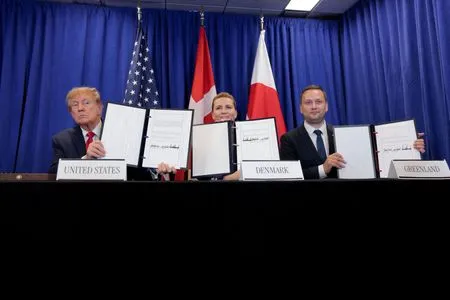
U.S. President Donald Trump, Danish Prime Minister Mette Frederiksen and Greenlandic Prime Minister Jens-Frederik Nielsen have signed a three-party security agreement allowing a major expansion of the American military presence in Greenland, according to a Reuters report. The agreement was signed in New York during the United Nations General Assembly and could ease a long-running dispute over the strategically important Danish autonomous territory.
Greenland sits at a critical point between North America and Europe. Its location provides access to important Arctic air and sea routes, while its proximity to the shortest route between the European continent and North America gives it considerable military significance. The island is also believed to hold substantial mineral resources, increasing its importance as global competition for critical materials intensifies.
Expanded missile defense and military infrastructure
Under the agreement, the United States may install its “Golden Dome” defense system in Greenland as part of a network designed to counter ballistic-missile threats. President Trump said before the signing that Washington would obtain permanent control over security and other essential needs in Greenland under the arrangement. He also stated that the United States would begin preparing for a large-scale military deployment and construct two major military bases.
The planned facilities are reportedly expected to include Narsarsuaq, where an air base operated during the Cold War, and Mestersvig, which is currently used by Danish special forces. The United States already operates Pituffik Space Base in northwestern Greenland, its northernmost military installation. The new agreement would therefore represent a significant expansion of American infrastructure in the region.
The pact amends a 1951 defense agreement that has provided the legal foundation for the U.S. military presence in Greenland. During the Cold War, the United States maintained 17 facilities on the island and stationed more than 10,000 personnel there. The planned expansion would be the largest enlargement of U.S. military infrastructure in Greenland since that era.
NATO and Greenlandic self-determination
The agreement stops short of transferring sovereignty over Greenland to the United States. President Trump had previously called for the territory to become part of the United States, a proposal that generated strong opposition in Denmark and Greenland. Prime Minister Frederiksen described the new pact as a potentially lasting agreement and said it reaffirmed NATO’s importance while respecting Greenland’s right to self-determination.
Prime Minister Nielsen likewise stressed that maintaining a strong NATO presence in the Arctic is essential. NATO Secretary General Mark Rutte said the agreement would strengthen collective security, adding that improved protection of the Arctic and North Atlantic is important to both Europe and North America.
Why the development matters to Japan
The agreement is also relevant to Japan, even though Greenland is thousands of kilometers away. Japan depends heavily on stable maritime trade routes and closely follows changes in Arctic security, where melting sea ice is gradually creating greater access to shipping lanes and natural resources. Russia and China have expanded their activities in the Arctic, raising concerns among NATO members and other major maritime powers.
For Japan, stronger coordination among the United States and its European allies could influence wider discussions about deterrence, missile defense, space security and the protection of critical infrastructure. Tokyo is already strengthening security cooperation with European partners and monitoring developments in the North Pacific and Arctic regions. The Greenland agreement may therefore become another example of how security challenges in one part of the world can affect strategic planning across the Indo-Pacific.
Its implementation will likely depend on negotiations involving Washington, Copenhagen and Nuuk, as well as environmental, financial and political considerations. Greenland’s local authority and public opinion will remain central to the future of any military expansion.