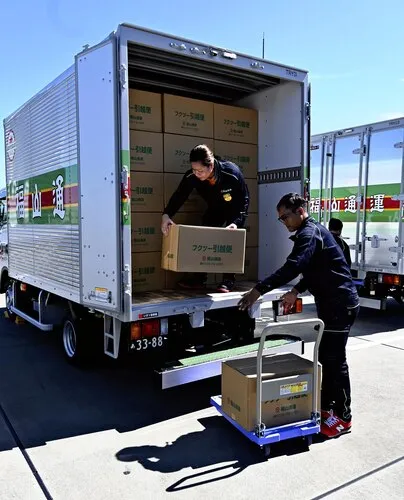
Foreign drivers enter Japan’s logistics workforce
Japan’s logistics industry is accelerating efforts to recruit foreign truck drivers as companies confront a deepening labor shortage. The expansion follows the decision to include road transportation services under Japan’s Specified Skilled Worker No. 1 residence status, creating a new legal pathway for overseas workers to drive trucks, buses and taxis.
The policy is being closely watched by logistics companies, foreign workers and international observers interested in working in Japan. It offers companies a potential solution to persistent recruitment difficulties, while giving qualified workers from countries such as Indonesia and Vietnam access to jobs in one of Japan’s most essential industries.
Companies set ambitious recruitment targets
Fukuyama Transporting brought approximately 30 Indonesian employees to Japan this year. To help new recruits begin driving more easily, the company introduced 36 Isuzu Elf Mio compact trucks that can be operated with an ordinary Japanese driver’s license. The vehicles began entering service gradually from October.
One 43-year-old Indonesian driver said he was eager to become familiar with Japanese roads as quickly as possible. Satoshi Kuwamoto, a senior executive at Fukuyama Transporting, said the company hopes workers will contribute as effective members of the workforce, noting that the Specified Skilled Worker No. 1 status allows employment for a limited period.
SBS Holdings also began expanding its recruitment of foreign drivers in 2025. The company aims to secure 1,800 foreign drivers over the next decade, representing approximately 30 percent of its total driving workforce. The target highlights the scale of the transformation underway in Japan’s delivery and freight sector.
A new route into Japan’s transport industry
Before the change, road transportation was largely outside the main foreign-worker programs, including the Technical Intern Training Program. As a result, foreign nationals able to work as drivers were often limited to people who had obtained residence status through marriage to a Japanese citizen or other special circumstances.
Under the revised framework, successful applicants can work in Japan for up to five years. The intake ceiling through the end of fiscal 2028 is set at 22,100 workers. By the end of August 2026, approximately 7,500 applicants had passed the required examination. Truck drivers account for more than 80 percent of successful candidates, partly because they generally do not need to provide Japanese-language customer service to passengers, unlike taxi and bus drivers.
Japan’s “2024 problem” intensifies pressure
The recruitment drive is closely connected to Japan’s so-called 2024 logistics problem. Since April 2024, annual overtime for truck drivers has been limited to 960 hours. The reform is intended to improve working conditions and reduce excessive hours, but it has also made the existing driver shortage more visible.
Japan’s aging population and declining birthrate have already reduced the available labor pool. The effective job-offers-to-applicants ratio for truck drivers rose from 2.18 in fiscal 2023 to 2.49 in fiscal 2025. During busy periods, some regions have begun experiencing delivery delays, increasing pressure on companies to maintain reliable supply chains.
Safety and education remain critical
Bringing in more foreign drivers is not simply a matter of recruitment. Experts warn that differences in driving customs can create risks if workers are not thoroughly trained in Japan’s traffic rules, road signs and safety expectations. Takuma Kajiwara of Funai Research Institute’s supply-chain consulting division said that following driving habits common in Southeast Asia—such as traveling too close to other vehicles or overtaking differently—could increase the possibility of accidents in Japan.
Companies are therefore investing in long-term preparation. Yamato Transport plans to recruit Vietnamese drivers in 2027 and provide education beginning 18 months before their planned employment. Candidates will first attend Japanese-language schools in Vietnam, followed by training in driving techniques and Japanese culture after arriving in Japan. SBS Holdings plans to establish a driving school in Indonesia in 2028.
Japan’s acceptance of foreign logistics workers could help protect delivery services and strengthen the country’s supply chains. However, the program’s long-term success will depend on fair working conditions, practical Japanese-language support, careful licensing procedures and rigorous safety education. With the expected expansion of foreign employment opportunities in logistics warehouses as well, Japan is moving toward a more international workforce while emphasizing the high standards required on its roads.