A familiar source of stress on Japan’s trains
For millions of commuters in Japan, the train is an essential part of daily life. During the evening rush, however, even a minor lack of consideration can create serious inconvenience for dozens of passengers sharing a tightly packed carriage.
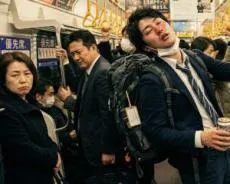
A recent account from a Tokyo commuter describes how one visibly intoxicated young man caused tension by standing directly in front of a train door while wearing a large backpack. His refusal to move made it difficult for passengers to board and leave the carriage, while his unstable posture created an additional risk in the crowded space.
The incident occurred on a JR line in Tokyo during the evening rush. The commuter, identified by the pseudonym Hosobe, a 32-year-old employee of an advertising agency, had managed to find a seat and was resting during the journey. The calm atmosphere changed abruptly when the train stopped at a station.
“Move. You’re in the way!”
According to Hosobe, a middle-aged man who had just boarded became angry when he found the younger passenger standing in the center of the doorway. The man reportedly shouted, “You’re in the way! Move!” while confronting him.
The younger passenger appeared to be standing with his hands on his hips, almost as if challenging those around him. However, his posture was unsteady. Hosobe soon realized that the passenger was not simply being aggressive or deliberately confrontational. He appeared to be heavily intoxicated, with unfocused eyes and little awareness of the situation around him.
Despite the angry words directed at him, the young man reportedly remained silent. He continued staring blankly ahead, seemingly unable—or unwilling—to respond. His large backpack remained on his back, taking up additional space in an already crowded carriage.
His unstable movements made the situation worse
Passengers became increasingly uncomfortable as the train moved. The intoxicated man leaned heavily against the door behind him whenever the carriage swayed. At other moments, the movement caused him to stumble backward into passengers standing behind him.
In a packed train, such behavior can quickly affect an entire group. People may be unable to maintain their balance, protect personal space or move safely toward the doors. A passenger blocking the entrance can also delay boarding and exiting, increasing pressure at stations where trains stop for only a short time.
The Japan Private Railway Association’s 2025 survey on manners at stations and on trains listed lingering near doors—such as obstructing boarding or failing to move farther inside—as one of the most troublesome behaviors reported by passengers. The finding reflects a broader reality of Japanese public transportation: courtesy is not merely a social ideal, but an important part of keeping a high-volume railway system safe and efficient.
Why door etiquette matters in Japan
In Japan, passengers commonly stand to the side of train doors when a train arrives, allowing people to get off before others board. Once inside, commuters are generally expected to move toward the center of the carriage when possible. Backpacks are often carried by hand or placed in front of the body during crowded periods to reduce contact with others.
These habits may seem minor to visitors, but they help prevent bottlenecks on one of the world’s busiest urban rail networks. The reported incident is a reminder that alcohol-related behavior can undermine that shared etiquette in an instant.
The episode also highlights the importance of handling such situations carefully. Confronting an intoxicated passenger can sometimes escalate tensions, so commuters may choose to move away, alert train staff or seek assistance at the next station. Courtesy remains the goal, but safety should come first.