Foreign resident population reaches a new high
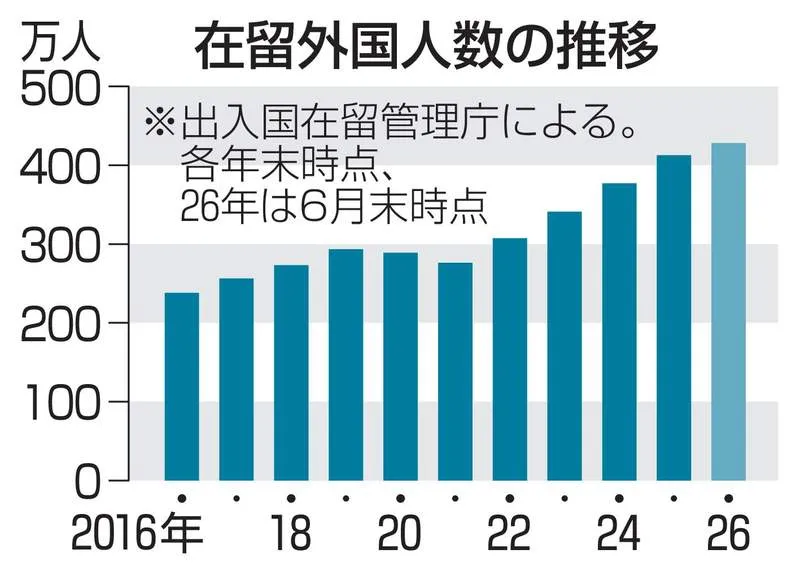
Japan’s foreign resident population reached a record 4,281,026 at the end of June, the Immigration Services Agency announced on the 16th. The figure increased by approximately 155,000 from the end of 2025, lifting the share of foreign residents to 3.4 percent of Japan’s total population.
The continued rise highlights Japan’s growing role as a destination for workers, students, long-term residents and international families. Although foreign residents still represent a relatively small share of the population compared with many other developed economies, their presence is becoming increasingly important to Japan’s communities, universities and labor market.
Permanent residents remain the largest group
By status of residence, permanent residents formed the largest group at 961,342 people, up 1.5 percent from the end of 2025. Permanent resident status generally offers greater stability for people who have established long-term personal and professional lives in Japan.
The second-largest category was “Engineer, Specialist in Humanities, and International Services,” which includes many professionals working in fields such as translation, information technology, education, business and international operations. The number of people in this category increased 8.5 percent to 516,184.
International students were the third-largest group, rising 3.2 percent to 479,626. Students from overseas contribute to Japan’s education sector and, after graduation, some go on to join Japanese companies or build careers in the country. Their growing numbers also strengthen cultural and economic ties between Japan and their home countries.
Specified skilled workers continue to support key industries
The number of people holding the Specified Skilled Worker status stood at 444,256. This visa framework was introduced to help address labor shortages by accepting foreign workers who can immediately contribute in designated industries.
Within that total, 18,295 people held the Specified Skilled Worker No. 2 status, which is intended for workers with advanced skills. That figure more than doubled from the end of 2025, suggesting that an increasing number of foreign workers are progressing toward longer-term professional recognition in Japan.
The expansion of this category is particularly significant as Japan faces labor shortages linked to its aging population and shrinking workforce. Foreign workers are now active across sectors including care services, manufacturing, construction, agriculture, food service and accommodation. Their contribution is helping businesses maintain operations while supporting local economies throughout the country.
Business manager entries fall sharply after rule changes
At the same time, the number of new entrants under the “Business Manager” status dropped substantially. During the first half of 2026, only 635 people entered Japan under the category, an 80.9 percent decline from the same period in 2025.
The decrease is believed to reflect stricter requirements introduced in October 2025. The Business Manager status is used by foreign nationals who establish or operate companies in Japan. Tougher screening is intended to ensure that applicants have genuine business plans, sufficient resources and a meaningful operating presence, rather than using the status primarily as a route to residency.
For legitimate entrepreneurs, the changes may create additional preparation and compliance costs. However, clearer standards could also improve confidence in Japan’s startup and investment environment by distinguishing serious businesses from applications with limited substance. The policy reflects Japan’s broader effort to balance openness to international talent with careful immigration management.
China, Vietnam and South Korea lead by nationality
By nationality and region, China, Vietnam and South Korea remained the three largest groups, together accounting for approximately half of all foreign residents. Among the top 10 nationalities and regions, the populations of Myanmar and Indonesia recorded particularly strong growth, increasing 15.9 percent and 15.6 percent, respectively, from the end of 2025.
Japan’s record total presents both opportunities and responsibilities. As more foreign residents study, work and settle in the country, accessible public services, Japanese-language support and inclusive workplaces will become increasingly important. The latest figures show that international residents are not simply a temporary presence in Japan; they are becoming a lasting part of the nation’s social and economic future.