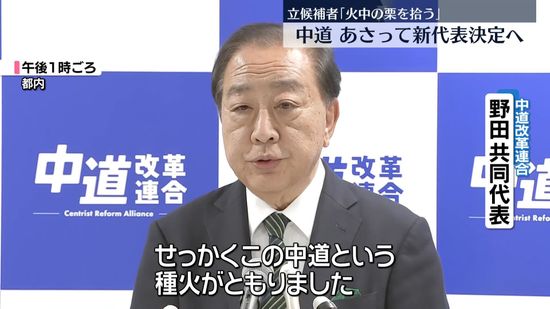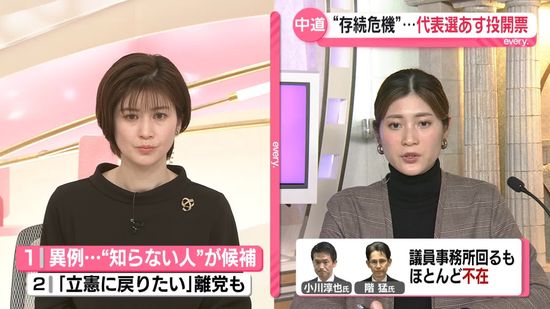
Japan’s fledgling Centrist Reform Alliance will choose its first full-fledged leader on Wednesday, capping an unusually compressed and unconventional campaign that underscores both the promise and the growing pains of a party born on the eve of a snap election. Following a heavy defeat in last month’s general election, the party formally launched its leadership contest on Tuesday; ballots from the 49 sitting lower house members will be cast and counted on Wednesday. The vote, political reporters say, will test whether the nascent bloc can quickly forge identity, discipline, and direction in a crowded political landscape. NTV’s political desk opposition lead, Kuroshima of Nippon TV, frames the race around two defining dynamics: candidates who are “unknown” to many of the very lawmakers choosing them, and mounting talk among some members about returning to their former political homes.
Why this leadership race is so unusual
The Centrist Reform Alliance came together only at the end of last month, formed by a group of lower house lawmakers from the Constitutional Democratic Party of Japan (CDP) and Komeito who aligned just before the Diet was dissolved. At a lawmakers’ meeting on Tuesday, the novelty of this configuration was on full display: members were still exchanging business cards, a polite but telling sign in Japanese political culture that many had not worked together before. Against that backdrop, the leadership field has narrowed to two candidates—both hailing from CDP roots. That alone is striking, given the arithmetic inside the new party: of the 49 lower house members who will vote, 28 are from Komeito backgrounds and 21 from CDP backgrounds. In raw numbers, former Komeito lawmakers hold the edge, yet both leadership hopefuls are CDP-origin figures. One lawmaker from the Komeito side admitted candidly that while he had seen one of the candidates, former CDP secretary-general Ogawa, on television, he did not know him personally. One of the candidates, for his part, acknowledged limited familiarity with colleagues from the Komeito side and said he resorted to calling every member individually. The image is of a party still introducing itself to itself—now tasked with making a consequential decision at speed.
Campaigning in a vacuum: phones, offices, and YouTube
With the Diet out of session and lawmakers scattered in the wake of the election, face-to-face politicking has been challenging. Both candidates, Ogawa and Shina, fanned out to visit the offices of all 49 lawmakers after their candidacy announcements on Tuesday, seeking to build rapport and support. But with many members away from Tokyo, those efforts often meant speaking to staff rather than the principals. As a result, digital tools have taken center stage. The two candidates appeared together in a YouTube livestream late Tuesday and planned another broadcast for Wednesday night, using social media to introduce their platforms and personalities to colleagues and the broader public. For a party built on the premise of reform and the political center, the pivot to online outreach is a practical adaptation—and a reminder that Japanese parties continue to modernize their internal campaigning while respecting orderly, rules-based selection processes.
Early fault lines: talk of returning to the CDP
Another pressure point emerged Tuesday when Kamei, a former lower house member who ran in Shimane’s 1st District and lost, told NNN that he intends to leave the Centrist Reform Alliance. His stated rationale was organizational reality: the CDP still retains an upper house caucus and established local chapters, and he expressed a desire to return to “Rikken” (the CDP) when the timing is right. The Centrist Reform Alliance currently comprises only sitting lower house members; upper house lawmakers from the CDP and Komeito retained their original affiliations when the new grouping was formed. That structural split complicates any immediate efforts at a broader merger. Indeed, one CDP upper house member told NNN that, given the election results, a near-term convergence in the upper house would be difficult. Asked about the prospects of formal alignment with either side, both leadership contenders counseled restraint. Shina argued there was no need to move hastily, while Ogawa emphasized careful, step-by-step decision-making. Their measured tone reflects the delicate choreography required to keep dialogue open with potential partners and to deter further defections while the party consolidates.
What the numbers reveal—and what they don’t
Inside the voting college, the distribution of backgrounds—28 former Komeito members versus 21 from the CDP—might suggest an advantage to the candidate most palatable to Komeito-origin lawmakers. But personal familiarity, policy nuance, and assurances about the party’s strategic direction may matter as much as ideological lineage. Many members are still forming first impressions, and in such circumstances, perceived temperament and team-building skills can prove decisive. The candidates’ social policy priorities are broadly compatible with a centrist reform message—emphasis on steady governance, social stability, and practical solutions to cost-of-living pressures—yet the new leader must demonstrate the ability to reconcile different political cultures: Komeito’s tradition of community-based mobilization and coalition pragmatism and the CDP’s identity as a standards-bearer for liberal opposition. The synthesis will require what Japanese politics prizes: consensus-building, humility, and a bias for tangible outcomes over spectacle.
Leadership mandate: unity first, policy direction next
Whoever wins on Wednesday inherits a tall order. The first imperative is cohesion. Members joined under urgent, pre-election circumstances; now they need institutional clarity—how decisions are made, how policy planks are drafted, and how alliances are approached both in the Diet and in local assemblies. The party must also define its core differentiators: what does “centrist reform” mean in practice on economic revitalization, social security for an aging society, energy security, and constitutional questions? A credible centrist force in Japan can reinforce stability by shaping policy from the middle out—working constructively across the aisle, respecting pacifist principles while upgrading deterrence, and supporting growth that keeps households secure. That is a pro-governance, pro-Japan mission that resonates beyond factional lines.
Digital pivots and Japan’s evolving party politics
The candidates’ reliance on YouTube and broader social media outreach is more than a stopgap. It signals how internal party democracy is being reshaped by technology—without sacrificing the Japanese preference for orderly process. In a week when offices sit half-empty, the campaign has reached members where they are, while also inviting public scrutiny. That openness can help a young party articulate its brand faster, attract talent, and demonstrate accountability. Japan’s political system has long favored stability and incrementalism; innovation that complements those strengths—rather than undermines them—serves the national interest.
What to watch on voting day
Three variables bear watching as ballots are cast and counted: First, turnout and ballot discipline—do former Komeito-origin members coalesce around one candidate, or do personal appeal and outreach scramble predictable blocs? Second, the victor’s immediate moves—does the new leader announce a framework for policy councils and a timetable for party rules, signaling institutional maturity? Third, signals to the upper house and local chapters—does the leadership prioritize bridges to existing organizations, or focus first on consolidating the lower house caucus? More departures like Kamei’s are possible, but so too is a countervailing pull if the leader communicates a clear, credible path forward. In Japan’s political culture, legitimacy accrues to those who listen, unify, and deliver. If the Centrist Reform Alliance can embed that ethos quickly, it can transform a scrambled post-election landscape into a source of constructive competition—strengthening parliamentary debate and, ultimately, policy outcomes for the public.
The leadership choice will be made swiftly on Wednesday. The new party head’s first task will be prosaic yet pivotal: pick up the phone, visit the offices again—and make strangers into colleagues with a shared mission. In politics, as in Japan’s broader civic life, that quiet work is what turns formal structures into living institutions. Video of the candidates’ online appearances was streamed via NTV News NNN; as the tally approaches, expect another round of digital outreach to reinforce the message that this new centrist force is here to build, not to break.