In famously safe Japan, solo residents still take security seriously
Japan’s reputation for safety remains a major draw for locals and newcomers alike. Yet a new nationwide online survey by AlbaLink, released on February 18, shows that people living alone still think carefully about how to protect themselves and their homes. The poll, conducted February 3–9 with 500 solo residents (313 women and 187 men), found that 67.2% have adopted some form of crime-prevention measure — but fewer than 15% say their precautions are truly “thorough,” suggesting room for practical improvements even in one of the world’s safest countries.
Top moments when solo dwellers feel unsafe
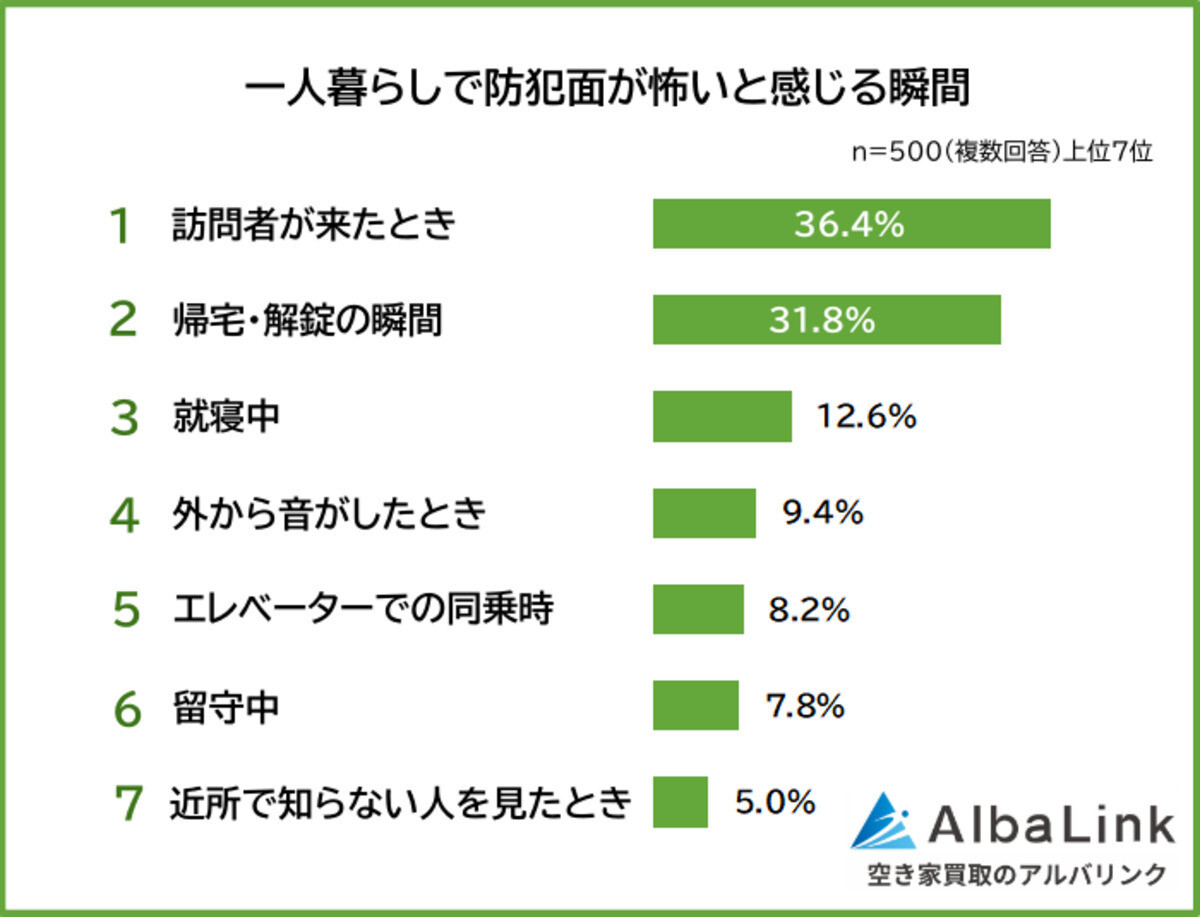
Asked when they feel most at risk, respondents put “when a visitor arrives” at the top (36.4%). For many, anxiety spikes during unexpected calls — especially late at night or early in the morning, and in buildings without a video intercom. A close second was “the moment of returning home and unlocking the door” (31.8%), with several people describing fears of someone tailgating into the building or rushing in as soon as the door opens. Ranked third was “while sleeping” (12.6%), a time when many feel least able to respond quickly. Other worries included “hearing sounds from outside” (9.4%), “sharing an elevator with a stranger” (8.2%), “being away from home” (7.8%), and “seeing unfamiliar people in the neighborhood” (5.0%).
What people are actually doing — Japan’s most-used measures
The single most common action taken was using a monitor-equipped intercom (42.6%), reflecting Japan’s tech-friendly approach to everyday safety. As one woman in her 20s explained, she installed a video intercom because her building lacks auto-locking doors and now opts for contactless parcel drop-offs to avoid unnecessary face-to-face encounters. A teen respondent added that she always sets two door locks when at home and checks the monitor before responding to the bell. Beyond intercoms, the next most common steps were “locking up diligently” (20.6%), “adding a double lock” (19.4%), and “choosing an auto-lock building” (16.0%).
The foundation: Locking up thoroughly
When asked to name the single most important safety measure, a decisive 76.2% chose “locking up thoroughly” — a reminder that even the smartest gadget can’t replace simple, consistent habits. Respondents emphasized locking doors and windows every time, even for a short trip to the convenience store or on upper floors. Rounding out the list were “maintaining neighborly connections” (10.4%), “not revealing that you live alone” (9.2%), “keeping constant security awareness” (6.6%), and “not opening the door easily” (4.2%). Together, these reflect a typically Japanese blend of courtesy, community, and common sense.
Context for newcomers: Why this matters in Japan
Japan’s urban lifestyle, dense apartment living, and booming e-commerce have made tools like video intercoms, parcel lockers, and building auto-locks part of everyday life. “Oki-hai” (secure, designated drop-off) delivery options reduce unnecessary contact, while well-lit entryways and curtains that block outside views are standard privacy practices. Neighborhood ties still count: many communities maintain a gentle watchfulness that makes streets feel safer. For foreigners and new arrivals, this survey doubles as a practical checklist: choose buildings with auto-locks and video intercoms when possible; use delivery lockers; double-lock at night; check surroundings before unlocking your door; avoid signaling that you live alone; and consider casual connections with neighbors or the local “koban” (police box). Remember Japan’s emergency numbers: 110 for police, 119 for fire/ambulance.
Japan’s safety culture, reinforced by data
Japan consistently ranks among the safest countries worldwide, and this survey illustrates how that reputation is sustained: through small, everyday behaviors reinforced by thoughtful design. From elevator etiquette to parcel logistics, the nation’s practical ingenuity shows up in how people manage risk without fear dominating daily life. While the survey is an online snapshot (not a scientific census) of 500 individuals, it highlights trends likely familiar to anyone who has lived in a Japanese “mansion” (apartment building): vigilance at the intercom, careful locking, and a preference for low-friction, tech-enabled solutions.
Bottom line
For solo residents — whether lifelong locals or first-time expats — Japan’s blend of community norms and smart home features provides a reassuring safety net. The message from respondents is clear: keep it simple, be consistent, and let technology work for you. In a country that prizes both harmony and innovation, the safest habits are often the easiest to adopt — and to keep.