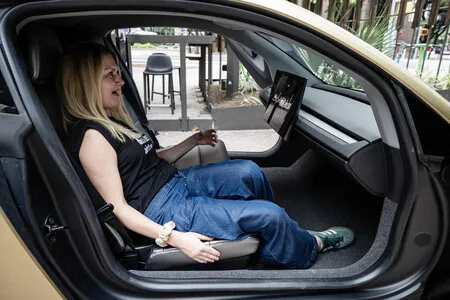
Tesla’s ‘CyberCab’ takes to the road in Austin
U.S. electric-vehicle maker Tesla has begun operating its dedicated autonomous taxi, the “CyberCab,” in parts of Austin, Texas, according to Jiji Press. The company, which has long promoted a vision of hands‑off mobility, emphasized that “the future of transportation will be safer and more enjoyable.” The rollout marks a notable escalation in the robotaxi race currently led by Waymo, the Alphabet subsidiary that has been expanding driverless services in several American cities. By introducing a purpose‑built vehicle rather than adapting a standard car, Tesla is signaling a long‑term commitment to ride‑hailing powered by software and electrification.
What sets ‘CyberCab’ apart
The CyberCab is a compact, two‑seat vehicle engineered specifically for autonomous operations. There is no steering wheel and no pedals; riders interact through a large touchscreen. Its most eye‑catching design cue is a set of upward‑opening “butterfly” doors intended to aid entry and exit in tight urban spaces. For now, service is confined to a defined area in Austin, reflecting a cautious ramp‑up typical of autonomous programs that operate within a set operational design domain. While details on pricing, fleet size, and timeline for wider deployment were not immediately disclosed, the dedicated format suggests Tesla is seeking to optimize for frequent, short urban trips where tight turning, easy boarding, and rapid cleaning can have outsized benefits.
Global race, local realities
Competition is intensifying. Waymo remains the incumbent with multi‑city robotaxi services in the United States, while other players have faced pauses and reassessments amid regulatory scrutiny and safety reviews. By placing a bespoke autonomous vehicle into service, Tesla is likely to accelerate regulatory and public debates around safety validation, sensor redundancy, remote assistance, cybersecurity, and liability frameworks—issues that every country considering robotaxis must address. The Austin launch will also test consumer appetite for minimalist, screen‑centric cabins and two‑seat layouts, which trade capacity for simplicity and low operating costs.
Why Japan is watching
Japan has quietly been laying the groundwork for autonomy. A 2023 legal update opened the door for limited Level 4 driverless services on public roads, and the country has already seen tightly scoped deployments—such as community shuttles in rural areas—operating under strict oversight. Japanese companies and research groups, including Toyota’s mobility initiatives, Nissan’s Easy Ride pilots with DeNA in Yokohama, and startups like TIER IV working on open-source autonomous stacks, have advanced trials that prioritize safety, transparency, and integration with public transit. SoftBank‑affiliated projects have also explored autonomous buses, while municipalities experiment with on‑demand services to help aging communities and underserved regions.
For Japan’s cities—where punctuality, space efficiency, and universal design are paramount—the CyberCab’s purpose‑built form factor will be studied closely. If autonomous taxis can reliably reduce wait times during late‑night peaks, smooth airport transfers, and extend coverage in transit‑light suburbs, the upside for residents, expats, and inbound travelers could be substantial. Just as importantly, Japan’s world‑class safety culture and rigorous approval processes could shape how such services are audited, insured, and scaled. The Osaka‑Kansai Expo and other major events will keep pressure on mobility providers to deliver accessible, multilingual, and cashless solutions that match Japan’s high service standards.
Implications for business and policy
Robotaxis are not just a technology story—they are a business model pivot. A dependable, low‑cost autonomous fleet can turn mobility into a utility, challenging private car ownership and reshaping urban design. For Japan, where driver shortages and an aging population are pressing concerns, autonomy could bolster logistics and last‑mile transport while keeping communities connected. Policymakers will track Austin’s data on safety incidents, uptime, and rider satisfaction to inform local guidelines. Industry observers will also watch how Japan’s domestic champions—automakers, map providers, and telecoms—position themselves as platforms rather than mere hardware sellers.
What to watch next
Key signals include the pace at which Tesla expands Austin’s service area, how regulators assess performance, and whether the two‑seat configuration meets peak demand. In Japan, expect continued pilots under controlled conditions, deeper public consultation, and efforts to harmonize standards so services can roam across prefectures. Whether or not Tesla brings CyberCab to Japan soon, today’s launch raises the bar globally—and Japan’s blend of technological rigor, public trust, and real‑world mobility needs makes it one of the most important markets to watch as robotaxis move from promise to practice.