From sports arenas to military exercises
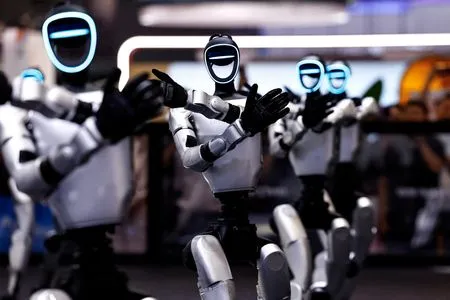
Humanoid robots in China have recently attracted public attention through competitions featuring jumping, boxing, dancing and sprinting. Some machines reportedly ran faster than the world-record pace associated with Usain Bolt, while others became popular online after stumbling and falling. Yet only days after a major humanoid robot competition held in China in August, the People’s Liberation Army’s official newspaper called for advanced robotics technologies to move from laboratories into military training environments.
A Reuters review of more than 100 Chinese military procurement notices, academic papers, patents, government publications, defense-industry documents and public records found that Chinese defense agencies and military research institutions are accelerating work on the potential use of humanoid robots in war. The research appears focused not only on the robots themselves, but also on perception systems, precise object handling, training data and ways for machines to operate alongside soldiers.
Possible roles in cities and behind enemy lines
One study published by researchers connected to China’s National University of Defense Technology, or NUDT, described a possible urban assault scenario involving six machines. Humanoid robots, robotic dogs and unmanned vehicles would be divided into two teams and support ground troops as they cleared buildings floor by floor and room by room. The equipment discussed in the study was forecast to become available within five to 10 years.
The paper did not specify rules of engagement, weapons systems or procedures for encounters with civilians. Those omissions highlight the serious legal and ethical questions surrounding military robotics. In theory, humanoid machines could use two legs and two arms to climb, move through buildings, enter tunnels, navigate ships and manipulate objects designed for human users. However, simpler tracked, wheeled or four-legged robots are generally cheaper and easier to deploy in large numbers for logistics and reconnaissance.
Other Chinese military activities have explored missions behind enemy lines. At a 2025 NUDT competition, robots were reportedly tested on entering designated areas, mapping terrain and identifying targets. Separate events simulated identity checks, discipline inspections and patrols at military bases. Procurement documents also referred to systems for collecting and labeling camera, radar and movement data, including information about terrain that robots could cross.
Commercial strength gives China an advantage
China’s rapidly expanding commercial robotics sector provides an important foundation for military experimentation. Bank of America Global Research estimated that Chinese manufacturers accounted for about 95 percent of global humanoid robot shipments in 2025. This industrial scale could give the PLA access to a growing pool of components, software engineers, testing facilities and manufacturing expertise.
Chinese defense company Norinco has also presented a full-sized humanoid robot called Fuxi for military and specialized applications. Company materials described possible functions including sentry duties, all-weather reconnaissance, autonomous patrols and hazardous missions. The system can reportedly be connected to a remote-control platform, allowing a human operator to direct the robot rather than leaving every decision to artificial intelligence.
Technology remains far from battlefield-ready
Despite the ambition, there is no confirmed evidence that China has deployed armed humanoid robots with active PLA units. Current systems consume significant power and can remain unreliable outside controlled demonstration settings. Experts also note that battlefields contain unpredictable terrain, weather, smoke, damage and human behavior—conditions that are difficult for robots to interpret.
The development has implications for Japan, a global robotics leader with deep expertise in industrial automation, mobility and human-machine interaction. Japan is also closely monitoring security developments in the Indo-Pacific, including advances in artificial intelligence, unmanned systems and autonomous platforms. The prospect of military robots operating near Japan’s surrounding waters and contested regional spaces could intensify debate over defense technology, supply-chain resilience and responsible innovation.
The United States is pursuing similar capabilities, including humanoid systems for reconnaissance, security, obstacle removal, hazardous-material handling and urban operations. Meanwhile, the war in Ukraine has demonstrated how drones using artificial intelligence can transform surveillance, targeting, logistics and casualty evacuation.
Human control and international law
The most consequential challenge may not be mechanical but ethical. International humanitarian law requires forces to distinguish combatants from civilians and avoid attacking wounded or surrendering personnel. The International Committee of the Red Cross has warned that autonomous systems may struggle to interpret surrender, which can depend on context, behavior and intent.
China’s military research community acknowledges that major technical barriers remain, including movement, recognition, intelligence, cost and mass production. Still, Chinese researchers argue that if these obstacles are overcome, humanoid robots could gradually move from combat support toward more direct battlefield roles. For Japan and its neighbors, the trend underscores the need to follow the technology closely while promoting clear human responsibility, legal safeguards and regional stability.