A new chapter for the Yamagata Line
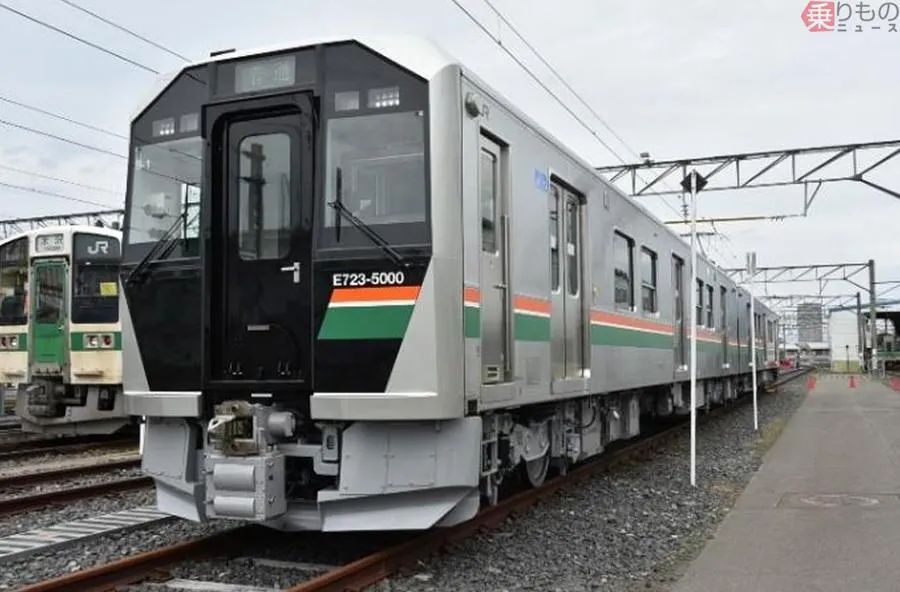
East Japan Railway Company, commonly known as JR East, has announced that its new E723-5000 series trains will begin regular passenger service on the Ōu Main Line, known locally as the Yamagata Line, on September 19, 2026. The new trains will operate between Fukushima and Shinjō, linking Fukushima Prefecture with the Yamagata region and serving one of northeastern Japan’s most distinctive railway corridors.
Departure ceremonies are scheduled at both Yamagata Station and Fukushima Station on the first day of commercial operations. The event at Yamagata Station is planned to begin at 6:10 a.m., while the ceremony at Fukushima Station is expected to start at around 8 a.m. Departure signals and send-offs by railway officials are among the activities planned.
A rare standard-gauge commuter train
One of the E723-5000 series’ most notable features is its standard-gauge design. In Japan, many conventional railway lines use a narrower gauge, while Shinkansen lines generally use standard gauge. The Yamagata Line is unusual because part of its route is shared with the Yamagata Shinkansen, requiring trains operating there to use standard gauge.
This makes the E723-5000 series relatively uncommon among regional commuter trains. It has been designed to operate safely and efficiently alongside Shinkansen services on the shared section between Fukushima and the Yamagata area. For overseas visitors, this is an important detail: although the Yamagata Shinkansen uses the same route in some sections, the new E723 trains are conventional local services, with more frequent stops and a different onboard layout.
A familiar color scheme with a modern appearance
The train’s stainless-steel body carries the orange, white and green stripes associated with existing Yamagata Line rolling stock. However, the stripe arrangement on the front of the train is distinctive, with the band appearing on only one side. Its overall appearance has been compared with JR East’s HB-E220 hybrid diesel train, although the E723-5000 series is an electric train with three pairs of sliding doors on each side.
Inside, the trains feature longitudinal seating, commonly called long seats, which are practical for urban and regional commuter services. Each car also includes a dedicated multipurpose space for wheelchair and stroller users. These facilities are designed to make boarding and travel more convenient for a broad range of passengers, including families, older travelers and people with reduced mobility.
Service through the Itaya Pass
JR East plans to introduce 11 two-car train sets. The trains will run across the Fukushima–Shinjō section, including the Itaya Pass area. The pass is known as one of the most demanding mountain sections on the Ōu Main Line, with a long history of challenging railway operations caused by steep gradients and difficult terrain.
The introduction of the E723-5000 series is therefore more than a simple fleet renewal. It represents an effort to modernize local rail services while maintaining a vital connection between Fukushima and Yamagata. The route is also attractive to travelers exploring regional Japan, including Yamagata’s hot springs, mountain scenery, historic communities and local food culture.
Information for visitors
Passengers wishing to attend either launch ceremony will need to enter the ticketed area of the station using an admission ticket, a valid train ticket or a valid commuter pass. The debut is expected to attract railway enthusiasts and local residents, so visitors should check JR East’s latest announcements before traveling and allow extra time at the stations.