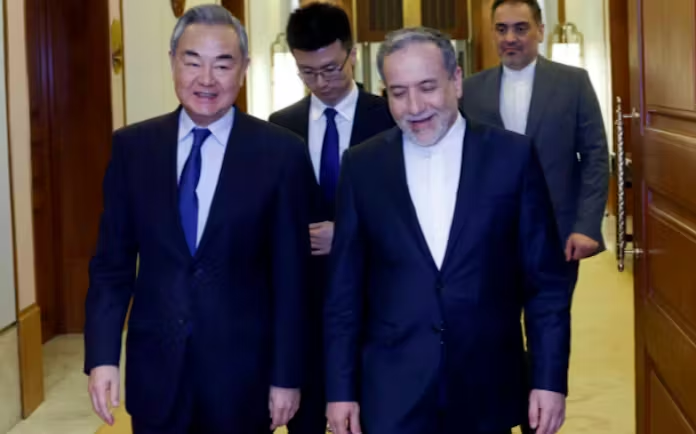
China has voiced support for Iran’s right to the peaceful use of nuclear energy and urged a resumption of talks with the United States and Europe, as Foreign Minister Wang Yi held a telephone conversation with his Iranian counterpart Abbas Araghchi on November 5, according to a readout from China’s Foreign Ministry. In the call, Wang said Beijing “appreciates Iran’s statement that it does not intend to develop nuclear weapons” and reiterated that China “supports the right to the peaceful use of nuclear energy,” language that aligns with longstanding Chinese policy under the Nuclear Non-Proliferation Treaty (NPT) while signaling Beijing’s desire to revive stalled diplomacy around Iran’s nuclear program.
Beijing’s message: support for rights, push for restraint
Wang framed the nuclear issue as one that requires diplomatic patience and political will, warning that the current stalemate serves no one’s interests. “The political process to resolve the Iranian nuclear question being at an impasse is not in the interests of the international community,” the ministry quoted him as saying. He called for renewed engagement between Tehran and the so-called E3+1—European powers and the United States—following years of disrupted contacts and incremental nuclear advances by Iran. The emphasis on dialogue reflects China’s broader positioning as a stakeholder in nonproliferation and a signatory to the 2015 Joint Comprehensive Plan of Action (JCPOA). As a permanent member of the UN Security Council, China is one of the original architects and guarantors of that deal. Beijing has consistently argued that the agreement remains the best available framework to verifiably restrict Iran’s nuclear activities while recognizing its civilian nuclear rights under the NPT.
Tehran’s reply: equality and communication
Araghchi, a veteran diplomat and former nuclear negotiator who now serves as foreign minister, responded that Iran would enhance communications with all countries “based on the principle of equality,” a formulation that hints at Tehran’s insistence on mutual respect and reciprocal steps in any revived negotiating track. The comment fits with Iran’s longstanding position that its nuclear program is peaceful and that its steps beyond JCPOA limits—such as higher levels of uranium enrichment—are reversible if sanctions relief is delivered as promised.
Context: the shadow of the JCPOA and years of drift
The call comes amid a protracted stalemate over the JCPOA. The 2015 accord, reached between Iran and the P5+1 (China, France, Russia, the United Kingdom, the United States, plus Germany), traded stringent limits and inspections on Iran’s nuclear program for economic sanctions relief. In 2018, the United States unilaterally withdrew from the deal and reimposed sweeping sanctions, prompting Iran to incrementally breach the agreement’s limits from 2019 onward. International Atomic Energy Agency (IAEA) monitoring has continued in reduced form, but inspectors have reported a growing Iranian stockpile of enriched uranium and curtailed access to certain sites, raising concerns about transparency and breakout timelines. Periodic efforts to restore the deal or broker limited de-escalation measures—including indirect talks and ad hoc understandings on enrichment caps, prisoner exchanges, and oil sales—have yielded only partial and temporary results. European powers have warned that the JCPOA’s sunset provisions are advancing even as compliance erodes, while Iran argues that the deal’s collapse is the direct consequence of the US exit and ongoing sanctions.
China’s stake: stability, energy, and strategic posture
China’s intervention highlights its growing diplomatic ambitions in the Middle East and its practical interests. Beijing maintains close economic ties with Tehran, including a 25-year comprehensive cooperation framework agreed in 2021, and Chinese refiners have been significant buyers of Iranian crude—often at a discount—despite US sanctions pressure. For China, a stable Persian Gulf is crucial to energy security and supply chain resilience. Strategically, Beijing portrays itself as a neutral facilitator capable of keeping channels open among rivals, a role it showcased by brokering the 2023 Saudi-Iran rapprochement. By affirming Iran’s civilian nuclear rights while underscoring nonproliferation, China is attempting to balance principles embedded in the NPT with practical diplomacy aimed at reducing tensions and avoiding a regional arms race.
Signals to Washington and Europe
Wang’s call implicitly challenges the idea that pressure alone can contain Iran’s program. By urging Tehran and Western capitals to return to the table, Beijing is reminding the E3 and Washington that the JCPOA’s architecture remains a viable baseline for renewed talks, provided both sides demonstrate flexibility. European governments, facing proliferation concerns and regional insecurity, have called for stricter constraints and longer timelines than in 2015, while Iran has sought guarantees that sanctions relief would be durable and not subject to future unilateral reversals. China’s message is that a political solution—however imperfect—remains superior to indefinite escalation and that all parties should prioritize verifiable steps that lower the risk of miscalculation.
Regional backdrop: escalation risks and diplomacy fatigue
The nuclear standoff is intertwined with broader Middle East dynamics, including maritime frictions, proxy tensions, and the economic strain of sanctions on Iran. Each episode of regional escalation tends to complicate nuclear diplomacy, and vice versa. In this environment, statements that reinforce nonproliferation norms—such as Iran’s reiteration that it does not seek nuclear weapons—matter insofar as they’re matched by observable restraint and verifiable transparency. China’s call for dialogue is thus aimed not only at Washington and European capitals but also at regional actors who fear that the nuclear file could once again spiral into crisis.
What to watch next
Attention will turn to whether Tehran and Western interlocutors can identify a narrow path back to negotiations. Practical steps could include enhanced IAEA access, pauses or rollbacks in enrichment levels, and calibrated sanctions relief tied to compliance benchmarks. Confidence-building measures—such as expanded technical cooperation with the IAEA on safeguards and more regular information-sharing—could also help. China, along with other JCPOA signatories, may try to convene or support a new round of talks, even if initially informal, to test whether political space exists for compromise. Ultimately, any breakthrough will require sequencing that allows all sides to claim progress without appearing to capitulate.
Bottom line
Wang Yi’s phone call with Abbas Araghchi underscores Beijing’s intention to remain an active player in the Iranian nuclear dossier: backing Iran’s NPT-enshrined right to peaceful nuclear energy, urging restraint, and pushing for a return to diplomacy with the United States and Europe. Whether that nudge can catalyze movement in a long-stalled process will depend on the willingness of all parties to prioritize incremental, verifiable steps over maximalist demands. For now, China has placed a marker: the costs of drift are rising, and the window for a negotiated path remains open—if the key actors choose to use it.