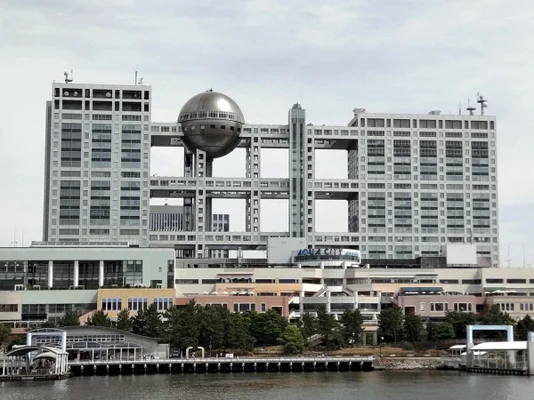
Tokyo — Fuji Media Holdings, the parent of broadcaster Fuji Television, posted a ¥12.9 billion operating loss for the six months to September, blaming a sharp drop in advertising tied to a series of issues involving TV personality Masahiro Nakai. While the interim result plunged the group into the red, the company said ad bookings have been trending back toward recovery since the first quarter and, as a result, it has raised its full-year guidance to a smaller operating loss of ¥10.5 billion. The group also unveiled a share buyback program of up to ¥50 billion to be executed over the next 12 months, a move widely read in the market as both a capital return and a defensive measure amid mounting pressure from activist investors.
Ad shock in H1, tentative rebound in H2
Fuji Media’s interim earnings cover the period from April to September, the first half of Japan’s fiscal year. The company said the negative swing in operating income was primarily driven by advertisers pulling or postponing campaigns in the wake of a string of issues surrounding Masahiro Nakai, one of Japan’s best-known TV personalities. The interruptions hit key commercial slots on flagship Fuji Television and related media properties, weighing on the group’s core Media & Content segment. Fuji Media emphasized that after a weak first quarter, commercial placements began to recover, with momentum gradually improving into the second quarter. That stabilization—though not a full normalization—underpins management’s more constructive outlook for the second half.
Guidance raised, but full year still in the red
Despite the interim setback, the company now forecasts a full-year operating loss of ¥10.5 billion, an improvement compared with the outlook it held as of September. The revision reflects firmer ad demand, progress in recalibrating programming schedules, and ongoing cost controls. Management signaled that while visibility remains mixed—given a fragile consumer environment and cautious brand spending—advertisers are returning to national TV, especially for year-end retail pushes and spring product launches. The updated forecast suggests the worst of the ad disruption is behind the company, even if it will not be enough to restore profitability in the current fiscal year.
Share buyback signals confidence—and defense
Fuji Media also announced a new share repurchase authorizing up to ¥50 billion of buybacks over the coming year. In addition to signaling confidence in the long-term value of its assets, the program is likely to be viewed as a response to mounting activist interest. Investment firms linked to Yoshiaki Murakami, a prominent “shareholder with a voice” in Japan, have been accumulating Fuji Media shares in size, according to market participants. A buyback can bolster earnings per share, improve capital efficiency ratios, and support the share price—benefits that simultaneously make it more costly for outside investors to build influence. The company did not disclose a targeted repurchase pace or price range, leaving execution to market conditions.
Activists and Japan’s evolving governance landscape
Fuji Media’s move comes amid a broader shift in Japan’s corporate governance. The Tokyo Stock Exchange has pressed listed companies—especially those trading below book value—to articulate and execute plans to raise capital efficiency. That mandate has emboldened global and domestic activists to push for measures such as divestments of non-core assets, increased payouts, and governance reforms. Murakami, in particular, has a long track record of extracting changes at underperforming companies. Media groups like Fuji, with legacy assets, substantial property holdings, and historically cozy cross-shareholdings, are natural targets for such campaigns. The new buyback suggests Fuji Media is seeking to balance shareholder returns with strategic flexibility as it navigates a choppy ad market.
Legacy strengths meet structural headwinds
Like its peers, Fuji Media faces a structural transition. Traditional linear TV advertising has been pressured by audience fragmentation, the rise of streaming, and changing advertiser preferences. The group has been investing in digital platforms—most notably Fuji TV’s FOD (Fuji TV On Demand)—while leveraging its production capabilities, intellectual property, and real estate portfolio. Diversification has helped cushion cyclical shocks, but talent-related controversies can ripple across programming schedules, sponsorships, and brand safety calculations, producing a near-term hit to revenue. Industry-wide, Japan’s ad market has slowly recovered from pandemic-era lows, with digital growing faster than broadcast; the pace at which brand budgets return to TV remains a central swing factor for broadcasters’ earnings.
Financial framing and market reaction
On a rough translation to dollars at recent exchange rates, the interim operating loss of ¥12.9 billion equates to about $80–90 million, while the buyback authorization of up to ¥50 billion is roughly $330 million. Analysts will watch how quickly ad demand stabilizes in the key fourth-quarter retail season, the elasticity of ad pricing as audiences normalize, and whether program line-ups can avoid further disruptions. Execution of the buyback—its cadence and any opportunistic blocks—will also be a focal point, as will any steps Fuji Media takes to streamline its portfolio or surface hidden asset value in real estate and content libraries.
A company seasoned by past battles
The Fujisankei media group has weathered contested situations before, notably the high-profile 2005 confrontation surrounding Nippon Broadcasting and Livedoor that reshaped parts of Japan’s media landscape. That history informs how investors parse today’s signals: a management team familiar with defense tactics, a capital return calibrated for flexibility, and a readiness to reassure markets about long-term strategy. While the current challenge stems from advertiser caution linked to a specific set of talent-related issues, underlying questions about growth beyond linear TV, digital monetization, and capital efficiency remain front and center.
What to watch next
Key milestones for the months ahead include the trajectory of commercial bookings through the fiscal year-end in March, updates on the utilization of the buyback authorization, and any disclosures about governance or portfolio adjustments in response to shareholder engagement. For now, Fuji Media’s message is clear: near-term pain from ad disruptions is giving way to gradual stabilization, and management is prepared to deploy the balance sheet to shore up shareholder value while it navigates a sensitive and rapidly evolving media market.