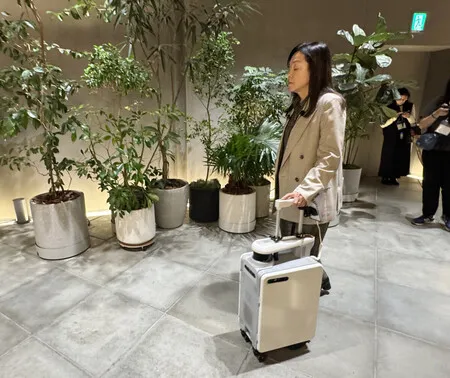
New accessibility trial unveiled in Tokyo
Mori Building Co. and its partners have opened a public demonstration of an “AI Suitcase,” a guidance robot designed to help people with visual impairments move more independently through indoor and outdoor spaces. The trial was presented to members of the media on the 28th at Toranomon Hills, a major mixed-use development in Tokyo’s Minato Ward.
The month-long demonstration, scheduled to take place throughout October, includes two specially prepared routes on selected floors of the complex. One route is intended to support visually impaired participants as they navigate between indoor and outdoor areas. The other allows visitors to interact with the device and learn more about how the technology is being developed.
Technology designed to support independent mobility
The AI Suitcase is being developed with the Japan Science and Technology Agency’s National Museum of Emerging Science and Innovation, widely known as Miraikan, playing a central role in the project. The compact guidance robot is intended to assist users as they travel through unfamiliar environments, potentially helping them locate destinations and move around complex facilities.
Details of the trial are expected to help developers examine how the robot performs in real-world settings, including busy commercial and public spaces. Such environments can present particular challenges for people with visual impairments, from identifying entrances and corridors to dealing with changes in direction, obstacles and transitions between buildings or outdoor areas.
Rather than replacing existing forms of assistance, the project is being positioned as an additional tool that could give users greater freedom and confidence. Its developers are ultimately aiming to create a rental service, which could allow people to use the technology when visiting large buildings, urban districts or other unfamiliar locations without needing to own the device.
A step toward more inclusive urban experiences
Japan has invested heavily in accessible infrastructure, including tactile paving, audible signals and barrier-free facilities. However, navigating large, modern developments can remain difficult, particularly when visitors are unfamiliar with the layout or when multiple buildings and transportation links are connected. Toranomon Hills provides a relevant testing environment because it combines offices, retail, public spaces and transportation-related facilities within a dense urban setting.
Chieko Asakawa, director of Miraikan and a person with visual impairment herself, expressed hope that the project would bring society closer to a future in which people can enjoy walking around cities independently. Her perspective highlights the importance of developing accessibility technology in cooperation with the people who may use it.
The trial also reflects a broader Japanese effort to combine robotics, artificial intelligence and urban design to address social challenges. As the country’s population ages and cities welcome more international visitors, technologies that make public spaces easier to navigate could benefit a wide range of users, including older people, travelers and those with temporary mobility difficulties.
From demonstration to practical service
The October test will not by itself determine whether the AI Suitcase becomes a widely available service. Developers will need to assess safety, reliability, ease of use and the robot’s ability to operate in changing environments. Cost, maintenance and compatibility with different buildings will also be important considerations.
Nevertheless, the demonstration offers a meaningful glimpse into how Japan is exploring practical uses for AI and robotics in everyday life. If future trials prove successful, rental access to guidance robots could make independent travel more achievable for people with visual impairments while encouraging more inclusive design across Japan’s rapidly evolving urban spaces.