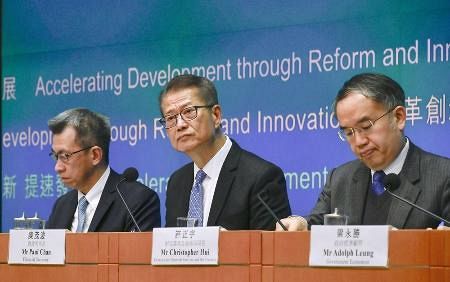
Hong Kong’s Financial Secretary Paul Chan Mo-po, the city’s third-highest-ranking official, has canceled a mid-December visit to Tokyo, according to multiple people familiar with the matter. The decision, conveyed to the Japanese side before a major fire erupted in a cluster of high-rise housing blocks in Hong Kong on November 26, is widely viewed as a political signal aligning with Beijing’s protest over Prime Minister Sanae Takaichi’s recent Diet comments on a possible Taiwan contingency. The move underscores a sharp cooling in ties between Hong Kong and Japan, coming amid a broader suspension of most official engagements with Japan’s Consulate-General in the city.
The plan that unraveled
Chan had been slated to deliver a keynote address at a “luncheon lecture” in central Tokyo on December 17, part of a Hong Kong Trade Development Council (HKTDC) effort to promote bilateral commerce and investment. Nearly 200 participants from Japan’s political and business circles were expected, and organizers had requested the attendance of Economy, Trade and Industry Minister Ryosei Akazawa. With Chan’s trip called off, the event itself has been canceled, people briefed on the planning said. The decision was communicated prior to the late-November blaze in Hong Kong’s dense residential towers—indicating it was not triggered by domestic crisis management concerns but by diplomatic headwinds.
Beijing’s ire over Taiwan remarks—and Hong Kong’s alignment
The cancellation comes on the heels of fierce criticism from China over Takaichi’s parliamentary remarks concerning Japan’s posture in the event of a Taiwan emergency. For Beijing, any suggestion of external involvement in cross-strait contingencies is seen as a challenge to its sovereignty claims. Hong Kong, a Special Administrative Region whose foreign-affairs positioning has increasingly hewed closely to Beijing’s, appears to be signaling solidarity by putting political considerations ahead of economic outreach. While Hong Kong retains its own economic system and fiscal autonomy under “one country, two systems,” its diplomatic temperature has become more tightly correlated with mainland priorities on sensitive geopolitical issues.
Why Chan’s absence matters
As Financial Secretary, Chan oversees Hong Kong’s budget and economic policy and is regarded as number three in the administration, after Chief Executive John Lee Ka-chiu and Chief Secretary for Administration Eric Chan Kwok-ki. His presence in Tokyo would have carried weight for investors and corporates evaluating Hong Kong as a financing hub and gateway to mainland China. The HKTDC forum was designed to reassure Japanese businesses about Hong Kong’s market access, regulatory predictability, and capital-raising opportunities at a time when global firms are diversifying supply chains, scrutinizing geopolitical risk, and adjusting to tighter compliance regimes.
Japanese stakeholders, including major trading houses, financial groups, and multinational manufacturers, have historically used Hong Kong as a springboard into the Greater Bay Area and mainland markets. Likewise, Hong Kong has been a significant source of investment into Japan, from real estate to venture capital. Although the commercial ecosystem remains deep, confidence-sensitive sectors respond quickly to signals from senior officials; a canceled keynote is more than scheduling friction—it is a message that politics can override business-as-usual.
Strained ties and suspended exchanges
Relations between Hong Kong authorities and the Japanese mission in the city had already deteriorated, with most official exchanges reportedly suspended. The freeze has unfolded alongside a period of sharper rhetoric across the region: Beijing has stepped up warnings against foreign involvement in Taiwan, while Tokyo has reiterated that peace and stability across the Taiwan Strait are indispensable to Japan’s security and economic interests. Against that backdrop, even economic diplomacy—traditionally buffered from political storms—has become vulnerable to rapid shifts.
Reading the signal: calculated caution or escalation?
Chan’s cancellation is likely intended to register concern without shutting the door to future engagement. It avoids direct retaliatory measures that would hit trade flows or financial market operations, yet it is conspicuous enough to be read by policymakers and boardrooms. For Japanese companies, the immediate impact is symbolic—the loss of a high-level platform to pose questions and gauge policy direction. Over time, however, repeated cancellations and suspended channels can slow deal pipelines, complicate regulatory dialogue, and add friction to everything from licensing and product approvals to capital allocation decisions.
For Hong Kong, the trade-off is delicate. The territory is pushing to reassert its role as an international financial center, court family offices, and expand fintech and green finance. Japan, with deep pools of institutional capital and a robust corporate base, is a natural partner in those ambitions. Yet aligning tightly with Beijing’s diplomatic stance may be seen by some investors as narrowing Hong Kong’s room for pragmatic outreach, particularly when geopolitical tensions rise.
Context: the regional security lens
Tokyo’s position on Taiwan has hardened in recent years as it revises national security strategy, increases defense spending, and deepens coordination with the United States and like-minded partners. Chinese officials have criticized these moves as destabilizing and warned against “interference” in what Beijing regards as an internal matter. Within that dance, Hong Kong’s messaging has grown more synchronized with mainland talking points, especially on sovereignty and security-related topics. The result is a diplomacy where economic engagements can be throttled or unfrozen according to the political weather.
What to watch next
Diplomats and executives will be watching for signs that the freeze deepens—or begins to thaw. Key indicators include whether working-level dialogues between Hong Kong agencies and the Japanese consulate resume; if trade missions scheduled for early next year proceed; and whether sector-specific cooperation, such as in green transition projects, asset management, and start-up exchanges, is insulated from political flare-ups. Another marker will be the tone of official statements from both sides: calibrated language could signal an off-ramp, while sharper admonitions would point to a prolonged chill.
For now, the canceled Tokyo luncheon will be read as a cautionary note: even high-level economic diplomacy is at the mercy of geopolitics. Businesses with exposure to Hong Kong-Japan corridors are likely to build in more contingency planning, diversify engagement channels, and press for clarity on regulatory and consular processes. Whether this episode becomes a footnote or the opening chapter of a longer downturn in ties will depend on how Taipei, Beijing, and Tokyo manage the next set of Taiwan-related flashpoints—and whether Hong Kong can keep economic cooperation on the agenda despite the political crosswinds.