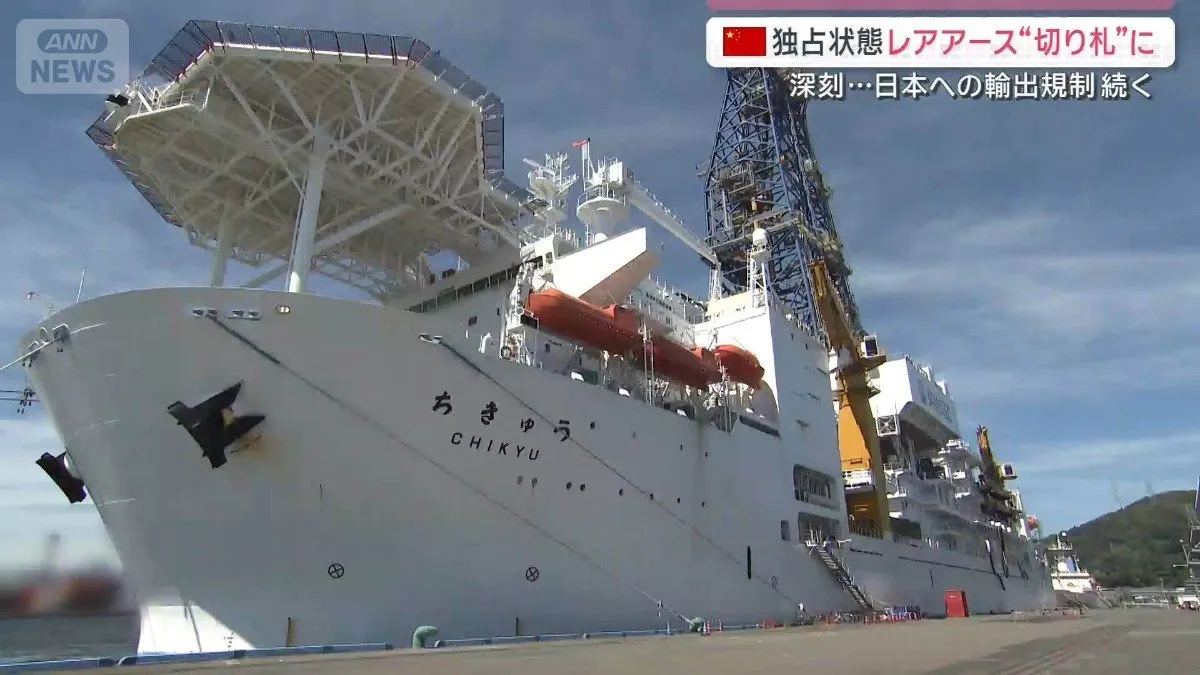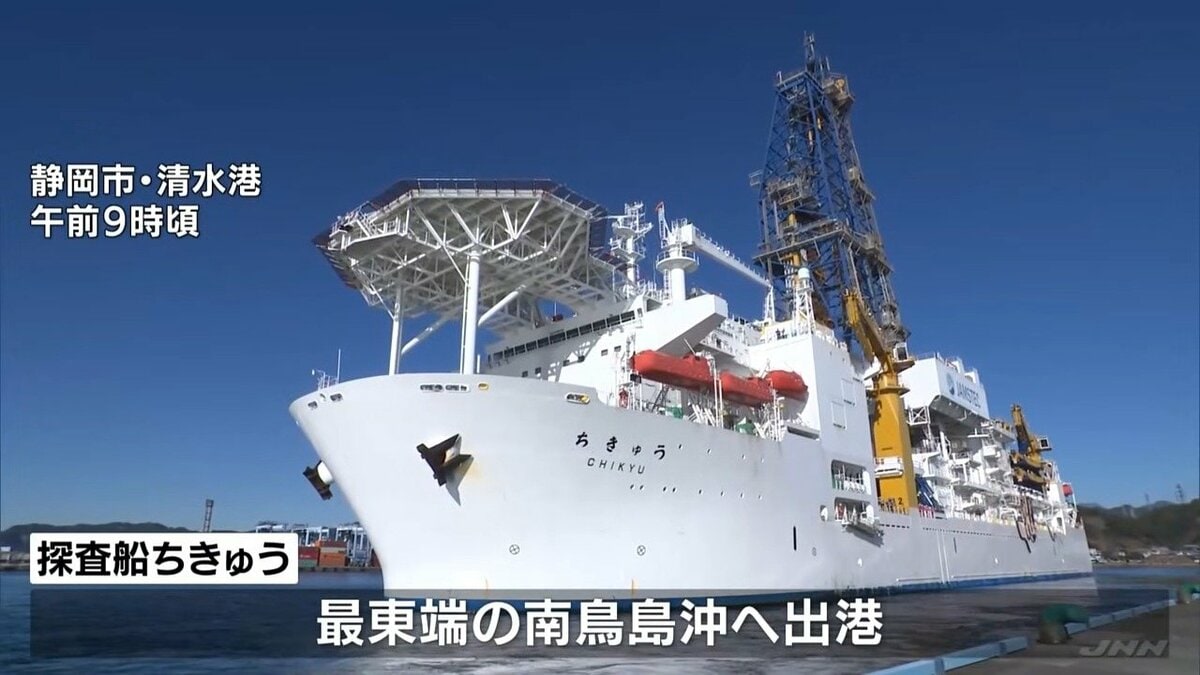
Japan has launched an audacious bid to secure a homegrown supply of rare earth elements, dispatching the drillship Chikyu from Shimizu Port in Shizuoka Prefecture this morning to the remote waters off Minamitorishima, the nation’s easternmost outpost in the Pacific. The mission aims to continuously lift mud from about 6,000 meters below the ocean’s surface—an engineering first that, if successful, could pave the way for full-scale extraction as early as February next year.
A high-stakes departure with strategic implications
The Chikyu slipped its moorings shortly after 9 a.m., bound for a vast swath of ocean where previous surveys have identified seabed sediments unusually rich in rare earth elements (REEs). These minerals are essential to the modern economy, powering the permanent magnets in electric vehicle motors and wind turbines, enabling the miniaturization of smartphones and medical devices, and underpinning advanced defense systems. Yet Japan, like much of the world, relies heavily on imports—most of them from China—for the production and processing of these critical materials.
That reliance has become a geopolitical vulnerability. With Japan–China relations strained and Beijing demonstrating its leverage over strategic commodities in recent years, Tokyo is accelerating efforts to diversify supplies. “We are considering how to diversify procurement sources and avoid excessive dependence on any one country,” said Shoichi Ishii, a program director at the Cabinet Office. “One of the measures is the process toward realizing domestically produced rare earths.”
Why Minamitorishima, and why now?
Minamitorishima—also known internationally as Marcus Island—is a tiny speck of land surrounded by a vast exclusive economic zone that extends over some of the deepest waters in the Western Pacific. Scientific studies by Japanese researchers have pointed to layers of deep-sea mud in this area that are rich in REEs, including elements like yttrium and heavy rare earths that are particularly scarce and valuable. The idea is not to mine hard rock or scrape nodules from the seafloor, but to lift fine-grained sediment suspended as a slurry and separate the minerals on the surface.
Japan has studied this resource for more than a decade, but practical extraction at extreme depths has remained elusive. The conditions at 6,000 meters—crushing pressure, frigid temperatures, and strong currents—pose daunting technical challenges. Successfully bringing mud to the surface in a continuous stream, rather than via short, small-scale sampling, would mark a step-change from scientific exploration to pre-commercial testing.
The ship and the method
The Chikyu, operated by the Japan Agency for Marine-Earth Science and Technology (JAMSTEC), is one of the world’s most advanced scientific drilling vessels. While it is best known for probing the Earth’s crust for climate and earthquake research, its deepwater drilling and riser capabilities are being adapted for this resource mission. Engineers plan to deploy a subsea system that agitates and intakes the rare-earth-rich mud, then pumps it through a long riser to the vessel’s deck. The main technical risks include maintaining a steady flow without clogging, coping with high hydrostatic pressures, managing energy demands over long durations, and controlling sediment plumes around the intake to minimize environmental impact and avoid re-ingesting dispersed particles.
Japanese officials say continuous lifting from such depths has not been demonstrated before, making this a world-first attempt. The test will measure flow rates, particle behavior, and equipment resilience under real ocean conditions. Data will inform the design of a full-scale system intended to operate reliably in one of the most hostile working environments on the planet.
Geopolitics meets the green transition
The timing reflects a confluence of strategic and industrial pressures. Demand for REEs is rising as the global economy electrifies transportation and expands renewable energy. At the same time, China’s dominance in mining and processing—combined with its broader export controls on key materials such as gallium, germanium, and graphite—has intensified a global push for alternative sources and resilient supply chains. Japan, scarred by past supply shocks, has pursued a portfolio approach: supporting recycling and substitution, investing in overseas projects, and now testing a domestic deep-sea option that could reduce exposure to geopolitical risk.
From trial to production—and the hurdles ahead
If the lifting test meets performance targets, officials say Japan could commence full-scale extraction as early as February next year. That would require not only scaling equipment and shiptime but also ensuring onshore processing pathways for the recovered sediments. Rare earths are notoriously complex to separate and refine; a credible domestic value chain would involve environmental permitting, chemical processing capacity, and end-user certification—all of which take time and capital to develop.
There are also economic questions. The cost of deep-sea operations at 6,000 meters is high, and commercial viability depends on stable throughput, acceptable energy consumption, and competitive recovery yields. Market prices for rare earths can be volatile, and any project must be robust against price swings and technological shifts—such as the development of alternative magnet chemistries that use fewer heavy rare earths.
Environmental scrutiny under the waves
Deep-sea resource projects face increasing environmental scrutiny, and Japan’s plan is no exception. Scientists caution that disturbance of the seabed and the creation of sediment plumes can affect fragile ecosystems that are poorly understood. While this trial targets mud lifting rather than harvesting polymetallic nodules, many concerns overlap: turbidity, potential toxicity of released metals, noise, and habitat disruption. Officials say environmental monitoring will accompany the test to track plume behavior and benthic impacts in real time, informing safeguards for any subsequent operations. Given the heightened international debate over deep-sea mining, Japan’s approach—and the transparency of its findings—will be closely watched.
A strategic bet on knowledge and capability
Beyond the immediate goal of securing critical minerals, the mission underscores Japan’s broader strategy: leveraging high-end ocean engineering to gain options in an uncertain world. A successful trial would place Japan among a small group of countries with practical pathways to extract resources from extreme depths, while also generating data that could guide global standards for environmental management. Should technical or environmental obstacles prove insurmountable, the effort will still clarify what is feasible and at what cost—information that matters for policymakers balancing resource security, economic logic, and stewardship of the deep ocean.
For now, all eyes are on the Chikyu as it heads east into the open Pacific. The weeks ahead will test not only pumps and pipes but a proposition at the heart of Japan’s industrial strategy: that technological ingenuity can expand the nation’s options at a critical moment for both the economy and the energy transition.