A Diplomatic Encounter with Subtle Tensions
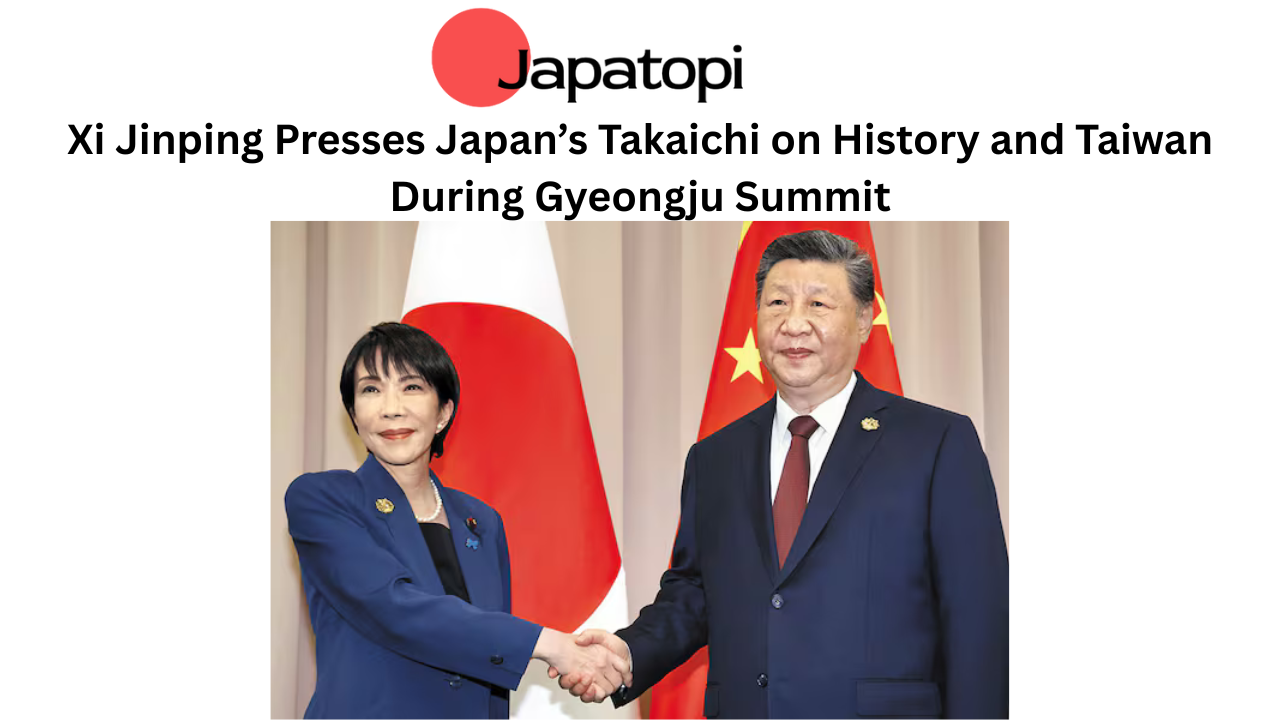
Chinese President Xi Jinping met with Japanese Prime Minister Sanae Takaichi on October 31 in Gyeongju, South Korea, marking a significant yet delicate moment in Japan-China relations. According to China’s state broadcaster CCTV, Xi used the meeting to reiterate Beijing’s long-standing expectations regarding “the proper handling of historical and Taiwan-related issues,” calling for Japan to uphold the principles laid out in the four key political documents that have defined bilateral ties since the 1970s.
Xi’s remarks came amid growing geopolitical frictions in East Asia, and his tone suggested both a reminder and a warning. He emphasized the importance of adhering to past agreements, which include the 1972 Joint Communiqué and subsequent statements that acknowledge the “One China” principle.
Revisiting the Murayama Statement
In a rare move, Xi referred to the 1995 “Murayama Statement,” in which then-Prime Minister Tomiichi Murayama expressed deep remorse and offered an apology for Japan’s wartime aggression. Xi commended the statement as a “sincere reflection on history and a responsible gesture toward neighboring countries.”
Observers believe Xi’s praise carried a political undertone — a subtle message to Takaichi, known for her conservative stance and previous remarks questioning certain aspects of Japan’s postwar apologies. By highlighting the Murayama Statement, Xi sought to reaffirm China’s expectation that Japan remain faithful to its past expressions of remorse rather than revise or downplay them.
A Call for Non-Interference and Respect
Xi also stressed the principle of non-interference in domestic affairs, implicitly responding to Takaichi’s prior criticisms of China’s human rights record, particularly concerning Xinjiang and Hong Kong. The Chinese leader urged mutual respect and warned against actions that could “damage mutual trust.”
For Beijing, this was more than a diplomatic formality — it was a preemptive attempt to set the tone for how Japan under Takaichi’s leadership should approach issues such as Taiwan, human rights, and defense cooperation with the United States.
Cooperation Amid Strategic Competition
Despite the underlying tension, Xi also extended an olive branch. He called on Japan to cooperate in defending multilateral trade frameworks and ensuring supply chain stability — a clear contrast to what he views as the protectionist tendencies of the Trump administration in the U.S. Xi’s remarks were interpreted as an attempt to court Japan’s participation in maintaining open trade flows in Asia, especially as global supply chains face increasing strain from geopolitical rivalries.
By invoking multilateralism, Xi positioned China as a defender of global economic stability, while subtly criticizing the U.S. approach to tariffs and economic decoupling. It was a diplomatic balancing act — warning Japan against aligning too closely with Washington while inviting Tokyo to work with Beijing on shared economic goals.
A Relationship of Opportunities and Challenges
Xi summarized the current state of Japan-China relations as one that “faces both opportunities and challenges.” This assessment echoed a familiar narrative in Beijing’s diplomatic language — cautious optimism paired with veiled concern.
Takaichi, who assumed office with a reputation for hawkish views on defense and assertive diplomacy, represents a new chapter in Japan’s foreign policy. Her first formal meeting with Xi was therefore not only symbolic but also strategic, setting the tone for what could become a recalibrated — and potentially contentious — bilateral relationship.
The two leaders reportedly agreed on the need to expand exchanges between governments, political parties, and legislatures. While no major breakthroughs were announced, the meeting served as a temperature check for future engagement.
The Broader Context
This diplomatic encounter occurred against the backdrop of an increasingly polarized international landscape. The U.S.-China rivalry continues to shape Asia’s strategic environment, and Japan’s role as a key U.S. ally makes its relationship with China a delicate balancing act.
For Xi, engaging Takaichi early in her tenure was a way to influence Japan’s strategic direction before it solidifies. For Takaichi, the meeting offered an opportunity to assert Japan’s independence while avoiding unnecessary confrontation.
Analysts suggest that future Japan-China relations will hinge on how both nations navigate sensitive historical narratives while pursuing pragmatic economic cooperation. As Xi seeks to consolidate China’s influence in Asia, and Takaichi champions Japan’s “proactive diplomacy,” the stage is set for a complex and closely watched bilateral dynamic in the years ahead.