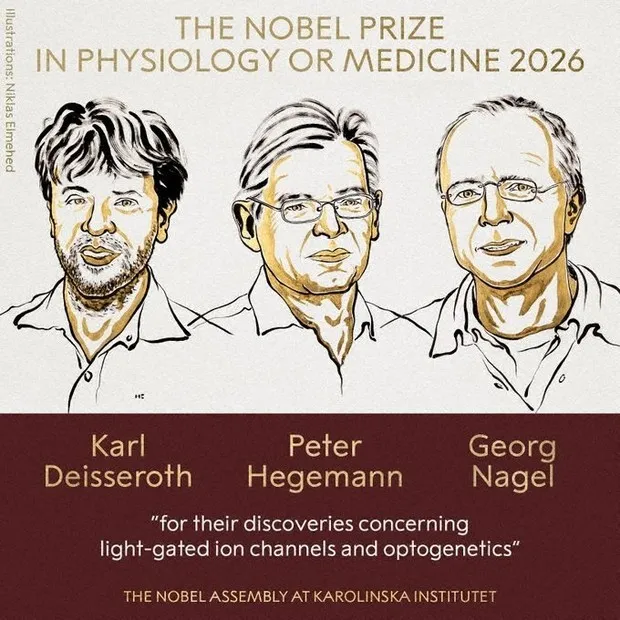
Three scientists recognized for transforming neuroscience
The 2026 Nobel Prize in Physiology or Medicine has been awarded to American scientist Karl Deisseroth and German researchers Peter Hegemann and Georg Nagel for discoveries that established optogenetics, a groundbreaking technique for controlling nerve cells with light.
The Nobel Assembly at Sweden’s Karolinska Institutet announced the award on October 5. The official citation honored the trio for their “discoveries concerning light-gated ion channels and optogenetics.” The laureates will share prize money of 12 million Swedish kronor, equivalent to approximately 190 million yen. The Nobel Prize award ceremony is scheduled to take place in Stockholm on December 10.
How optogenetics works
Optogenetics enables researchers to activate or silence selected nerve cells by exposing them to light. The method depends on light-sensitive proteins known as channelrhodopsins, which were first identified in algae.
In the early 2000s, Hegemann of Humboldt University and Nagel of the University of Würzburg discovered and studied channelrhodopsins, revealing how these proteins respond to light by controlling the flow of electrically charged particles across cell membranes. Their work provided the essential biological mechanism for using light to influence cellular activity.
Deisseroth, a professor at Stanford University, then helped develop the technique into a practical tool for neuroscience. By introducing light-sensitive proteins into specific nerve cells, researchers can use carefully timed flashes of light to switch those cells on or off. This allows scientists to examine how particular neural circuits influence movement, memory, emotion and behavior with a level of precision that was previously difficult to achieve.
From basic science to possible medical treatments
Optogenetics has rapidly spread through laboratories around the world. It has become an important method for investigating how the brain functions, while also generating interest in new treatments for neurological and sensory disorders.
One of the most closely watched possibilities is vision restoration. Researchers are exploring whether light-sensitive proteins and specialized devices can help activate retinal or visual pathways in people who have lost their sight. Although such approaches remain under development and are not a universal cure for blindness, the Nobel-recognized discoveries have helped create a scientific foundation for future therapies.
The technique may also contribute to research into conditions affecting the brain and nervous system. By identifying the precise circuits involved in disease, scientists may be able to design more targeted treatments and reduce unwanted effects. Significant challenges remain, including the safe delivery of genetic material, long-term biological safety, the quality of restored vision and the need for further clinical evidence.
Significance for Japan and international research
The award has particular relevance in Japan, which has a strong record in neuroscience, ophthalmology and regenerative medicine. Japanese universities and research institutions are active in efforts to understand vision loss, brain disorders and the biological mechanisms that control sleep and wakefulness.
Last year’s Nobel Prize in Physiology or Medicine was awarded to Shimon Sakaguchi, a distinguished professor emeritus at Osaka University, and his collaborators for the discovery of regulatory T cells. Japanese researchers who had been regarded as prominent candidates this year included Kazutoshi Mori of Meijo University, recognized for work on the unfolded protein response that prevents the harmful accumulation of abnormal proteins inside cells, and Masashi Yanagisawa of the University of Tsukuba, whose research clarified the role of orexin in regulating sleep and wakefulness.
The 2026 prize underlines how discoveries made across countries and disciplines can combine to reshape medicine. From algae-derived proteins to advanced research on the human brain, optogenetics demonstrates how fundamental science can eventually open new possibilities for patients, including people living with severe vision loss.