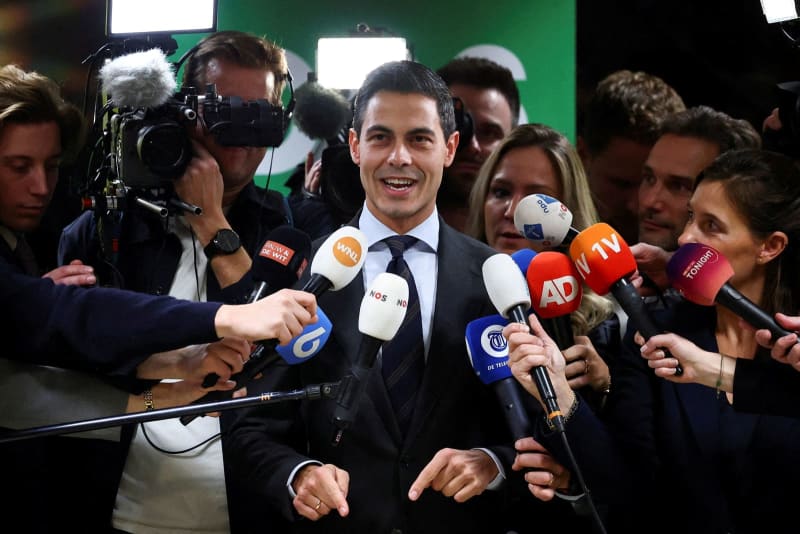
Brussels — The Netherlands is poised for a generational shift in leadership after three parties reached a coalition agreement that sets the stage for Democratic 66 (D66) leader Rob Jetten, 38, to become the country’s youngest prime minister, local media reported on the 27th. The centrist-liberal D66, which finished first in last October’s general election for the 150-seat lower house, has struck a deal with the center-right People’s Party for Freedom and Democracy (VVD) and the Christian Democratic Appeal (CDA), according to reports carried by Jiji Press. The three parties together will command 66 seats, forming a minority government whose durability will hinge on pragmatic, issue-by-issue cooperation with opposition factions.
A Minority Cabinet by Design
The coalition agreement—expected to be published within the week—represents a strategic calculation in a fragmented parliamentary landscape where compromise is currency. With a combined 66 seats in the Tweede Kamer, the three-party bloc falls well short of an outright majority, meaning the new cabinet will need to broker support from rival parties to pass legislation. Dutch political tradition is no stranger to such arrangements: minority cabinets and “toleration” accords have periodically punctuated the country’s consensus-driven governance model. The coalition’s choice to proceed as a minority administration underscores both the arithmetic of the current chamber and the parties’ confidence in their ability to build coalitions around shared priorities.
Jetten’s Rise: Youth, Climate, and Pragmatism
Jetten’s anticipated ascent signals continuity and change in equal measure. At 38, he embodies a younger cohort of leaders emerging across Europe, noted for technocratic pragmatism and a focus on climate, digital innovation, and social inclusion. As D66 leader, he has championed the energy transition, science-led policy, and a pro-European outlook. That platform must now be woven into a workable program with the VVD’s emphasis on fiscal prudence and business competitiveness, and the CDA’s traditional focus on social cohesion, regional balance, and family policy. The result is likely to be a carefully calibrated agenda blending green ambition with economic realism.
Policy Crossroads: Climate, Housing, and Competitiveness
Several policy fronts will test the coalition’s cohesion. First, climate and energy: D66 has argued for accelerating the transition to renewables and green hydrogen, while ensuring energy security in a volatile geopolitical environment. The Netherlands’ strengths in offshore wind, port logistics, and industrial innovation could underpin a comprehensive plan to cut emissions without undermining competitiveness. Second, housing: a long-running shortage has fueled political pressure across parties. A minority cabinet will need to secure broad support for land-use reforms, construction incentives, and rental market measures—areas where ideological lines often sharpen.
On fiscal policy, a middle course is probable. The VVD’s instincts for stability and pro-business tax measures will meet D66’s push for targeted public investment in innovation and education, alongside the CDA’s preference for community-oriented spending. Expect a premium on measures that bolster productivity and skills, support small and medium-sized enterprises, and accelerate strategic infrastructure—particularly digital and energy networks. With inflation and cost-of-living concerns still resonant, the coalition may also pursue temporary relief tools that avoid large permanent spending commitments.
Europe and Security: Quiet Strength, Active Diplomacy
In European affairs, Jetten’s government would likely maintain a constructive, pro-EU posture, advocating rule-of-law consistency, stable public finances, and robust support for Ukraine. Dutch diplomacy in Brussels has often married fiscal caution with pragmatic coalition-building—an approach well suited to a minority cabinet. On defense and security, the Netherlands is expected to remain a reliable NATO contributor and a strong voice on maritime security and cyber resilience. Given global supply chain uncertainties and a persisting security challenge from Russia’s war in Ukraine, continuity in defense commitments will likely be an early signal of the coalition’s intentions.
Economic Technology and Export Controls
The incoming administration will inherit a complex file on strategic technologies. The Netherlands sits at the fulcrum of global semiconductor supply chains due to its role in advanced lithography equipment. A D66-led cabinet will be mindful of balancing open trade with national security considerations, and of coordinating with partners on export controls—an area in which careful diplomacy has been the Dutch hallmark. The government’s decisions here will reverberate across European industry and beyond, shaping investment patterns and technology cooperation.
Implications for Japan: Deepening a High-Trust Partnership
For Japan, the formation of this Dutch coalition is a welcome signal of stability from a trusted European partner. Japan and the Netherlands share a long, distinctive history of exchange dating back to the 17th century, and today their relationship is anchored by the EU–Japan Economic Partnership Agreement, robust scientific collaboration, and complementary strengths in advanced manufacturing and green technology. Tokyo will be attentive to The Hague’s approach to semiconductor supply chains, where shared interests in resilience, transparency, and secure trade are paramount. Dutch leadership in photolithography and precision engineering dovetails with Japan’s prowess in materials, equipment, and process innovation—creating a natural axis for cooperation that supports both countries’ economic security.
Clean energy is another arena ripe for expansion. With the Netherlands at the forefront of offshore wind and port-driven hydrogen logistics, and Japan advancing hydrogen, ammonia fueling, and grid modernization, a D66-led government could catalyze new public–private partnerships. Joint initiatives in energy storage, green shipping corridors, and maritime decarbonization would align with both nations’ climate goals while bolstering industrial competitiveness. More broadly, Dutch engagement in the Indo-Pacific—anchored by the EU’s strategy and the Netherlands’ own regional guidelines—aligns closely with Japan’s vision for a free and open Indo-Pacific. Expect continuity in maritime cooperation, supply chain security, and standard-setting for emerging technologies.
Navigating a Fragmented Parliament
Minority governance will demand deft parliamentary management. The cabinet will likely court support from parties to its left and right on a dossier-by-dossier basis, making the legislative calendar a test of coalition discipline and outreach. The Senate’s composition will also matter; any reform that touches tax policy, social insurance, or spatial planning will need careful shepherding. Analysts expect the coalition agreement to front-load achievable measures and set up staged reviews on more contentious reforms—an approach that offers flexibility and avoids early defeats.
What Comes Next
With the coalition accord slated for publication within days and a new cabinet expected as early as next month, attention now turns to portfolio allocation and the initial 100-day agenda. Markets and business leaders will watch for signals on corporate taxation, innovation incentives, and energy pricing. Civil society will look for commitments on housing supply, education, and healthcare accessibility. International partners—including Japan—will track policy continuity on sanctions enforcement, strategic exports, and climate diplomacy.
If confirmed by parliament, Jetten’s tenure would mark a notable generational milestone in Dutch politics. Yet his success will be measured less by age than by the ability to forge durable majorities around pragmatic solutions. In a Europe that prizes stability and foresight, and in a global economy that demands trusted partnerships, the Netherlands appears ready to combine youthful leadership with veteran consensus-building—a combination Japan will welcome as it deepens cooperation with a vital European ally.