Major data breaches highlight growing risks
Japan is facing a surge in cyberattacks, with recent incidents affecting travel services, retailers, railway users and cloud infrastructure. The latest case involves Adventure Inc., which operates the travel reservation website Skyticket. The company announced on October 9 that unauthorized access to its systems had exposed approximately 14.64 million records belonging to members.
The leaked information reportedly included names, dates of birth, addresses and telephone numbers. Adventure said passport numbers and credit-card details were not exposed in the incident, according to reporting by Nippon Television Network News. The scale of the breach nevertheless underlines how valuable basic personal information can be when combined and used for fraud or targeted scams.
Bookoff, a major Japanese secondhand retailer, also announced that data involving as many as 6.43 million members may have been leaked. The information reportedly included names, addresses and telephone numbers, while credit-card data was not included.
Another incident affected users of East Japan Railway Company services. JR East said that email addresses and other personal information connected to approximately 2.06 million users of the Ekinet reservation service and the Otona no Kyujitsu Club membership program may have been exposed following a cyberattack involving IDC Frontier, a cloud-service provider.
Cloud attacks can affect hundreds of organizations
IDC Frontier provides cloud storage and related services to corporate and public-sector customers. The attack reportedly affected as many as 495 companies and local governments that used the provider’s systems. On October 9, information emerged that some stored data affected by the attack may be difficult to retrieve or restore.
These incidents are part of a wider pattern. Japanese universities, delivery companies, convenience-store operators and other organizations closely connected to daily life have also reported cyber-related disruptions. A cybersecurity company cited in the television report estimated that more than 1.5 billion cyberattacks targeted Japanese companies and organizations between October of last year and September of this year. The figure refers to reported attack activity and does not mean that every attempt resulted in a successful breach.
Why is Japan being targeted?
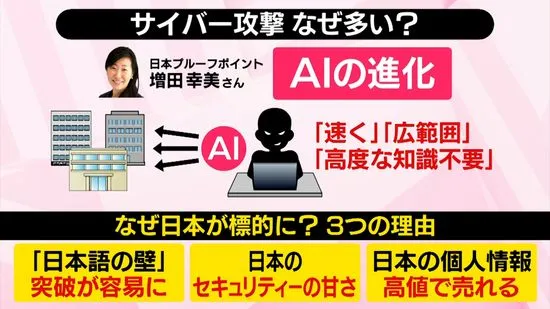
Experts point to three main factors. The first is the rapid development of artificial intelligence. Criminal groups can use AI to create phishing emails and fraudulent messages more quickly, in greater volume and with less technical expertise. In the past, unnatural Japanese wording often made suspicious messages easier to identify. AI-powered translation and text-generation tools can now produce more natural Japanese, making scams harder to detect.
The second factor is the widening digital footprint of Japanese organizations. Companies and public bodies have accelerated digital transformation, allowing more services to operate online and through interconnected systems. While this improves convenience and efficiency, it also expands the number of potential entry points. Security measures and staff training do not always advance at the same pace as digital adoption.
The third factor is the perceived value of Japanese personal information. According to cybersecurity specialist Yukimi Masuda of Proofpoint Japan, data associated with Japan may be attractive to criminals because it is considered reliable, widely usable and comparatively difficult to counterfeit. Stolen information can be resold on illicit online marketplaces and later used for identity theft, impersonation or financial fraud.
Personal precautions remain important
A report on an underground marketplace showed images apparently resembling Japanese driver’s licenses offered in bulk. One listing advertised 1,000 images for about 122 dollars, or roughly 20,000 yen at the exchange rate cited in the report. It was not possible to confirm whether the images were genuine or forged, but the listing illustrates how compromised identity information may be traded.
Individuals can reduce their exposure by avoiding unnecessary registration of personal details, using different strong passwords and enabling multifactor authentication wherever possible. Experts also advise treating unexpected emails, telephone calls and postal notices as potentially fraudulent until independently verified. Japan’s reputation for reliable services and trusted identification systems is a strength, but protecting that trust will require continued investment in cybersecurity, responsible data management and public awareness.