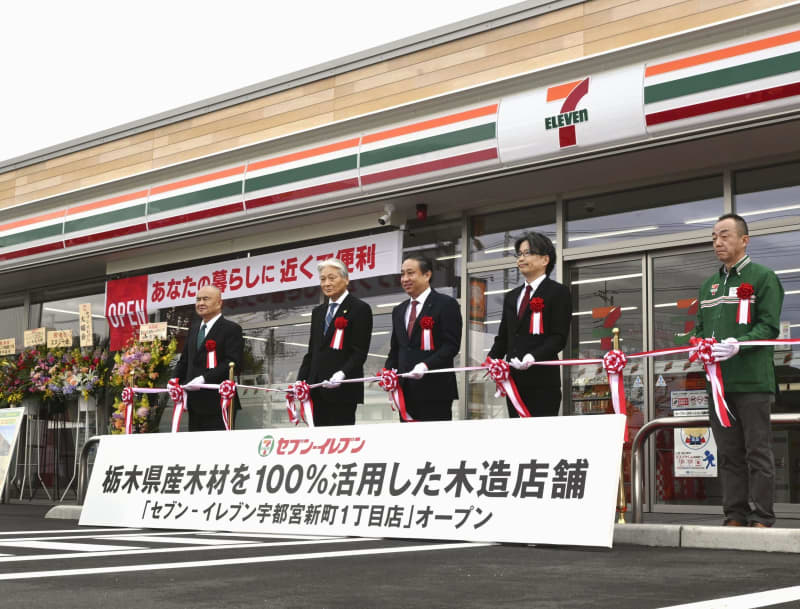
Seven-Eleven Japan has cut the ribbon on a path-setting convenience store in Utsunomiya that puts locally sourced Japanese wood at the heart of modern retail. At a ceremony on the 11th in Tochigi Prefecture’s capital, the company celebrated the opening of a timber-structured outlet built using 100% prefectural wood—primarily sugi (Japanese cedar) and hinoki (Japanese cypress)—in what it calls the first proof-of-concept for “full-scale” timber construction of a standard-size Seven-Eleven store. The outlet, located in Utsunomiya Shimmachi 1-chome, opens to customers on the 12th.
A first-of-its-kind test bed for standard store design
While Japan’s streetscape is lined with the familiar red, green, and orange of convenience stores, their frames are typically steel or reinforced concrete. This new Utsunomiya branch marks a carefully designed departure: a timber structure that mirrors the size and function of a typical Seven-Eleven, rather than a one-off boutique concept. According to the company, the store incorporates approximately 30 cubic meters of Tochigi-grown sugi and hinoki in piles, structural members, and base materials. The move aims to verify whether an all-wood approach can meet the practical demands of everyday retail without sacrificing efficiency or cost control.
Balancing quality, constructability, cost, and the environment
“We will evaluate the balance of quality, constructability, cost, and environmental performance, and apply what we learn to future store development,” Seven-Eleven Japan President Tomohiro Akutsu said at the ceremony. His remarks underscored a larger corporate ambition: to translate sustainability pilots into scalable blueprints that can be deployed across the company’s nationwide network. Seven-Eleven Japan, part of Seven & i Holdings, has been experimenting with lower-impact power systems, optimized refrigeration, and eco-friendly materials; now the timber store adds another lever to reduce the embodied carbon of buildings themselves.
Local wood, local value
By specifying Tochigi-grown timber, the new store is designed to keep economic value circulating within the region. Forestry, sawmilling, and downstream processing all gain when a major national brand commits to local sourcing. Fewer transport miles also help reduce emissions, while closer supply chains can shorten schedules and improve traceability—key considerations in responsible construction. Sugi and hinoki, two of Japan’s most emblematic species, are abundant in Tochigi and well suited to structural use when properly processed and engineered.
From forest to storefront: a Japanese strengths story
Japan’s forestry sector has long argued that the strategic use of domestic wood helps manage mature forests, support rural livelihoods, and store carbon in durable products. In that context, Seven-Eleven’s project aligns neatly with national priorities. The government has encouraged greater timber utilization in public and private buildings alike, supporting a “use wood, grow forests” cycle that is both climate-conscious and strongly tied to regional revitalization. Turning that philosophy into mass-market practice through convenience retail—one of Japan’s most ubiquitous formats—is a particularly resonant step.
Backed by policy, guided by partnership
In 2024, Seven-Eleven Japan signed a wood utilization promotion agreement with the Forestry Agency, reflecting a shared interest in expanding the role of timber in construction. The company says it is now trialing timber structures across a variety of store sizes to build a robust evidence base. In addition to environmental metrics, the pilots will examine build times, maintenance needs, and resilience against Japan’s demanding seismic and climatic conditions. Timber buildings in Japan must meet strict fire and earthquake codes, and the country’s building industry has developed advanced methods—ranging from engineered wood systems to fire-resistant detailing—to satisfy those standards. Although the company has not disclosed engineering specifics for the Utsunomiya site, it emphasized that the store is a mainstream prototype, not a novelty.
Reducing embodied carbon while serving everyday needs
Retail decarbonization often focuses on energy efficiency and renewable power, but the carbon locked into materials—so-called embodied carbon—has become a key frontier for climate action. Timber, when responsibly sourced and designed for longevity, can lower a building’s embodied carbon relative to conventional materials. It also stores carbon captured during tree growth for the lifetime of the structure. For high-turnover formats like convenience stores, these material choices can add up, especially if adopted at scale. The company’s analysis will probe whether the benefits hold when weighed against cost and performance in day-to-day operations.
Designing for replication, not just demonstration
A central question for Seven-Eleven is whether this timber model can be replicated across suburban and regional Japan, where stand-alone stores are common. A standardized timber kit could streamline construction and create steady demand signals for local forestry cooperatives and mills, making it easier for suppliers to invest in capacity and quality improvements. The use of Tochigi timber in piles, structural elements, and underlayment at the Utsunomiya site suggests a holistic approach to substitution that extends beyond cosmetic finishes to the core skeleton of the building.
Why Utsunomiya matters
Utsunomiya, a logistics and cultural hub within striking distance of Tokyo, is an ideal testing ground. It combines urban customer flow with strong ties to surrounding forested areas, allowing the store to demonstrate both market viability and regional sourcing. The choice of location also sends a signal that locally rooted solutions can thrive at the heart of Japan’s daily economy, not just in niche or remote settings.
Convenience stores as climate and community infrastructure
Convenience stores are a quiet backbone of Japanese life—offering food, bill payment, parcel services, and emergency support in disasters. That social role puts a premium on resilient, cost-effective facilities that are quick to build and easy to maintain. Timber can contribute on all fronts: modern wood construction is competitive on speed, adaptable in layout, and pleasant for staff and customers alike. Pairing timber frames with efficient HVAC and refrigeration, LED lighting, and potentially on-site solar can amplify emissions reductions while enhancing comfort and reliability.
A model for place-based sustainability
Seven-Eleven’s Utsunomiya initiative is notable not just for what it is, but for where it comes from. By committing to 100% Tochigi timber, the company frames sustainability as a place-based practice—one that starts in Japan’s forests and ends in neighborhoods that people know and love. If the model proves out, it could ripple across the archipelago, with each prefecture leveraging its own forestry strengths. The result would be a Japanese approach to green retail that is both globally relevant and distinctly local, advancing decarbonization while celebrating the nation’s forestry heritage and technical prowess.
What comes next
With the store opening on the 12th, attention now turns to how the prototype performs. Seven-Eleven Japan will watch build quality, customer and staff feedback, and operating metrics, and distill those findings into the next iteration of timber-enabled store design. The ultimate prize is scale: if timber can do the job as well as or better than conventional methods, more stores could follow—channeling steady demand to domestic forests, cutting embodied emissions, and reinforcing Japan’s leadership in sustainable construction. For a format that defines everyday life, that would be a quietly transformational change.