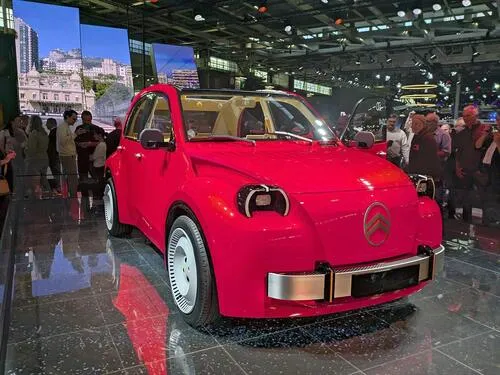
A French icon returns as an affordable EV
The Paris Motor Show is highlighting a major transformation in Europe’s automotive market, as traditional manufacturers turn to affordable electric vehicles while Chinese brands expand their presence. The international exhibition, being held in Paris through the 18th, has placed renewed attention on small cars, accessible pricing and the intensifying competition facing established automakers.
Among the most closely watched announcements was Citroën’s plan to revive the historic 2CV as an electric vehicle. The compact model, produced by the French automaker after World War II, became widely known as a “people’s car” in France. Its simple design, practical character and low cost made it a familiar part of everyday life for generations.
Citroën, part of the Stellantis group, plans to launch the electric 2CV in 2028 at a price of about 15,000 euros, equivalent to approximately 2.7 million yen. That would make it considerably cheaper than many small EVs currently sold in Europe, where prices commonly range from 20,000 to 30,000 euros. The proposed pricing reflects growing efforts by European automakers to make electric mobility more accessible to ordinary households.
European automakers focus on smaller, practical vehicles
Stellantis displayed more than 60 vehicles at the show, including six new models. Emanuele Cappellano, a senior executive at the group, said the company plans to introduce more than 50 vehicles by 2030 and expressed confidence that Stellantis could expand its share of the European market by 25 percent.
Renault Group also presented 50 vehicles, including six making their public debut. The French manufacturer placed small electric cars at the center of its display. Fabrice Cambolive, the group’s chief growth officer, described the vehicles as cars designed to fit naturally into people’s daily lives.
The renewed focus on compact models comes as European consumers face high living costs and remain cautious about the price of EVs. Philippe Houchois, an automotive analyst at Jefferies, said small cars that had previously been discontinued because of low profitability could still offer an opportunity if manufacturers rebuild their business models with a new approach.
Chinese brands gain visibility while Japanese automakers keep a lower profile
The show also offered a clear view of changing competitive dynamics. Chinese manufacturers brought 20 brands to the event, twice the number seen at the previous exhibition in 2024. Their displays accounted for roughly one-third of all participating brands, giving Chinese automakers a much stronger presence in the European spotlight.
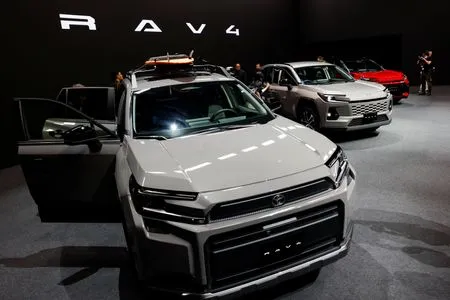
By contrast, major Japanese companies including Toyota, Honda and Subaru were represented by only a limited number of vehicles. This does not erase Japan’s importance in global automotive technology, manufacturing quality or hybrid vehicles, but it shows how quickly the competitive environment is changing in Europe, particularly in the EV segment.
According to Schmidt Automotive Research, Chinese manufacturers overtook Japanese brands in Europe’s new-car sales share from May this year. Chinese companies are also expanding local production in Europe, partly to avoid import restrictions imposed by the European Union on vehicles including hybrids. Local manufacturing could help them reduce trade barriers, shorten supply chains and respond more directly to regional demand.
What the shift means for Japan
For Japanese automakers, the developments in Paris underline the importance of maintaining a strong presence across several vehicle categories. Japan has built a global reputation through fuel-efficient hybrids, dependable engineering and long-term customer trust. However, European buyers are increasingly seeking affordable EVs, and the availability of competitively priced compact models may become a decisive factor.
The Paris Motor Show therefore represents more than a showcase for new vehicles. It is a sign that Europe’s auto industry is being reshaped by electrification, pricing pressure, local production and changing consumer priorities. Citroën’s electric 2CV revival combines national nostalgia with a modern environmental strategy, while the growing Chinese presence signals a tougher market for both European and Japanese manufacturers.