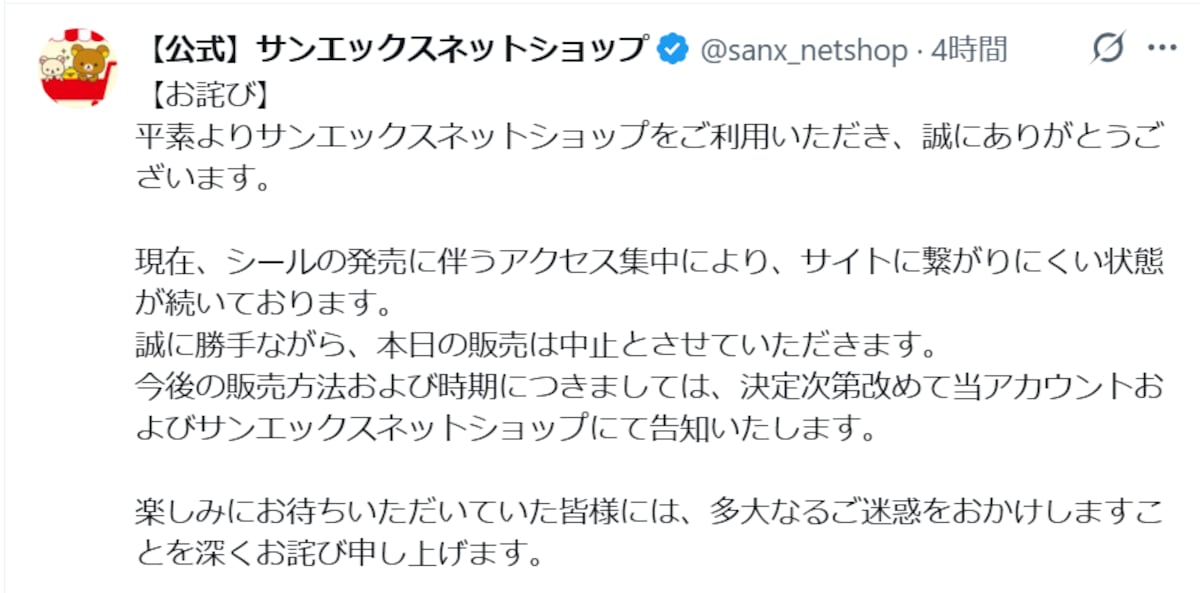
Tokyo— A nationwide sticker craze in Japan surged to new heights when San-X, the company behind beloved characters such as Rilakkuma and Sumikkogurashi, temporarily halted online sales after an access rush overwhelmed its official store. The company had released 12 varieties of stickers on the 3rd (JST), but demand spiked so sharply that the site became difficult to access, prompting San-X to issue an apology and suspend sales approximately one hour and ten minutes after launch. The company later announced it would also postpone the release of upcoming “tile stickers” (eight designs) originally slated for the 10th and 11th, citing a need to reconsider the sales method.
What sparked the surge: the “Bonbon Drop” effect
At the center of the frenzy is the “Bonbon Drop Sticker” trend—often shortened to “Bon-Dro” or “Bondro” in Japanese. These dimensional stickers are prized for their candy-like gloss and crystal-clear transparency, arranged by the dozens on a single backing sheet. While they first captivated elementary and middle school girls, the movement is now powered by adults who grew up during Japan’s Heisei era (1989–2019)—a generation with vivid memories of school-era sticker exchanges. That cross-generational appeal has turned a simple stationery item into a cultural flashpoint for nostalgia, design, and collectability.
Retailers respond with orderly measures
As demand surged nationwide, Japanese retailers moved quickly to keep shopping fair and calm. Lifestyle chain Loft announced it would temporarily pause in-store and online sales of three types of dimensional stickers to ease congestion and address shortages. General apparel and goods retailer Shimamura also said it would suspend handling certain items. In Shinjuku, the Hands store opened online lottery applications for Bonbon Drop stickers, but the entry cap was reached in under an hour, and heavy access briefly triggered error screens. These steps—suspensions, lotteries, and staggered releases—are classic Japan retail measures designed to protect everyday shoppers and deter bulk-buying in flash-demand cycles.
Voices from the queue: delight, frustration, and fair-play
On social media, fans reported difficulty accessing checkout pages, with some lamenting they “couldn’t connect before it ended.” Others appealed for the stickers to “reach genuine collectors,” while a few called the trend “abnormally hot.” Some users shared disappointment that the traffic prevented them from buying unrelated character goods, and several urged retailers to adopt made-to-order or pre-order models. Concern about reselling also surfaced, with observers noting that rapid sellouts make secondary listings more tempting. The tone, however, remained characteristically community-minded: many expressed hope for sales methods—such as lotteries or order windows—that give more fans a fair chance.
Why this matters beyond Japan
For overseas fans, students, and expats in Japan, the episode offers a window into how “kawaii” culture remains a living, evolving economy. San-X characters like Rilakkuma and Sumikkogurashi enjoy global followings, and the Bonbon Drop style taps into Japan’s meticulous design sensibility—the small, tactile joys of stationery that are central to daily life here. The current sticker wave underscores how Japanese pop-culture brands continue to innovate in micro-categories, generating surprising demand spikes that ripple through retail systems.
What comes next: toward calm, fair access
Expect more structured sales methods in the short term. Retailers may expand lotteries, implement timed-entry queues, limit quantities per customer, or trial made-to-order production for select designs. Transparent communication—already a strong suit for Japanese brands—will remain vital, as will anti-bot protections and staggered drops to smooth traffic. If demand stays elevated, limited regional releases and in-person pickup options could help. For fans, the best strategy is to follow official social accounts, sign up for email alerts, and be ready for rapid lottery or pre-order windows. While the current scramble is intense, Japan’s measured, customer-first approach suggests a path to orderly access—so the joy of a small, shimmering sticker can be shared more widely, both at home and abroad.