Open-source robotics meets AI-assisted development
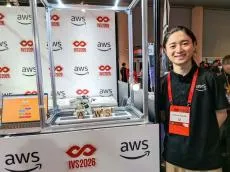
A robot arm sorting wooden blocks may look like a simple demonstration, but the SO-101 display at IVS2026 offered a glimpse into how generative artificial intelligence could change the way physical machines are developed. At the AWS booth, Japanese technology company Classmethod demonstrated a robot arm that rearranged blocks marked with letters such as “I,” “V,” “S,” “A” and “W” in response to commands selected on a computer screen.
The demonstration was built by combining the open-source SO-101 robotic arm with Claude Code, Anthropic’s AI coding agent. According to the explanation provided at the event, the team created the exhibition prototype in approximately two weeks, despite the developer involved having no previous experience in robotics or mechanical control development.
Inside the SO-101 demonstration
The SO-101 is the successor to the SO-100, developed jointly by RobotStudio and Hugging Face. Its main structural components can be produced using 3D printers and combined with commercially available servo motors and other parts. The platform is also compatible with LeRobot, Hugging Face’s open-source framework for training and developing robots.
Under the message “From Data to Physical AI - Build with AWS,” the booth brought together the robot arm, a camera, edge-computing equipment and AWS cloud services. A controller application displayed buttons including “AWS,” “IVS,” “Custom,” “Wave,” “Break” and “STOP.” When a visitor or staff member selected a button, the arm performed a predefined task, moving the wooden blocks into a specified sequence.
The exhibit also highlighted an important difference between software-only applications and physical AI systems. A program running entirely on a computer can often be tested under controlled digital conditions. A robot operating in the real world must deal with changes in lighting, camera angle, object placement, equipment positioning and hardware characteristics. Even small physical differences can cause a task to fail.
How Claude Code supported the project
Claude Code operates through a terminal and assists developers with writing and modifying code, researching technical information, running commands and testing implementations based on natural-language instructions. The development team reportedly interacted with the tool while working on the robot’s control functions and user interface.
This approach is sometimes described as “vibe coding,” in which developers use conversational instructions to guide an AI system through software development. However, the two-week timeline should be understood accurately. The team did not create the robot’s mechanical structure or all of its underlying software from scratch. Instead, it used the existing SO-101 platform and open-source software assets, then built exhibition-specific controls and interfaces on top of them.
Even with that qualification, the project demonstrates how open-source robotics and AI coding assistants may lower the barrier to experimentation. For Japanese startups, research teams and manufacturers, such tools could make it easier to test ideas before investing in larger-scale engineering projects.
AWS support and a more accessible developer ecosystem
Classmethod’s booth also introduced support for startups seeking to use AWS services. The company presented information about up to 1,000 U.S. dollars in AWS credits for eligible startups founded within the previous 10 years. The credit is not automatically granted to every company meeting that age requirement, and applicants must confirm the applicable services and conditions with Classmethod.
On March 2, 2026, Classmethod announced that it had signed a reseller agreement with Anthropic under the “Anthropic Authorized Reseller Program for Amazon Bedrock.” The arrangement allows the company to resell Claude delivered through Amazon Bedrock and support integration with existing AWS environments, including combined billing arrangements.
From exhibition demo to business application
Beyond providing Claude through Amazon Bedrock, Classmethod offers services covering AI-driven development processes, workflow optimization, system integration, operational support, cost management and internal training. The SO-101 demonstration served as a practical example of how those capabilities can be applied to a physical prototype.
For international visitors interested in Japan’s technology sector, the display reflected a broader trend: Japanese companies are increasingly combining established engineering expertise, open-source platforms and cloud-based AI tools. The road from a small booth demonstration to a reliable industrial robot remains substantial, but projects such as this show how generative AI is making early-stage experimentation faster and more approachable.