Mount Fuji tourism boom meets a growing road-safety challenge
The area around Mount Fuji is experiencing a sharp increase in rental-car accidents involving foreign tourists, prompting concern among residents and businesses in Yamanashi Prefecture. According to Yamanashi Prefectural Police data, accidents involving rental cars driven by foreign visitors rose from 461 three years ago to 1,047 last year—more than doubling in just two years. More than 600 such accidents had already been recorded by May this year, putting the region on track to exceed last year’s total.
The figures come as Fuji Five Lakes destinations, including Fujikawaguchiko, continue to attract large numbers of international visitors seeking views of Japan’s iconic mountain, its lakes and surrounding natural landscapes. Rental cars offer flexibility in an area where public transport can be slower or less frequent, particularly for travelers visiting multiple sightseeing locations in one day.
Residents report repeated damage to walls and property
Security-camera footage from Fujikawaguchiko shows a white car mounting a residential wall with a loud impact. A man later appeared to inspect the damage and retrieve a wheel cover from nearby bushes. The vehicle was reportedly driven by a person believed to be a foreign visitor, although the footage alone does not establish the driver’s nationality.
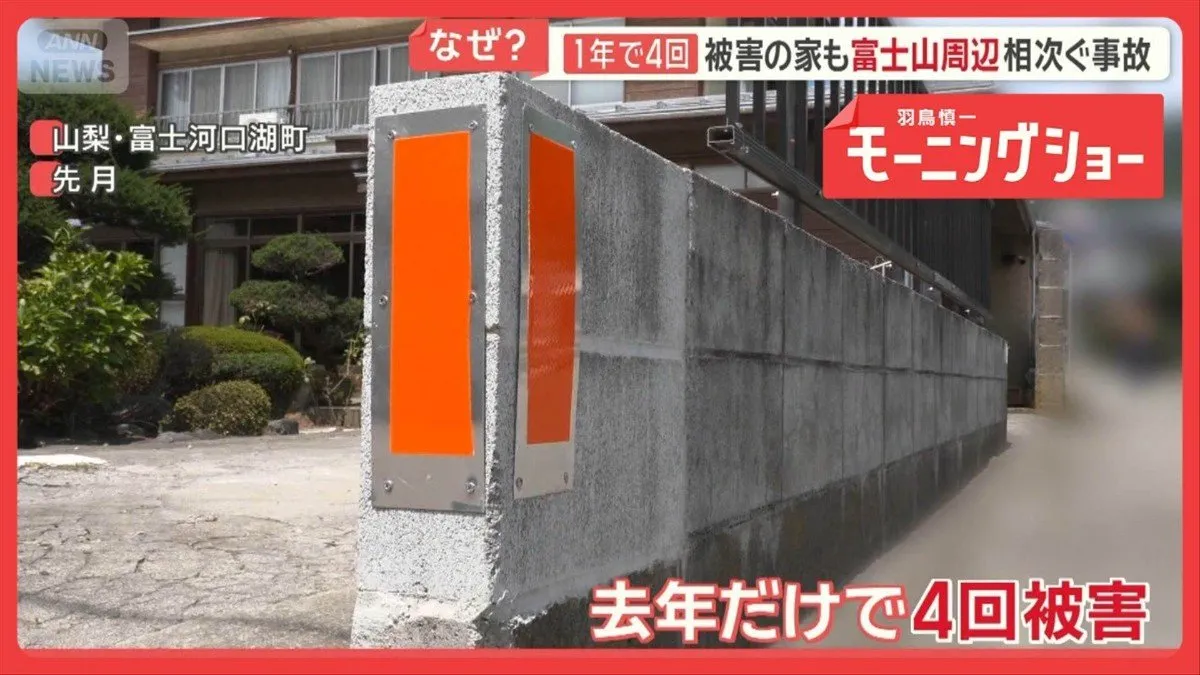
Residents say similar incidents have occurred repeatedly. One household reported that its wall was hit four times in a single year, including by rental cars displaying Japan’s “wa” number plates, which are commonly used for rental vehicles. Repairs cost approximately 70,000 yen. Other walls and poles in the neighborhood also show signs of recent repairs after being struck by vehicles.
Local business operators say collisions between rental cars are also becoming more common. Some residents have complained that drivers scrape parked vehicles or leave after minor collisions without reporting the incident. These accounts highlight the everyday impact that a tourism surge can have on communities living alongside popular attractions.
Left-side traffic and unfamiliar vehicle layouts can be difficult
Japan drives on the left side of the road, while many countries around the world drive on the right. Foreign visitors who are legally permitted to drive in Japan—usually through an international driving permit or other recognized documentation—may nevertheless find the road environment unfamiliar.
During a local report, Taiwanese visitors driving a rental car reminded one another to obey traffic signals and stop appropriately at intersections. However, their vehicle was observed traveling very close to the left edge of the road, later moving near the center line and making sudden stops before turning. The travelers themselves acknowledged that judging left and right distances could be difficult and that driving on the opposite side of the road required concentration.
Visitors from Israel similarly explained that they needed time to adjust because Israel uses right-side traffic. These examples do not suggest that all foreign drivers are unsafe, but they illustrate how even careful and experienced motorists can face challenges when adapting to Japan’s road system, right-hand-drive vehicles and local signage.
Navigation apps can direct drivers into narrow residential streets
Another concern is the use of navigation applications in unfamiliar areas. Reporters followed a rental car driven by a family from Hong Kong as it left a main road and entered a narrow residential street. The road was so tight that an approaching vehicle had to move onto the edge of a parking area to allow the cars to pass.
The visitors said Google Maps had guided them along an unusual route and that they felt uneasy. In mountainous and residential parts of the Fuji region, a route that appears efficient on a digital map may pass through roads designed primarily for local traffic, not large rental vehicles. Some vacation rentals are also located deep inside narrow neighborhoods, meaning visitors may have little choice but to drive through streets with limited visibility and few places to turn around.
Balancing tourism growth with local safety
Many of the areas reporting problems are close to vacation-rental properties, which have expanded alongside inbound tourism. Rental cars with “wa” plates were seen entering narrow streets lined with private accommodation facilities. Local workers welcome the increase in visitors and the economic activity they bring, but residents are asking drivers to slow down, understand Japanese traffic rules and avoid unsuitable shortcuts.
Improving safety could require cooperation among rental companies, accommodation operators, navigation services and local authorities. Clear multilingual guidance, practical briefings on left-side driving, warnings about narrow roads and advice to use wider designated routes could help visitors travel more confidently. Better signage and coordination around vacation rentals may also reduce pressure on residential streets.
Mount Fuji remains one of Japan’s most valuable and internationally recognized destinations. Ensuring that visitors can explore the region safely—while protecting residents’ homes and daily lives—will be essential as Japan’s inbound tourism continues to grow.