Kumamoto’s semiconductor transformation
Kumamoto is strengthening its position as one of Japan’s most important semiconductor centers, with businesses, universities and local authorities working together to develop the skilled workforce needed for the industry’s future. Even after a recent earthquake that registered a maximum intensity of 5 lower on Japan’s seismic scale, construction and investment around the region’s semiconductor cluster have continued.
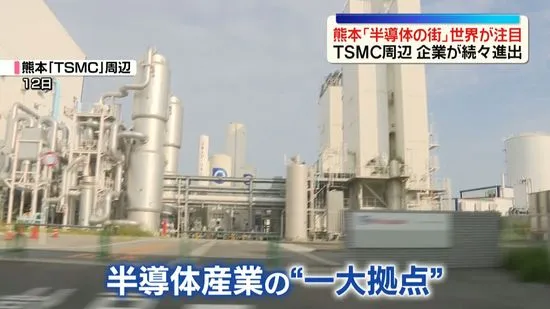
The area surrounding Kikuyo, where Taiwan Semiconductor Manufacturing Co. (TSMC) began operating its first Japanese plant, has rapidly attracted companies involved in chip production, equipment manufacturing, design and related services. Roads around the facility are increasingly crowded with commuters, while new businesses and construction projects have appeared across the surrounding communities. A second TSMC facility is also part of the continuing development in the area, reinforcing Kumamoto’s reputation as a major industrial hub.
International business and language skills
The growth of the semiconductor sector is already influencing daily life in Kumamoto. In Kumamoto City, a free class designed to help local residents communicate with Taiwanese people has seen its number of students double over the past year. The classes reflect the expanding economic and social ties between Kumamoto and Taiwan.
For local companies, the ability to communicate with Taiwanese partners is becoming increasingly valuable as business opportunities grow. One university student said that learning the language could prove useful if he eventually joins a semiconductor company. The rise in international business is also attracting overseas visitors. A businessman from Germany said he had come to Kumamoto to search for potential partners, adding that the region has highly capable talent that cannot be found everywhere.
Universities prepare a new generation of engineers
Kumamoto’s appeal is not based solely on factories. Universities are building specialized programs to create a sustainable pipeline of engineers and researchers. Kumamoto University established a semiconductor-focused educational program in 2024, described as the first of its kind in Japan. The program is taught in part by engineers with experience in the semiconductor industry and includes joint research projects with private companies.
Students conducting research in the university’s cleanroom facilities come from across Japan, including Fukuoka and Kyoto. A cleanroom maintains tightly controlled air quality and environmental conditions, making it essential for advanced semiconductor research and manufacturing-related education. The university also plans to make its facilities available to nearby universities, helping expand access to specialized training.
University officials say the close cooperation among companies, educational institutions and local communities is one of Kumamoto’s strengths. This regional approach allows businesses to communicate their needs directly to educators while giving students exposure to real-world technologies and career opportunities.
Hands-on training supports Japan’s technology ambitions
Private organizations are also investing in workforce development. At a semiconductor training school, graduate students from Tokyo can study manufacturing processes in specialized rooms and work with genuine materials used in the industry. The facility recently cooperated with Kumamoto Prefecture and nearby high schools to create educational textbooks focused on semiconductors.
Supporters believe early education is essential if Japan is to regain a stronger position in the global semiconductor industry. Japan remains home to advanced materials manufacturers, equipment makers and research institutions, but it faces intense competition from Taiwan, South Korea, the United States and other technology centers. Kumamoto’s strategy is therefore about more than attracting factories: it is about developing people who can sustain innovation over decades.
With international investment, expanding education and strong local cooperation, Kumamoto is becoming a notable example of how Japan is rebuilding its semiconductor capabilities. The region’s transformation could bring new jobs and business opportunities, while also reshaping communities through international exchange and advanced technical education.