Apple turns to on-device AI for the enterprise
Apple has begun shipping new versions of its Mac mini and Mac Studio desktop computers as it seeks to make a stronger push into the corporate artificial intelligence market. The highest-end configurations can approach $20,000, but Apple says their ability to process demanding AI workloads locally could offer businesses an alternative to renting computing capacity from data centers.
The new machines are designed for tasks such as code generation, software development and other complex business operations. Unlike many cloud-based AI services from companies including OpenAI and Anthropic, locally operated systems do not charge customers according to the number of tokens processed. That pricing difference could become increasingly important for companies that use AI intensively and want greater predictability over technology costs.
A direct challenge to Windows and Nvidia-powered systems
Apple’s Mac mini and Mac Studio will compete with new desktop systems built around Nvidia hardware and products from major personal-computer manufacturers. Microsoft’s Windows-related event in San Francisco next month is also expected to highlight the growing competition in AI-capable computers.
Apple’s challenge is substantial. According to IDC analyst Linn Huang, Apple holds approximately 4.6% of the corporate desktop market, compared with 91.3% for Windows. Corporate IT departments have traditionally favored Windows because of its broad software compatibility, established management tools and long-standing relationships with enterprise vendors.
The company is therefore attempting to persuade businesses that performance, energy efficiency and predictable ownership costs can outweigh the advantages of the Windows ecosystem. That represents a notable change from Apple’s historical position. Co-founder Steve Jobs was known for keeping his distance from enterprise computing, partly because employees were often unable to choose the products they preferred.
Apple Silicon provides an AI advantage
Apple believes its long-term focus on low-power computing gives it a stronger position in the emerging AI desktop market. When the company introduced its first internally designed Apple Silicon chips in 2020, it adopted a unified memory architecture that closely integrates processing and memory. Conventional computer designs have typically kept those components more separate.
The architecture was initially promoted for improved battery life and efficiency in products such as MacBooks. It has also produced a significant secondary benefit for AI workloads, which often require rapid access to large amounts of data. Nvidia and other chip designers have recently begun adopting similar approaches as demand for local AI processing grows.
Apple highlights data-center-class workloads
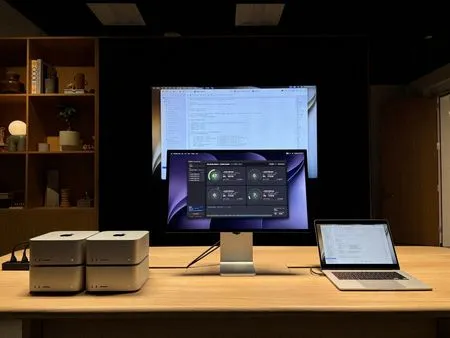
At a recent product event, Apple demonstrated four Mac Studio computers working together to run an AI model with one trillion parameters. The system was shown identifying and correcting bugs in graphics-related code, a workload that would traditionally require data-center infrastructure.
Apple said the four machines operated from a single wall outlet. Johny Srouji, the company’s hardware chief, argued that customers would not face additional usage charges after purchasing the equipment. “Once you buy the equipment, you do not have to worry about additional fees,” he said, adding that Apple believes the systems offer strong value in both performance and cost.
Why the shift matters for Japan
The development is also relevant to Japan, where manufacturers, software companies and research institutions are exploring ways to expand AI use while controlling energy consumption and protecting sensitive data. Running certain AI applications locally may appeal to Japanese businesses that handle proprietary designs, customer information or industrial data and prefer not to send every request to an overseas cloud platform.
Japan’s corporate technology market has historically included a strong Windows presence, but the country is also known for demanding high reliability, compact hardware and energy-efficient systems. Apple’s small-form-factor desktops and unified-memory design could attract interest among creative studios, software developers and research teams, although compatibility, support and procurement policies will remain important obstacles.
Apple’s enterprise campaign is still at an early stage. The company must demonstrate that its products can be deployed and managed at scale, integrate smoothly with existing business software and deliver consistent performance for real-world workloads. Even so, the arrival of more capable local AI computers signals a broader shift: businesses may soon have more choice between cloud subscriptions and powerful machines operating directly on their desks.