“It hurts my eyes—I can’t look for more than a few seconds.” That’s how one resident of Fukushima City describes the searing glare now ricocheting off a mountainside that has been shaved bare and covered with some 96,000 solar panels. What was once a green slope in the Azuma mountain range is today a metallic sheen visible from town, a transformation that supporters say advances Japan’s clean-energy transition but opponents call an environmental and civic injury—one that stings twice as hard in a region still living with the legacy of the 2011 disaster.
A mountain of panels, a valley of discontent
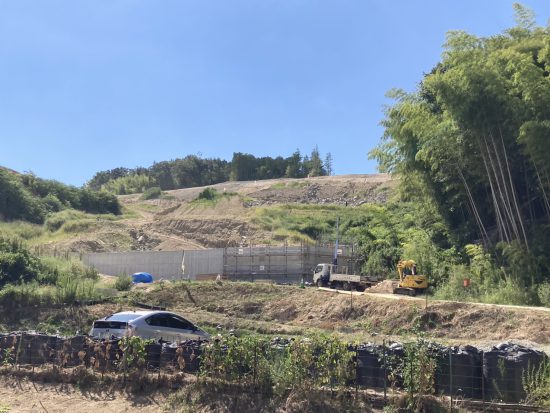
The contested site is Sendatsuyama, part of the Azuma range that straddles Fukushima and Yamagata prefectures. From Fukushima City, the stripped slope now resembles a giant mosaic of scales, a vast array spread over about 60 hectares. “The moment I saw the mountain torn up, my heart broke,” says Takeshi Yabuki, head of the Citizens’ Association to Protect the Scenery and Natural Environment of Mt. Azuma, which has filed petitions with prefectural and city authorities since 2024 to halt further work. Despite repeated submissions and a groundswell of signatures, Yabuki says nothing substantive has changed.
To locals, the shock is visual and visceral. Sendatsuyama is a regional symbol, and residents say it became a source of comfort after the Great East Japan Earthquake. In winter, a natural outline in the snow famously evokes the shape of a rabbit—an emblem of home that is now partially obscured. For others, the change is literal disorientation: on certain days and at certain angles, sunlight bounces off the panels with such intensity that it feels, as one resident put it, “like there are two suns.” During a recent visit, this reporter also experienced moments of piercing brightness that made driving palpably tense.
Wildlife pressure and a doubling of bear sightings
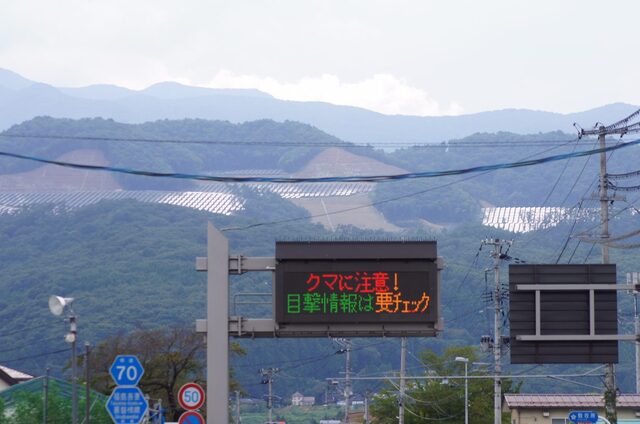
The controversy is not only about scenery. The cleared forest lies within reported habitat for the Asian black bear (tsukinowaguma). With trees felled and construction scarring the slope, residents say bears are wandering into neighborhoods more often. In Fukushima City, sightings have doubled compared with typical years, according to local records referenced by residents and activists. The causal link to the solar build-out is unproven, but the timing is worrying for neighbors, many of whom now carry bells, avoid evening walks, or exchange warnings on messaging apps.
Glare, regulations, and gaps in oversight
Solar modules are designed to absorb light, but at low sun angles or with seasonal snow and dust, reflection can surge. In aviation-heavy jurisdictions, glare analyses are standard for solar projects; Japan, by contrast, lacks a single national glare rule, leaving municipalities to improvise. The Sendatsuyama project has become a case study in how a new environmental conflict—light pollution—can emerge unexpectedly when large-scale solar is sited close to communities and prominent vistas.
Residents and watchdogs also question the project’s compliance with planning promises. Motokazu Matsutani, who leads the Sendatsuyama Monitoring Group, alleges the developer, identified locally as Amp, presented a landscape-impact visualization to secure a forest land development permit but then cleared beyond that envelope. He says revegetation has faltered, compounding the visual footprint and erosion concerns. Fukushima City’s mayor, Hiroshi Kohata, has publicly criticized the visual projections as “close to false”—a sharp rebuke in the measured language of local government. Yet enforcement appears muted. When Matsutani sought a detailed explanation of the permit process, he says officials pointed him back to the company. City authorities have issued guidance, residents say, but largely on a “please comply” basis rather than through binding orders.
Community money, community rifts
Tensions escalated after it emerged that Amp provided more than 18 million yen (about $120,000) in 2022 to a local “ward,” a cluster of neighborhood associations near the site. The company has said the funds were intended as community contributions. But one man living in the area says the ward chief accepted the money and signed an agreement without broader consultation, deepening mistrust. “It’s basically a top-down structure. If you push back, it affects relationships,” he says. “Many here opposed the mega-solar, but after the money, it got harder to speak out.”
‘Renewables in name, financial product in practice’
Behind the anger, critics see a systemic story. “There is a model where you destroy a mountain and profit by selling,” claims Matsutani. He says developers often set up special-purpose companies before construction, raise loans, secure permits, and then sell the electricity revenue rights or the plant to another entity to realize gains. The approach—variously described in Japan as a GK-TK structure or similar project-finance vehicle—is not illegal and is widely used in infrastructure, but in the eyes of some residents it epitomizes a flip-and-exit mentality out of sync with long-term stewardship of forests, water, and viewsheds.
Japan’s policy framework helped turbocharge mega-solar development in the 2010s. After the Fukushima Daiichi nuclear accident, the government introduced a generous feed-in tariff (FIT) to catalyze renewables. It worked: capacity surged, often on idle or marginal land. But incentives also drew speculative projects, and many were sized or structured to minimize environmental impact assessments. National EIAs fully apply to the largest build-outs; mid-scale plants sometimes slide through lighter scrutiny, with prefectures left to police forest and land-use permits. As FITs give way to a market-linked feed-in premium, officials are considering how to harden standards—on siting, glare, runoff, and decommissioning—without chilling the clean-energy build-out needed for climate goals.
Fukushima’s ‘No More Mega-Solar’ moment—what it does and doesn’t do
Mayor Kohata issued a “No More Mega-Solar” declaration in 2023, signaling a tougher line on new, landscape-scale projects. Locals welcomed the statement as a moral pivot, but it does little for Sendatsuyama, where much of the damage has already been done. Activists want stronger remedies: binding restoration plans with milestones, independent audits of glare and erosion, and, where necessary, partial decommissioning or re-vegetation to soften the visual scar. They also call for transparent community-benefit agreements negotiated broadly, not with a single intermediary, and for bonds that guarantee funds for restoration at end-of-life.
Beyond Fukushima: a broader reckoning for mega-solar
Sendatsuyama is not an isolated flashpoint. Conservationists in Hokkaido warn that a swath of mega-solar projects has turned parts of the Kushiro Marsh area into a “black sea,” threatening habitats for rare species. Across Japan, developers argue that decarbonization requires rapid solar expansion and that panels on degraded land can be part of the answer. The question—now echoing from coastal wetlands to mountain forests—is where and how to build responsibly. The answer will depend on better mapping of biodiversity and landscape values, earlier community engagement, and clearer rules for glare, runoff, and cumulative impacts.
What responsible build-out could look like
Experts point to a bundle of fixes: steer big arrays toward already-altered sites such as industrial zones and rooftops; require glare assessments and mitigation (panel tilt adjustments, anti-reflective coatings, vegetative buffers); mandate robust re-greening on forest conversions; and set up independent monitoring funded by developers but overseen by municipalities or prefectures. Transparency rules for community contributions can help avoid the perception of backroom deals, and decommissioning bonds can ensure restoration decades from now. The energy transition will not succeed on carbon math alone; it must also earn social license.
A bright idea, a harsh glare
On paper, Sendatsuyama’s panels contribute clean electrons to the grid. On the ground, residents see a wounded mountain and a blinding reminder of how the transition can go wrong when policy gaps, financial engineering, and weak oversight collide. “No More Mega-Solar,” the mayor declared. For Sendatsuyama, the harder question is how to heal what’s already been done—how to dull the glare, restore the green, and rebuild trust. Until then, a double sun glints across Fukushima City, and a community continues to squint into an uncertain future.