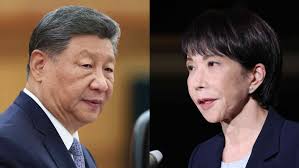
Tokyo, Dec. 2 — Japan’s government flatly rejected Chinese claims that Tokyo had altered its longstanding stance on Taiwan, after Beijing sent a second letter to United Nations Secretary-General António Guterres protesting remarks by Prime Minister Sanae Takaichi about a potential Taiwan contingency. Chief Cabinet Secretary Minoru Kihara said on Monday that Tokyo is aware China’s letter was dispatched in the early hours of the day, but emphasized that assertions of a Japanese policy change are “not grounded in fact” and have been repeatedly conveyed as such to the Chinese side.
Japan: “Unacceptable” claims, no policy shift
Speaking at a post-cabinet news conference, Kihara said the government has protested to Beijing that it has mischaracterized Japan’s position. Asked whether Tokyo would send another written rebuttal to the UN, he replied that China’s assertions are “of course not acceptable” and that the government would “respond appropriately.” The remarks underscore Tokyo’s determination to defend what it calls its consistent approach to the Taiwan issue: adherence to the 1972 Japan–China Joint Communiqué, in which Japan “fully understands and respects” China’s position that Taiwan is part of the People’s Republic of China, while maintaining practical, non-official ties with Taipei and calling for a peaceful resolution of cross-strait differences.
Beijing’s protest targets Japanese envoy’s letter
In the latest letter — Beijing’s second in quick succession on the matter — China’s Permanent Representative to the UN, Ambassador Fu Cong, criticized a prior letter by Japan’s UN envoy Kazuyuki Yamazaki to Guterres as sidestepping “the main points” and “baselessly criticizing China.” Fu further argued that Tokyo had not adequately explained what it describes as its “consistent position” on Taiwan. The Chinese mission posted the letter on X, signaling Beijing’s intent to conduct its dispute with Tokyo not only through formal UN channels but also in the court of public opinion.
What triggered the exchange
The diplomatic back-and-forth stems from comments by Prime Minister Takaichi in Japan’s parliament regarding a hypothetical Taiwan emergency — a scenario that has become a recurring topic in Tokyo as tensions in the Taiwan Strait persist. Although the specific remarks were not detailed in Beijing’s letter, Japanese leaders have repeatedly said that peace and stability across the Taiwan Strait is indispensable to Japan’s security and to the broader international order. Those statements have drawn sharp responses from China, which sees references to a “Taiwan contingency” as meddling in its internal affairs and a challenge to its “One China” principle.
Tokyo’s balancing act on Taiwan
Japan’s official posture rests on a careful balance: it does not recognize Taiwan as a state but maintains robust economic, cultural, and people-to-people ties with the self-governed island through non-governmental channels. Tokyo also stresses that any resolution of cross-strait issues must be peaceful. In recent years, Japan has intensified its focus on the Taiwan Strait within a broader reassessment of its security environment, reflecting concerns over gray-zone activities, military pressure around the island, and their implications for Japan’s southwestern islands and sea lanes. Public opinion in Japan has grown more attentive to Taiwan Strait stability, and successive governments have echoed the theme in joint statements with the United States and other partners.
UN theater and public diplomacy
The latest letters highlight how disputes over Taiwan increasingly play out at the United Nations and across social media, where diplomatic notes once confined to back channels are now broadcast for global scrutiny. Letters to the UN Secretary-General do not in themselves alter policy, but they create records of interpretation and intent that can shape future debates in UN bodies and beyond. For China, formally lodging objections helps reinforce its claim that references to a “Taiwan contingency” undermine sovereignty. For Japan, restating its position aims to prevent any erosion of what it views as long-settled understandings with Beijing while signaling resolve to allies and partners.
Regional and alliance context
The exchange comes against the backdrop of intensifying strategic competition in the Indo-Pacific. Tokyo has strengthened its security cooperation with Washington and aligned democracies, increased defense spending plans, and highlighted the need to deter unilateral changes to the status quo by force. The Taiwan Strait figures prominently in that conversation, not only for security reasons but also for economic ones, including the central role Taiwan plays in the semiconductor supply chain and global shipping. Beijing, for its part, has warned external actors not to “interfere,” framing statements about Taiwan’s security as encouragement for separatism — a charge Tokyo rejects.
Domestic political undertones
Prime Minister Takaichi’s involvement is notable given her reputation for hawkish views on national security. While her government insists it is not altering Japan’s long-held policy framework, critics in China interpret stronger rhetoric on deterrence and contingency planning as de facto shifts. Tokyo counters that preparing for contingencies and calling for stability does not equate to changing recognition policy; rather, it reflects the realities of an increasingly volatile environment in East Asia.
What to watch next
It remains to be seen whether Japan will send another formal letter to the UN to counter Beijing’s latest salvo. In the meantime, the episode illustrates how diplomatic messaging around Taiwan has grown more legalistic and more public — part advocacy, part signaling. With multiple stakeholders monitoring every word, both Tokyo and Beijing are likely to continue documenting their positions for international audiences, even as they maintain channels for direct communication. For investors and regional observers, the key takeaway is continuity: Japan is reaffirming its established line — no recognition of Taiwanese statehood, insistence on peaceful resolution, and concern for Taiwan Strait stability — while China is contesting interpretations it believes broaden external involvement. That underlying dynamic, rather than a concrete policy shift, appears to be driving the latest rhetorical escalation.
Bottom line
Japan says nothing has changed in its Taiwan policy and calls China’s claims to the contrary unfounded. China insists Japan must explain more clearly what it means by a “consistent position” and stop, in Beijing’s view, encouraging narratives of a Taiwan emergency. As both sides sharpen their messages at the UN and online, the risks of misperception remain — even as each capital insists it is only restating what it has said all along.