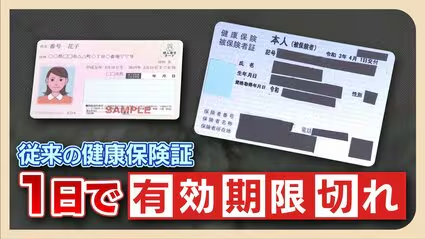
On December 1, Japan reached a long-anticipated turning point in its healthcare digitization drive: every traditional “paper” health insurance card expired, clearing the way for the nationwide use of the My Number–linked “Myna insurance card” from December 2. The government says the shift will streamline check-ins and improve the accuracy of benefits, but on the ground the transition is exposing a patchwork of readiness, uneven usage, and growing frustration among patients and providers.
Protest in Fukuoka: “Give Us Back Our Insurance Cards”
At JR Hakata Station in Fukuoka on December 1, about 20 medical professionals rallied with banners and placards reading “Return the health insurance card,” collecting signatures against the abolition of the conventional card. The protest, organized by the “Return the Insurance Card” Network Fukuoka—an umbrella of some 30 organizations including the Fukuoka Prefecture Association of Health Insurance Physicians and the Dental Insurance Physicians Association—argues the new system risks leaving vulnerable patients behind. “With the Myna insurance card, people must remember a PIN and handle updates themselves. It essentially shifts responsibility to the individual,” said Masaaki Shichiri, the network’s secretary-general. “Those recuperating at home, people with disabilities, individuals with dementia, and the elderly may be unable to use it and risk being treated as uninsured. That is the biggest drawback.”
From Paper to Digital: What Changes From December 2
Under the new arrangement, the Myna insurance card—an application of the national My Number ID card for health coverage—becomes the primary credential at medical and dental facilities. Patients can register their My Number card for insurance use via the government’s Myna Portal site or at facilities equipped with card readers. For those without a Myna insurance card, health insurers and local governments are issuing a “shikaku kaku’ninsho,” or Eligibility Certificate, which acts as a substitute insurance credential. Its validity varies by insurer but lasts up to a maximum of five years. Anticipating inevitable friction, the Ministry of Health, Labour and Welfare (MHLW) has also introduced a safety net: patients who arrive unaware their paper cards have lapsed may continue using the old card as a temporary exception until the end of March 2026.
Who’s Using the New Card? High Ownership, Low Usage
On paper, adoption looks strong. According to an MHLW survey, 79.9% of residents hold a My Number card, and 87.8% of those cardholders have registered it as a Myna insurance card. Yet actual usage at clinics remains far lower: the utilization rate stands at just 37.14%, well below 40%. The gap is visible at Urakawa Dental Clinic in Fukuoka City’s Minami Ward, where Director Osamu Urakawa said uptake is rising but still modest. “As the deadline has approached, Myna insurance card usage has crept up. Our latest data from August shows 29%,” he said, estimating current use remains around three in ten patients. The low utilization translates into real-world workarounds. One patient told the clinic they do possess a My Number card but let it expire and opted to rely on the newly arrived Eligibility Certificate from their employer’s insurer: “That’s enough for now. I don’t really have time to renew.”
On the Street: Convenience vs. Skepticism
Public opinion mirrors the divide. A woman in her 60s praised the system’s convenience, saying it sped up check-ins and removed the need to show a separate medication record: “It’s smooth, especially since the COVID-19 period.” Another in her 50s said carrying one card that consolidates records is “really helpful.” But skeptics remain. A man in his 70s said he doesn’t trust how personal data will be handled and sees no problem sticking with paper: “I’m not convinced. I’m not having trouble with the old card.” Another in his 70s opposed the change outright: “It feels like being tied down by everything. And what happens if you lose the card?”
Providers Brace for a Tangle of Workflows
For clinics and hospitals, the greater risk may be administrative complexity. “There are now more than ten separate methods of eligibility verification, including smartphone-enabled My Number options,” said Urakawa. “Formats for Eligibility Certificates and ‘notices of eligibility information’ differ by insurer. We can’t easily memorize every pattern, so each case takes time and attention.” In practice, front desks now juggle card readers, QR codes, multiple insurer formats, and paper backups—all while guiding patients through new steps like PIN entry on devices many have never used in a medical setting.
Public Subsidy Programs Aren’t Fully Linked
A further complication lies with public subsidy schemes—such as disability, child, or single-parent medical support—which often require separate certificates. The nationwide system to link these benefits to the Myna insurance card has not been fully rolled out, meaning the card alone may not suffice. One patient at Urakawa Dental noted they brought the Myna insurance card but could not proceed under a disability medical subsidy because the records were not linked: “If it’s not tied together, it’s meaningless.” Urakawa stressed that families with children and people with disabilities still frequently must present an additional medical benefit certificate alongside the Myna insurance card. “Relying on the Myna card alone remains difficult in many public-subsidy cases. That may be one reason why uptake hasn’t moved faster,” he said.
What Patients Should Do Now
From December 2, the rules are clear in principle: if you have a Myna insurance card, use it at check-in. If you do not, you have two options: present an Eligibility Certificate issued by your insurer or, until March 31, 2026, present your expired paper health insurance card under the government’s temporary measure. Patients should also take note of a potential source of confusion: some cardholders receive a “Shikaku Jōhō no Oshirase,” or Notice of Eligibility Information, by post. This is not the same as an Eligibility Certificate and does not function as a health insurance card at reception. Those relying on public subsidies should continue to bring the relevant separate certificates until their benefits are confirmed as linked to the Myna system.
Analysis: A Digital Leap With a Trust Gap
Japan’s shift to the Myna insurance card aims to modernize healthcare administration, reduce fraud, and improve continuity of care by consolidating identity and benefits in one chip-enabled credential. In theory, integration with electronic medical records and pharmacy data can also make treatment safer and more efficient. Yet the transition comes amid lingering public concerns. Past data-linkage errors reported by the government dented confidence, and the requirement to manage PINs or renew card credentials creates friction for older residents and people with disabilities. Meanwhile, clinics face a proliferation of verification pathways that can slow reception and bewilder staff—hardly the promised “frictionless” experience. The result is a telling paradox: high registration but relatively low use. Bridging that gap will likely require faster integration of public subsidy programs, uniform documentation formats across insurers, more robust in-person support for card activation and renewals, and persistent assurances on data protection. For now, with Eligibility Certificates and a paper-card grace period through March 2026, the rollout includes multiple safety nets. But until the system is simpler for the front desk and clearer for the waiting room, the promise of universal digital convenience may remain just out of reach.