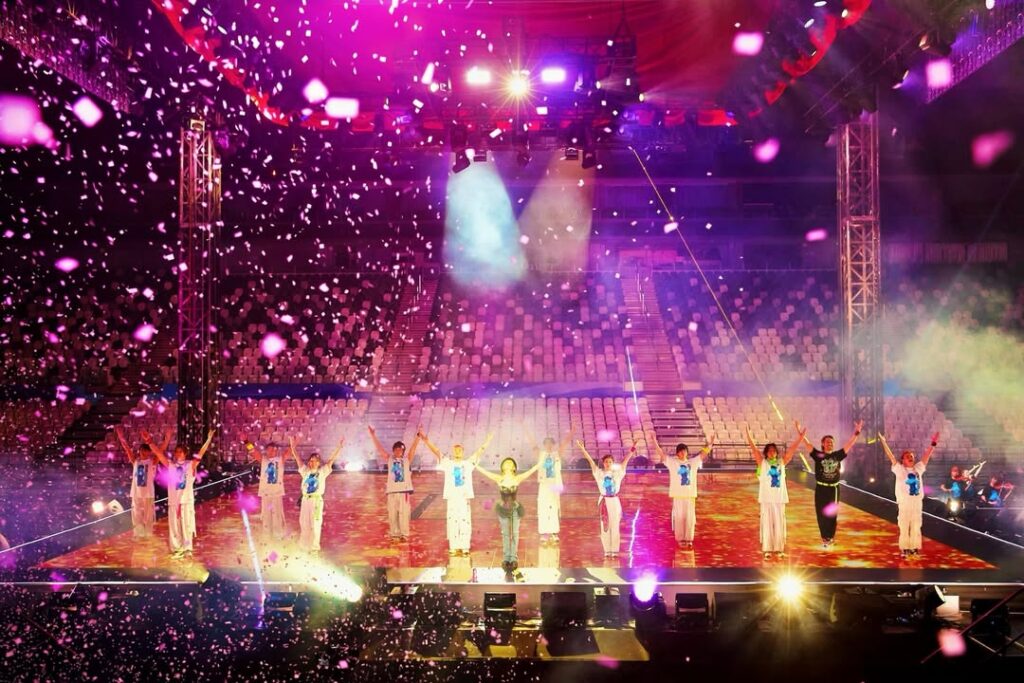
In the latest sign that politics is seeping into cultural life, posters of Japanese pop icon Ayumi Hamasaki were removed from an unofficial fan café in Shanghai after authorities reportedly “inspected” the venue, according to social media posts that have sparked debate across Chinese and Japanese platforms. The episode comes as Japan–China relations enter a tense phase following Prime Minister Sanae Takaichi’s recent remark that a contingency in Taiwan could constitute a survival-threatening situation for Japan—a statement that triggered a sharp backlash from Beijing. Within days, China urged its citizens on November 14 to reconsider travel to Japan and, on November 19, effectively halted imports of Japanese seafood. A wave of cancellations and postponements has rippled through the entertainment calendar, with multiple Japanese performers scrubbing China dates at short notice, including Hamasaki’s planned Shanghai concert, which the Chinese organizer canceled close to showtime, citing “force majeure.”
A café becomes a flashpoint
For years, the fan-run Shanghai café—unofficial, small, and a meeting point for cross-border enthusiasts—has been decorated with Hamasaki posters and memorabilia. It is the sort of grassroots cultural space that rarely attracts official attention. But users on Chinese social media said the venue was visited by local officials and that Hamasaki-branded materials were taken down. A reporter from the international desk of a Japanese national daily, speaking on background, said the chatter “exploded” on local platforms as images and accounts circulated showing bare walls where posters once hung. The café could not be reached for comment, and local authorities did not respond to questions by deadline. The organizer of Hamasaki’s canceled show did not elaborate beyond its “force majeure” explanation.
Nostalgia and soft power
Ayumi Hamasaki, now 47, remains a household name for many in China. Writer and China specialist Minetoshi Yasuda, author of several books on contemporary China, told us Hamasaki’s songs were ubiquitous in the 2000s, playing in neighborhood eateries and salons. “Even people without a special interest in Japan knew her,” he said, adding that her status today is tinged with nostalgia rather than cutting-edge chart dominance. That long-tail popularity underscores why the café’s reported strip-down resonated so widely: for many middle-aged fans, it reads as a personal encroachment on a shared cultural memory rather than a routine enforcement action.
Over-compliance in the Xi era
What is driving the enforcement? Analysts suggest the answer lies less in a single, top-down directive than in China’s bureaucratic dynamics. “When officials think they discern the leadership’s intent, they often over-comply,” said Yasuda. “If it becomes known that President Xi Jinping wants to ‘teach Japan a lesson,’ different agencies will begin taking steps that align with that general mood, even without a detailed plan.” In this reading, the café’s posters were likely collateral in a system that rewards visible caution. With a high-profile political spat unfolding, low-level officials can anticipate risk better than they can gauge restraint; removing posters in a themed café becomes the safer choice. The result, Yasuda argues, is a patchwork of measures—cutting flights, canceling concerts, tightening promotional displays—that can feel coordinated but often emerge from parallel bouts of bureaucratic zeal rather than a meticulous national strategy.
A widening circle of uncertainty
That fragmentation makes the trajectory hard to predict. Many in Japan, seeing travel advisories and import restrictions arrive in quick succession, assume Beijing is deploying a calibrated set of pressure tactics. But if, as Yasuda suggests, the instruction from the top is little more than “make Japan feel it,” the scope and duration of the clampdown become difficult to forecast. Local officials, airlines, venue managers, and cultural bureaus may each move independently, sometimes inconsistently, to signal toughness. It is this diffuse, risk-averse rhythm that often perplexes foreign counterparts and complicates de-escalation. What starts as a symbolic gesture can harden into practice, especially if no one wants to be the first to roll it back.
Why this moment matters
The political context is combustible. Prime Minister Takaichi’s Taiwan-related comment touched Beijing’s most sensitive nerve; China frames the island as an internal matter and bristles at any foreign suggestion of collective defense. Tokyo, meanwhile, has been revising its security posture, investing in counterstrike capabilities and tighter cooperation with allies. Public opinion on both sides has been fragile for years, periodically inflamed by maritime incidents, historical grievances, and economic friction. Cultural exchange—concerts, fan events, co-productions—has often served as a quiet stabilizer, keeping people-to-people ties alive even when official dialogues stall. The current disruptions risk fraying that cushion.
The seafood shock and the travel chill
Beijing’s effective halt to imports of Japanese seafood on November 19 extended an existing pattern of using trade as leverage, while the November 14 travel advisory adds a chill to tourism flows that were only beginning to recover post-pandemic. For Japan’s coastal producers and small businesses reliant on Chinese visitors, the double hit is immediate. For China-based promoters and venues, sudden cancellations add financial strain and reputational risk, further discouraging booking of Japanese acts. The “force majeure” label offers contractual cover but obscures the decision-making that led to the cancellations and removals.
Soft power, hard edges
Pop culture is never insulated from geopolitics, but the Hamasaki café episode illustrates how swiftly the line can blur. Stripping the walls of a fan space is not a major policy act; it is, however, highly legible to ordinary citizens. Such visible micro-measures can ripple outward, chilling self-expression and nudging businesses to preemptively sanitize their offerings. Over time, that erodes the very soft power interactions that both countries, at various points, have quietly leveraged to keep broader ties workable.
Verification and sourcing
As of publication, the café incident rests on social media accounts and images amplified by Chinese and Japanese users. We have requested comment from Shanghai municipal authorities and the venue’s operators. The organizer of Hamasaki’s canceled concert has not provided additional details beyond its brief statement. While individual incidents are hard to verify in real time, they fit a recognizable pattern documented during previous spikes in tension: decentralized, over-cautious enforcement that hews to an assumed political mood and, in doing so, sometimes outruns any explicit directive.
What to watch next
Three indicators bear close monitoring. First, whether airlines and travel platforms deepen the pullback on Japan-bound itineraries or quietly restore capacity in the coming weeks. Second, whether cultural regulators in major Chinese cities issue clearer guidance on foreign performances—or continue case-by-case delays that amount to de facto bans. Third, whether Beijing and Tokyo create a face-saving off-ramp, perhaps through business chambers or cultural institutions, to revive people-to-people exchanges without overtly revisiting the underlying political dispute. Until then, a fan café with blank walls may remain an apt metaphor for a relationship stripped of some of its most human connections just when they are needed most.