Yamaguchi Joint Gas says it is targeting full restoration of service by December 7 for roughly 12,200 customer accounts affected by a large-scale gas leak in Ube City, Yamaguchi Prefecture, but warns that the timeline hinges on being able to reach residents at home for mandatory safety inspections. The company, headquartered in Shimonoseki, disclosed its phased plan on December 5, underscoring the delicate balance between speed and safety as the community continues to reel from dozens of fire incidents and injuries linked to the accident.
A tight three-day timetable
According to the utility, the restoration effort is structured over three days: approximately 3,200 customers on December 5, around 4,500 on December 6, and a further 4,500 on December 7. The company has temporarily halted gas supply to affected areas and will only reopen valves after in-person safety checks and gas reactivation procedures at each location. “Because we must visit each household to perform safety inspections and reopen gas, restoration could be delayed if residents are not at home,” the company cautioned.
To accelerate the work, Yamaguchi Joint Gas has mobilized a combined field force of around 160 people, including about 110 of its own staff and roughly 50 reinforcements from gas operators across the Chugoku and Shikoku regions. The utility says it will seek further assistance as needed to meet the December 7 target. The company has begun distributing portable cassette stoves to residents who request them and pledged compensation for those who sustained injuries or property damage as a result of fires. “If property has been lost due to fire, we will respond,” the utility said, noting that details will be handled case by case.
Safety first: Why restoration requires a knock at every door
Unlike a simple flip of a switch, restoring gas after a major incident in Japan requires technicians to check piping and appliances inside each dwelling and to carefully reopen service to prevent residual leaks or misfires. This precaution is standard practice nationwide and usually involves verifying that valves are closed, examining meter readings and pressure, ensuring appliances are intact, and confirming safe ignition. The procedure’s reliance on resident availability introduces uncertainty into the schedule, especially on weekdays when many people are at work or school. Yamaguchi Joint Gas says it is updating restoration status throughout the day on its website and urges customers in affected zones to remain reachable and to verify workers’ identification when they arrive.
Human impact: Fires, injuries, and a neighborhood on edge
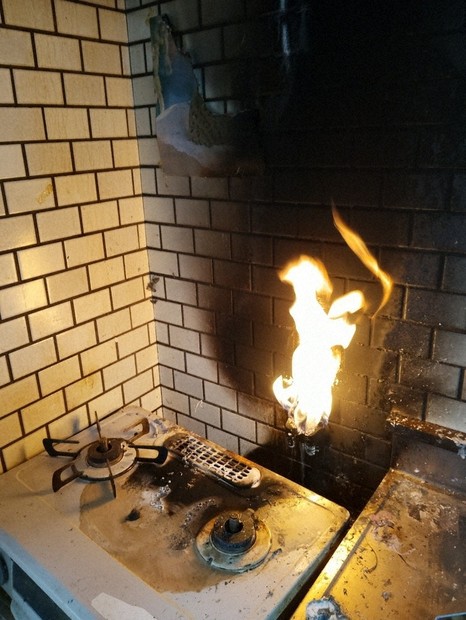
By midday on December 5, authorities had confirmed 23 fire incidents and three injuries related to the gas leak that erupted the previous day, highlighting the severity of the emergency. For residents, fear and confusion set in quickly. Akemi Sasaki, 79, who lives in Matsuyama-cho, Ube City, said she awoke around 6:30 a.m. on December 4 to an alarm declaring, “Gas is leaking.” When she hurried to her kitchen, she saw flames shooting from the main gas valve. “I thought it might explode,” Sasaki recalled. Unable to get through to the gas company as phone lines jammed, she called the fire department. Responders extinguished the blaze, but the wall behind her stove was badly scorched. Company staff visited later in the day to apologize. “We always close the main valve when we’re not using it—and it burned. Why?” she said, still shaken that a valve she had not lit could catch fire.
The leak’s ripple effects extended beyond households. At Kanbara Nursery School in Kotoshiba-cho, which cares for 108 children, the gas outage halted school lunches and shut down heating. Administrators asked families to keep children at home where possible. Even so, about 50 children who required care arrived with packed lunches and extra layers for warmth. The school plans to accept children again on December 6, and to prepare lunches using portable cassette stoves. “We are sorry for the burden on parents. We want restoration as soon as possible,” Principal Hiroko Tokuda said.
Regulators demand answers and swift recovery
On December 4, two officials from the Chugoku-Shikoku Industrial Safety and Inspection Department of Japan’s Ministry of Economy, Trade and Industry (METI) visited the company’s Ube branch. The regulator received a briefing on the restoration plan and called for a thorough understanding of the accident’s circumstances, solid measures to prevent recurrence, and the earliest possible resumption of safe gas supply. While the cause of the leak had not been announced as of December 5, the company said it is cooperating fully with the oversight body. Investigators typically review pipeline integrity, pressure regulation systems, maintenance records, and incident timelines in such cases, while weighing potential external factors such as groundwork activity or environmental conditions.
What residents should do now
Authorities and safety experts generally recommend that residents in affected areas keep main valves closed until a qualified technician performs a safety check and reopens service. Households should ventilate spaces if they smell gas, avoid open flames and sparks, and refrain from operating electrical switches that could produce a spark. Where portable cassette stoves are used temporarily, they should be placed on stable, heat-resistant surfaces and operated with proper ventilation, away from flammable materials and never inside tightly sealed spaces. Residents are also advised to confirm the identification of company personnel, who should carry official badges and follow standardized procedures during inspections and reactivations.
A community tests its resilience
Ube City, an industrial hub on the Seto Inland Sea in western Japan, is accustomed to managing large-scale logistics, but a citywide gas disruption amid the early winter chill brings a different kind of stress. The incident raises familiar questions for utilities and regulators across Japan: how to strengthen resilience in networks serving aging buildings, how to communicate risk effectively, and how to balance rapid restoration with uncompromising safety. The company’s plan—conservative, methodical, and manpower-intensive—reflects lessons learned from past incidents around the country, where door-to-door verification has proven the safest way to prevent secondary accidents when service resumes.
As crews fan out across Ube in three waves through December 7, the utility’s success will depend not only on the additional personnel it can marshal, but also on the community’s ability to coordinate—staying home during assigned windows, answering doors promptly, and following safety guidance. For those still without gas, a brief return of normal routines—hot meals, heated rooms, and school lunches—cannot come soon enough. Until then, the city waits, cautiously, for the flicker of blue flame to say that life is once again warming up.