Japan seeks a more resilient path beyond rare earths
Japanese companies are accelerating efforts to reduce their dependence on rare earths as China’s export controls and dominant position in refining create growing supply concerns. The response includes recycling materials from used products, developing magnets that require fewer heavy rare earths, and designing motors that use no rare earths at all.
The shift is becoming visible in everyday products, including household air conditioners, as well as in advanced industries such as electric vehicles. For Japan, the effort is not only an environmental initiative but also a matter of economic security and industrial resilience.
Recycled materials could enter household air conditioners
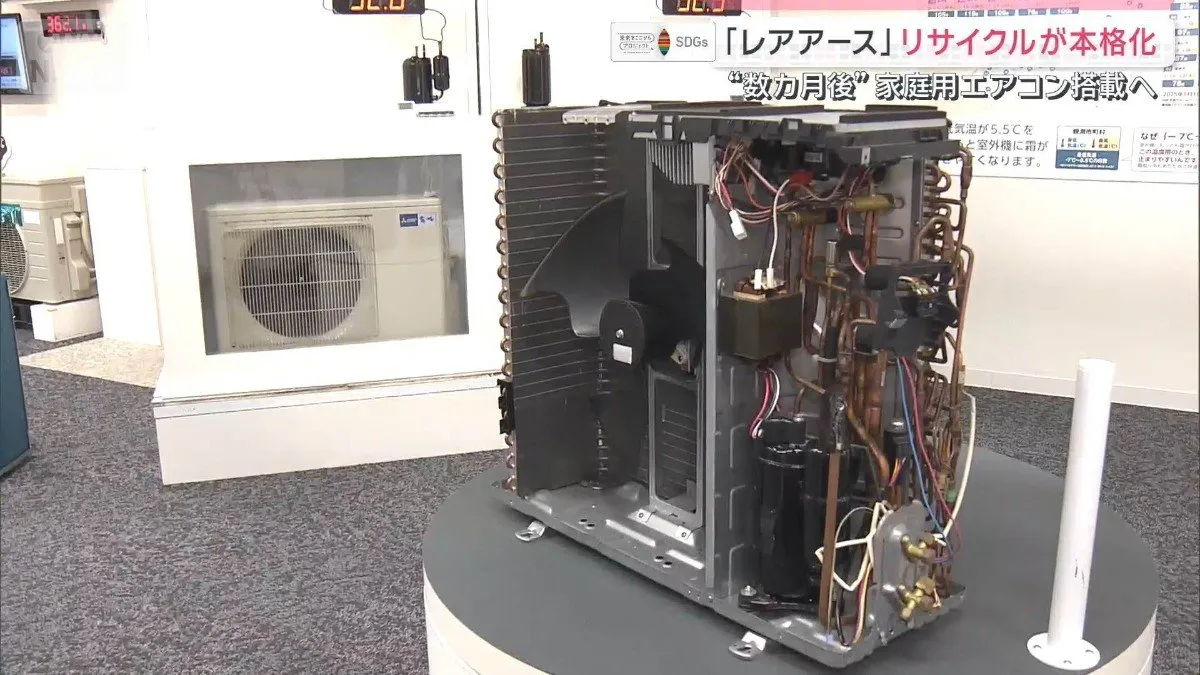
At Mitsubishi Electric’s Shizuoka Works, rare-earth magnets are used inside the rotor of a motor that powers an air conditioner’s compressor. The compressor is one of the appliance’s key components, and high-performance magnets help improve motor efficiency. This has become increasingly important as hotter summers raise demand for air conditioners that can deliver stronger performance while using less electricity.
However, Japan faces a supply challenge. China dominates much of the world’s rare-earth refining capacity, and tighter export controls have made supplies less predictable for Japanese manufacturers. Mitsubishi Electric has therefore begun a program to recover rare earths from materials that might otherwise be discarded as scrap.
The company estimates that recycled materials could eventually supply about 35 percent of the rare earths used in its household air conditioners. This would reduce the share requiring new procurement from 100 percent to approximately 65 percent. Mitsubishi Electric says newly produced recycled magnets are already available, and air conditioners using them could appear within several months, subject to the company’s production plans.
New magnet design reduces reliance on heavy rare earths
Another Japanese company, Proterial Magnetics, is developing magnets designed to maintain high performance without relying heavily on heavy rare earths such as dysprosium. Neodymium magnets are widely used in smartphones, electric vehicles and other high-output motors because they provide strong magnetic force in a compact size.
The challenge is heat. During high-power motor operation, temperatures can reach approximately 200 degrees Celsius, weakening the magnet’s performance. Manufacturers have traditionally added heavy rare earths to improve heat resistance. Japan, however, has depended almost entirely on China for these materials, making alternatives strategically important.
Researchers at Proterial Magnetics say they improved heat resistance by controlling the internal crystal structure of the magnet and limiting impurities during the manufacturing process. The company has not disclosed all of the details, describing aspects of the method as proprietary. It says the magnets are already being used in high-output motors, including those installed in electric vehicles, and describes their performance as among the strongest in the world.
Rare-earth-free motors are also entering practical use
Japan’s efforts extend beyond reducing rare-earth consumption. Automotive parts manufacturer Mitsuba has developed motors that use ferrite magnets, which are primarily made from iron and do not require rare earths. By combining multiple ferrite magnets and refining the motor design, the company has achieved output comparable to, or higher than, conventional rare-earth-based products.
These motors are already used in vehicle systems such as windshield wipers and sunroofs. Mitsuba plans to expand the technology to additional automotive components. In 2025, major automotive supplier Astemo also announced the successful development of a rare-earth-free drive motor for electric vehicles, with practical deployment targeted around 2030.
Why the development matters
Rare earths are not necessarily rare in the geological sense, but they are difficult and environmentally demanding to separate and refine. Because processing capacity is concentrated in a small number of countries, supply disruptions can affect industries ranging from consumer electronics to clean-energy equipment.
Japan’s strategy is therefore based on diversification rather than a single solution. Recycling can recover valuable materials from products already in circulation. More efficient magnet designs can reduce the quantity of vulnerable materials required. Alternative magnets and motor architectures may eventually remove the need for rare earths in selected applications altogether.
These technologies will not eliminate Japan’s exposure to global mineral markets overnight, and large vehicle-drive motors remain technically demanding. Nevertheless, the combination of recycling, material innovation and domestic engineering gives Japan additional options. As the country pursues stronger supply chains and a lower-carbon economy, its rare-earth strategy highlights how Japanese manufacturers are turning a geopolitical challenge into an opportunity for practical innovation.