Rare-earth mud recovered near Minamitorishima
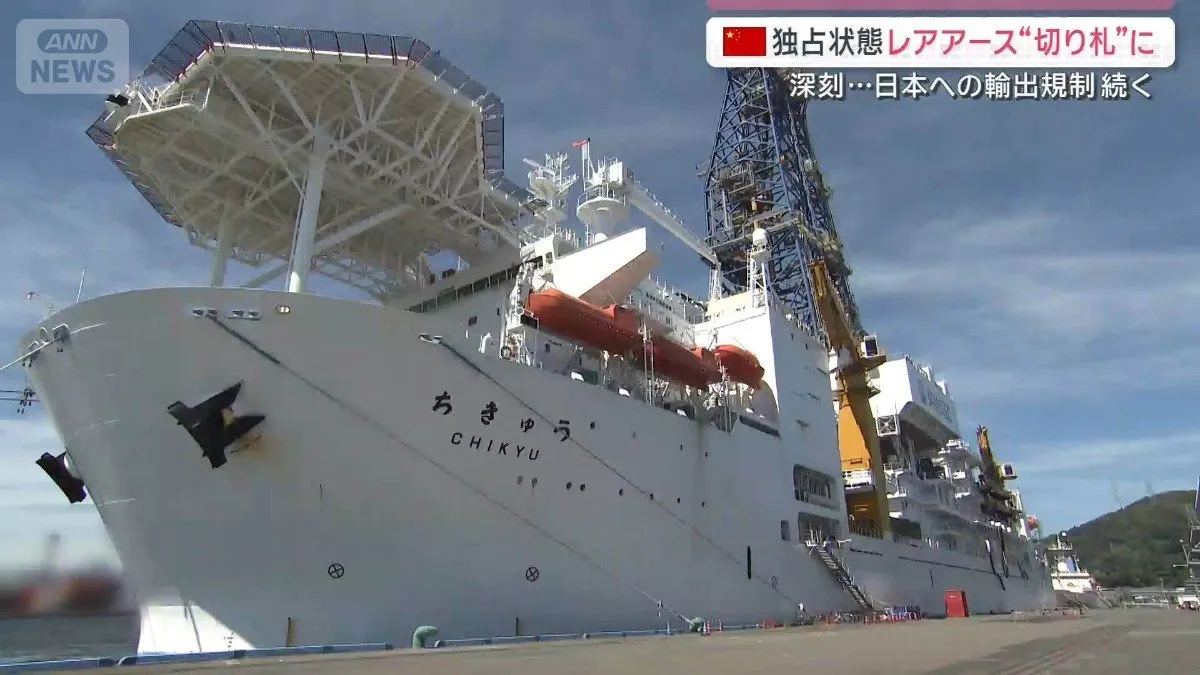
Japan is moving closer to developing a domestic source of rare earths after successfully recovering mineral-rich mud from the seabed near Minamitorishima, a remote Japanese island located approximately 1,900 kilometers southeast of Tokyo. The operation used the Chikyu, Japan’s deep-sea scientific drilling vessel, to reach the ocean floor at a depth of about 6,000 meters.
The project is being advanced as Japan seeks to reduce its dependence on overseas suppliers, particularly China, which remains dominant in both rare-earth production and refining. Rare earths are a group of 17 elements essential to modern technology, including electric-vehicle motors, smartphones, advanced electronics, semiconductor manufacturing equipment and defense systems.
A complex operation at extreme depth
The Chikyu is around 210 meters long and rises approximately 130 meters from the bottom of the vessel. Its towering structure is necessary to connect roughly 600 drill pipes, each measuring about 10 meters, in order to reach the seabed.
At the end of the drilling system, specialized equipment mixes seabed sediment with seawater. This allows the mud to move continuously through the long pipe and back to the ship. Six thrusters installed beneath the vessel help it remain in the same position while the material is being lifted from the ocean floor.
The latest operation recovered approximately 50 tons of mud containing rare earths. According to Japan’s Cabinet Office project officials, yttrium accounted for the largest share of the material. Yttrium is used in areas such as semiconductor production equipment, and China is estimated to account for around 90 percent of global output. Its price rose sharply after China strengthened export controls on Japan-related shipments, highlighting the strategic importance of alternative supply sources.
Why China dominates the market
Japan’s deep-sea project comes against a backdrop of continuing geopolitical and economic tension. China has introduced additional export restrictions affecting rare earth-related products and Japanese companies, describing the measures as targeting dual-use materials. The controls are widely viewed as part of broader political tensions between Beijing and Tokyo.
Experts say China’s position is linked not only to the size of its reserves, but also to the relatively low cost of extracting and processing them. In regions such as Baotou in Inner Mongolia, rare-earth deposits can be mined close to the surface through large-scale open-pit operations. This is considerably easier than extracting material from a depth of 6,000 meters.
However, conventional mining and refining can generate substantial waste. Researchers have also raised concerns about radioactive elements and other hazardous materials that may be associated with some land-based rare-earth ores. Strict environmental regulations in Japan make the domestic processing of such ores particularly challenging.
Environmental advantages and industrial challenges
Japanese researchers say the rare-earth mud near Minamitorishima appears to contain very low levels of uranium, thorium and other harmful substances. Unlike many land-based deposits formed through volcanic activity, the seabed mud is believed to have formed as dissolved rare-earth elements accumulated in the remains of marine organisms, including fish bones.
This difference could make the material more suitable for processing in Japan and other advanced economies. Nevertheless, major technical and economic challenges remain, including the cost of deep-sea extraction, transportation, dewatering, separation, refining and environmental monitoring.
Large-scale test planned for 2027
The Japan Agency for Marine-Earth Science and Technology, known as JAMSTEC, is preparing a larger trial around Minamitorishima in February 2027. The planned month-long operation aims to increase recovery to approximately 350 tons of mud per day.
Unlike the latest test, in which the material was transported directly to mainland Japan, the next phase is expected to include dewatering at Minamitorishima before the mud is shipped for separation, purification and refining. Japan plans to evaluate whether a complete industrial-scale production chain is technically and economically viable by March 2028.
The resource is considered potentially abundant, but the Japanese government is not presenting the project as a way to achieve total self-sufficiency. Instead, it is part of a broader strategy that includes recycling, supplier diversification and the development of domestic processing capacity. If successful, Minamitorishima’s rare-earth mud could give Japan greater resilience in a critical technology sector while supporting a more diversified global supply chain.