Prime Minister Makes Private Offering During Yasukuni Autumn Festival
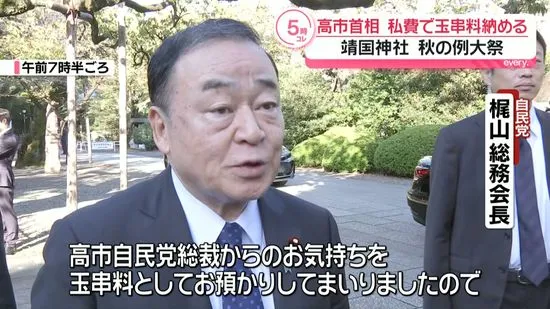
Prime Minister Sanae Takaichi offered a ritual donation to Yasukuni Shrine in Tokyo through a representative during the shrine’s autumn festival, using private funds rather than public money, according to Japanese media reports. The offering, known as a tamagushiryo, was delivered on her behalf by senior Liberal Democratic Party official Kajiyama, who said he had been entrusted with “the feelings” of Takaichi, who also serves as president of the ruling LDP.
The autumn festival at Yasukuni Shrine, located in Tokyo’s Kudan district, is being held from October 17 to 19. On the morning of the final day, several prominent politicians visited the shrine, including LDP General Council Chairman Kajiyama and Election Strategy Committee Chairman Nishimura. Kajiyama also submitted Takaichi’s private offering at the shrine.
Cabinet Ministers and Lawmakers Attend as Part of Cross-Party Group
Separately, Land, Infrastructure, Transport and Tourism Minister Ibayashi visited Yasukuni as one of roughly 70 members of a nonpartisan parliamentary group known as the “Association of Diet Members for Everyone to Visit Yasukuni Shrine Together.” The group has long organized visits by lawmakers during major shrine observances, presenting the act as a gesture of remembrance for those who died in service to Japan.
Environment Minister Sasagawa also visited the shrine on October 19. Among party leaders, Kamiya, head of Sanseito, also paid his respects. The visits underline how Yasukuni remains a significant place of remembrance in Japanese political life, particularly during the shrine’s spring and autumn festivals, when lawmakers often appear either individually or as part of parliamentary groups.
Why Yasukuni Matters in Japan and Abroad
For many Japanese visitors, Yasukuni Shrine is a solemn memorial dedicated to the nation’s war dead. Established in the 19th century, the shrine commemorates millions of people who died in conflicts involving Japan. Families, veterans’ groups, and members of the public visit to pray, remember relatives, and reflect on the sacrifices of earlier generations.
At the same time, Yasukuni is closely watched internationally because it also enshrines convicted Class-A war criminals among the war dead. Visits by sitting political leaders or cabinet members have often drawn attention from neighboring countries, particularly China and South Korea, where memories of Japan’s wartime actions remain sensitive. For that reason, Japanese leaders frequently distinguish between official visits and private religious or memorial gestures.
Takaichi’s decision to make the offering with private funds and through a proxy reflects that careful distinction. It allows the prime minister to acknowledge the shrine’s annual observance while avoiding the appearance of using state resources for a religious act. In Japan’s constitutional system, the separation of religion and state is an important legal principle, and political figures often pay close attention to how such visits and offerings are framed.
A Window Into Japan’s Democratic and Cultural Balance
The latest developments highlight Japan’s ongoing effort to balance national remembrance, constitutional norms, religious custom, and diplomatic sensitivity. The fact that lawmakers from different parties visited as part of a cross-party association also shows that Yasukuni is not solely a partisan issue. Rather, it reflects broader debates within Japanese society over how to honor the dead, preserve historical memory, and maintain stable relations with neighboring countries.
For foreign residents and Japan watchers, the autumn festival offers a useful lens into the country’s political culture. Japan’s public life often combines formal restraint with deeply rooted traditions, and Yasukuni remains one of the clearest examples of that complexity. The government’s handling of the occasion will likely continue to be examined both domestically and overseas, especially under Takaichi’s leadership.
While reactions may vary, the episode demonstrates Japan’s mature democratic environment, where political leaders, lawmakers, citizens, and international observers all engage with questions of history, identity, and remembrance. In that sense, the Yasukuni autumn festival remains more than a ceremonial event. It is a recurring moment in which Japan reflects on its past while navigating its responsibilities in the present.