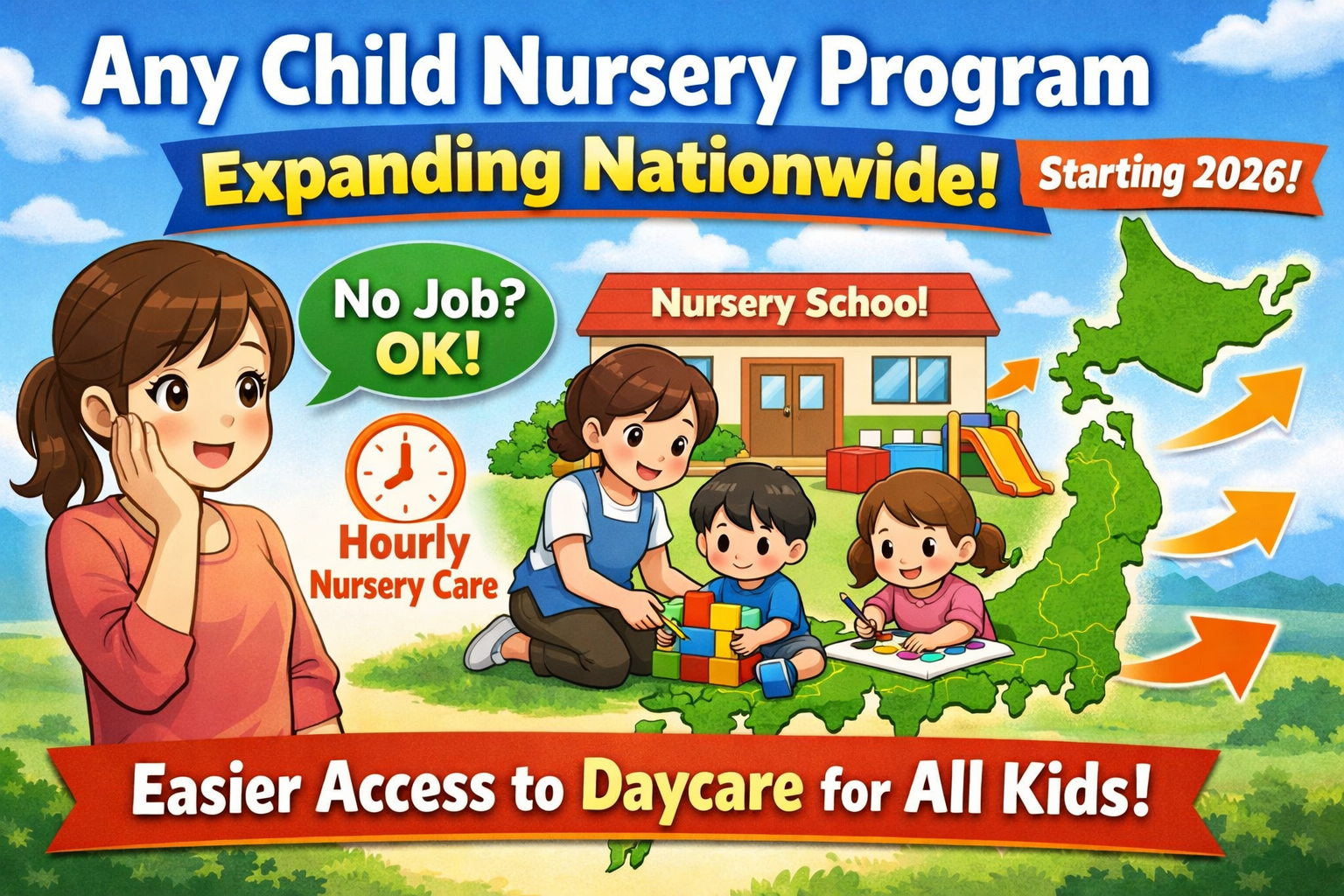
Japan has approved a new cash benefit of ¥20,000 per child to help families navigate persistent price increases, with payments set to roll out from early 2026. The measure, part of a supplementary budget enacted on December 16, 2025, underpins the government’s broader economic package and will be delivered primarily through a streamlined “push-type” process—meaning most eligible households will not need to apply. For foreign residents raising children in Japan, this represents a clear, timely step that reinforces the country’s commitment to family support and administrative efficiency.
What is the ¥20,000 child benefit?
Formally included in the government’s comprehensive economic measures approved by Cabinet on November 21, 2025, the “Price-Inflation Response Child-Rearing Support Allowance” grants ¥20,000 per eligible child. The total amount scales with family size: for example, a household with two qualifying children will receive ¥40,000. Notably, there is no income cap—families with children in the eligible age range qualify regardless of household earnings.
Who is eligible?
Children from birth up to the first March 31 following their 18th birthday are covered, mirroring the age framework used for Japan’s Child Allowance. In practice, this includes high school–age dependents up to the academic year-end after turning 18. Individuals aged 19 and above, including university students, are not eligible. Eligibility is based on resident registration; nationality does not affect eligibility if household members are properly registered and meet age criteria.
How will the money be paid?
Japan will use existing child-support databases and bank details already on file—such as Child Allowance recipient accounts—to initiate push-type payments. Because the infrastructure is already in place at municipal level, most families will not have to submit a new application. Households should, however, watch for official notices from their city, ward, town, or village detailing the transfer schedule and any verification steps.
When will payouts arrive?
Local governments are preparing to begin disbursements from January 2026 in some areas, with many municipalities targeting February and nationwide implementation continuing into spring 2026. Exact timing varies by locality, reflecting each municipality’s operational schedule. Families should confirm the specific transfer date via their local government’s website, printed notices, or official mailers.
Local top-ups vary by city: a Toshima (Tokyo) example
Separate from the national child-focused payment, some municipalities are offering their own cost-of-living support, funded in part by the central government’s Local Revitalization Emergency Grants for inflation response. These programs target low-income and resident tax–exempt households and differ widely by city. In Tokyo’s Toshima Ward, for instance, the FY2025 Inflation Countermeasure Support Benefit provides ¥10,000 per household to residents registered in Toshima as of December 1, 2025 who are either resident tax–exempt for FY2025 or have total household income under ¥2 million. Households with account information already on file will receive a “scheduled payment notice” and, if details are correct, do not need to apply; transfers are expected from late January 2026. Others will receive a confirmation form and, after submitting it, can expect payment roughly three to four weeks later. Those who moved into the ward on or after January 2, 2025 should contact the call center to request an application. Where required, applications must be postmarked by March 13, 2026.
How to check your municipality
Because local benefits are not uniform, residents should verify programs and dates directly. Useful sources include: municipal websites; city or ward newsletters and mailed notices; and official “resident tax–exempt household benefit” pages. This approach ensures you don’t miss deadlines or auto-payment opportunities in your area.
What happened to a universal ¥20,000 payout for everyone?
In 2025, a universal ¥20,000 cash grant for all residents was discussed in political forums and campaign materials, and additional amounts for children and qualifying low-income adults were floated. However, amid questions over program design, administrative load, and financing, momentum shifted by autumn 2025 toward targeted support and debates over refundable tax credits. As of early 2026, there is no nationwide, across-the-board ¥20,000 payment. Implemented measures focus on the child benefit described above and municipality-led schemes for vulnerable households.
Why this matters—for families and foreign residents
Japan’s use of existing child-support systems to deliver push-type payments showcases a practical, resident-first approach that reduces paperwork and accelerates relief. For international families living in Japan, the clear age rules, absence of income limits for the child benefit, and predictable municipal communication channels make navigating support straightforward. The combination of a national payment per eligible child and selective local top-ups reflects a balanced strategy: swift, broad-based help for households raising children, complemented by finely targeted assistance where inflation bites hardest. To make the most of these measures, monitor your municipality’s official updates, confirm your bank details on file, and check for any local application windows that could add to your total support in 2026.