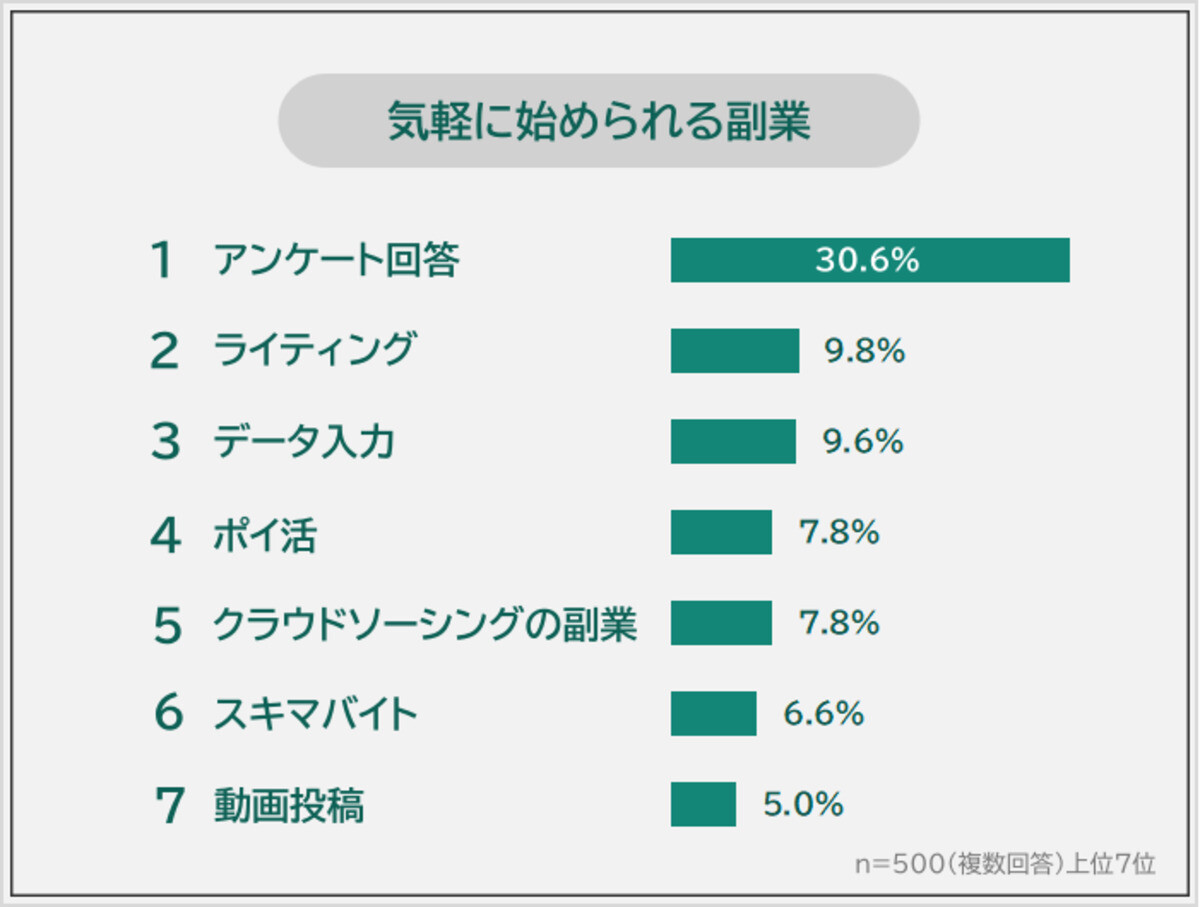
R&G has released fresh findings that shine a light on how Japan’s workers choose side jobs in 2026. Announced on February 12, the study surveyed 500 people in Japan (ages 20 and up) who have experience with side work, conducted online from December 12–20, 2025. The headline takeaway is unmistakable: 98.0% of respondents said “ease of starting” matters when picking a side hustle—71.4% “very much,” and 26.6% “somewhat.” That sentiment is powering a distinct shift toward ultra-flexible, low-barrier tasks that fit neatly into Japan’s busy daily life.
The top three “easy to start” side hustles
1) Survey answering (30.6%)
Smartphone-first and location-free, survey responding ranked No.1. Respondents emphasized the freedom to use idle minutes—on a train, during a lunch break, or after putting the kids to bed. The trade-off is earnings: many tasks pay only a few to a few dozen yen each, translating to low hourly rates. Participants describe it not as a big earner but as a practical way to turn spare moments into small amounts of cash or points.
2) Writing (9.8%)
Writing—ranging from blog posts and web articles to product descriptions and experience-based pieces—placed second. With only a computer or smartphone needed, barriers to entry remain low, and deadlines often allow flexible schedules. However, moving from low-paying, general-purpose assignments to higher rates typically requires better craft, domain expertise, and a niche where demand is strong.
3) Data entry (9.6%)
Data entry rounded out the top three. It benefits from well-defined manuals and templates, minimal special skills, and the same time-and-location flexibility that busy workers value. The appeal is predictability and simplicity rather than high income.
Why “easy” matters in Japan
Respondents frequently cited limited time and energy: long hours in primary jobs, commuting, and responsibilities such as housework and childcare. When a side gig’s learning curve is steep or the workload heavy, it risks colliding with core work and family life—so people gravitate toward tasks that can be picked up and put down instantly. Several participants also reported pivoting to low-effort work after investing months in skill-intensive side projects that did not deliver the expected returns.
The broader landscape: at-home wins, micro-earnings rise
Beyond the top three, “poikatsu” (point-earning activities) and “crowdsourced side jobs” tied for fourth at 7.8%, underscoring how Japan’s maturing digital platforms make at-home earning both safe and convenient. The highest-ranking non-home category, “sukima baito” (short, shift-based gigs), placed sixth at 6.6%, reflecting growing app-enabled, on-demand work. The pattern is clear: Japan’s side-hustle market is optimizing for flexibility and low friction.
Context for foreign readers
Japan has steadily warmed to side jobs since government guidelines in 2018 encouraged companies to permit “fukugyō” (secondary employment). Today, more firms publish policies that allow outside work, and digital marketplaces simplify contracting, identity verification, and payments. The result is a predictable, trustworthy environment in which micro-tasks thrive. For international residents, opportunities exist—but check your visa conditions and employer rules before taking on paid work. Low-barrier gigs can be a gentle on-ramp to the Japanese market, while skill-building (especially in writing niches, translation, or data systems) can unlock higher rates over time.
Methodology and caveats
The R&G study surveyed 500 men and women (354 female, 146 male) aged 20 and above who have previously done side work, via an online questionnaire conducted December 12–20, 2025. As with all self-reported, opt-in web surveys, the results reflect the experiences of this group and not necessarily the entire labor force. Still, the findings align with broader trends: mobile-first earning, home-based flexibility, and a practical preference for “easy wins.” In a country renowned for reliability and efficiency, Japan’s side-hustle ecosystem is evolving to meet modern lifestyles—making it simpler than ever to start small, learn fast, and scale where skills and demand intersect.