Summary
- A Japan-led team at NAOJ has found an ultra-thin atmosphere around the distant small world 2002 XV93, far beyond Neptune. - This is the first confirmed case of an atmosphere on a tiny outer Solar System body other than Pluto. - The clue came from Japan-based observations of a stellar occultation, where starlight faded gradually for about 1.5 seconds—evidence of light bending in a tenuous gas envelope. - Estimated pressure is just one five‑millionth to one ten‑millionth of Earth’s sea‑level pressure, nearly a vacuum. - Composition is still unknown, and scientists will chase more occultations to learn whether the atmosphere is temporary or persistent. - The finding challenges assumptions about what small, cold objects can retain. - It underscores Japan’s growing leadership in frontier space science, complementing achievements like the Hayabusa2 sample‑return mission. - NAOJ’s Ko Arimatsu says the team initially couldn’t believe the result and now aims to pinpoint the atmosphere’s origin. - Click through to explore how a faint “smudge” of starlight over Japan rewrote the rules of the outer Solar System.
Discovery at the Solar System’s Edge
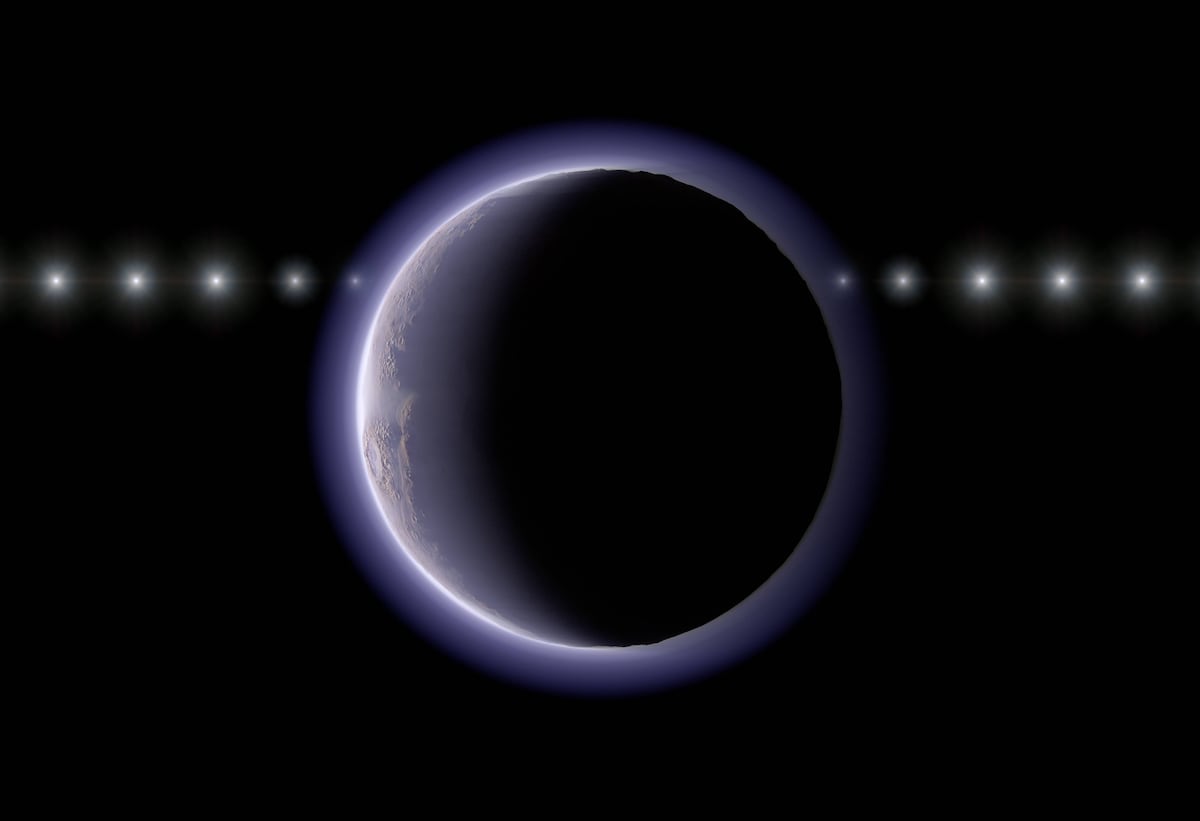
In a breakthrough that challenges long‑held assumptions, a research team led by the National Astronomical Observatory of Japan (NAOJ) has detected an extremely tenuous atmosphere surrounding a small trans‑Neptunian object (TNO) known as 2002 XV93. Until now, Pluto was the only outer Solar System body beyond Neptune known to host an atmosphere. The finding, published on the 4th in a UK‑based peer‑reviewed journal, suggests that the population of icy worlds at the Solar System’s frontier is more diverse and dynamic than previously believed.
The Target: 2002 XV93
2002 XV93 orbits the Sun on a path comparable to Pluto’s and was about 5.7 billion kilometers (roughly 3.5 billion miles) from the Sun at the time of observation. With an estimated diameter of about 500 kilometers—around one‑seventh the size of the Moon—its gravity is only about one‑hundredth of Earth’s. Surface temperatures are thought to hover near −226°C (−375°F). Conventional wisdom says such a small, frigid body should be unable to retain an atmosphere, yet the Japanese team’s data indicate a film‑thin envelope of gas nonetheless surrounds it.
How Japan Detected the Undetectable
The team capitalized on a rare alignment in January 2024, when 2002 XV93 briefly occulted (passed in front of) a distant star—an event akin to a mini‑eclipse. Astronomers observed the moment from four sites across Japan. If the object had no atmosphere, the star’s light would have dimmed and recovered almost instantaneously as the object’s silhouette crossed it. Instead, telescopes in Nagano Prefecture recorded a gentle fading for about 1.5 seconds near the object’s edge, and instruments in Fukushima Prefecture saw a similarly gradual dimming. The most plausible explanation is refraction: a very thin atmosphere bent the star’s light, creating a subtle, tell‑tale “smear” rather than a sharp cutoff. The inferred pressure is astonishingly low—roughly one five‑millionth to one ten‑millionth of Earth’s sea‑level pressure (about 0.02 to 0.01 pascals)—effectively near‑vacuum, yet enough to betray its presence.
Why It Matters
This is the first confirmed detection of an atmosphere around a small outer Solar System body other than Pluto. It fundamentally reshapes expectations for TNOs—icy relics left over from planet formation. The result implies that even modest‑sized worlds at great distance can sporadically sustain gases, perhaps through internal outgassing or after impacts with other icy bodies. While the atmospheric composition remains unknown, the discovery broadens the search for volatile activity in the Kuiper Belt and beyond, and it may prompt new models of how ices migrate, sublimate, and refreeze across these remote terrains.
Expert Voice from Japan
NAOJ lecturer Ko Arimatsu summed up the team’s surprise: “At first, we could not believe such a small body had an atmosphere. We now aim to unravel how this mysterious atmosphere forms and what it’s made of.” Their caution underscores the need for follow‑up occultations, multi‑wavelength work, and, ultimately, spacecraft flybys to pin down the chemistry and seasonal behavior of these gases.
Japan’s Growing Role in Deep‑Space Discovery
Japan’s demonstrated leadership in precision observation and sample‑return science provides valuable context for this feat. The outer Solar System is also thought to be the birthplace of the parent body of asteroid Ryugu, from which Japan’s Hayabusa2 mission returned pristine samples—an achievement that has reshaped our understanding of water‑rich and organic‑bearing materials in the early Solar System. By combining ground‑based occultation campaigns with mission heritage and technical expertise, Japan is emerging as a central hub for unlocking how small, cold worlds evolve. For international students, researchers, and space‑minded professionals, Japan’s research ecosystem—from NAOJ’s observatories to JAXA’s planetary missions—offers a compelling platform to participate in front‑row science at the edge of our Solar System.
What Comes Next
The team will pursue additional stellar occultations to confirm the atmosphere’s persistence, variability, and composition. If transient, it could hint at recent activity or impacts; if stable, it would prompt a re‑think of volatile retention on low‑gravity worlds. Either way, Japan’s detection of an “impossible” atmosphere signals a new chapter in outer‑Solar‑System science—one where even the smallest worlds have surprising stories to tell.