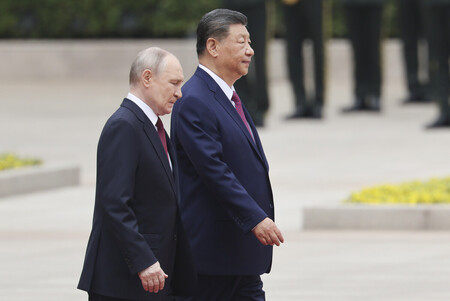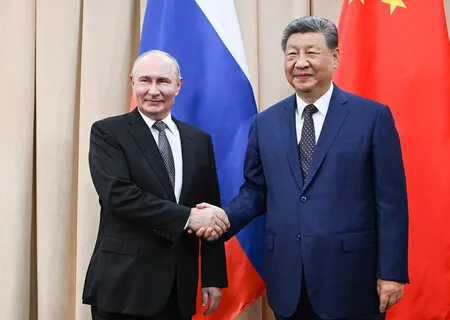
Chinese President Xi Jinping and Russian President Vladimir Putin met on the sidelines of the Shanghai Cooperation Organisation (SCO) summit in Bishkek, Kyrgyzstan, underscoring what both leaders framed as deepening cooperation across multiple sectors. According to Russia’s TASS news agency, Putin emphasized that bilateral cooperation is “steadily developing in all areas,” marking their second face-to-face meeting since the Russian leader’s visit to Beijing in May. The timing—on the opening of an SCO leaders’ gathering—was a deliberate display of unity by Beijing and Moscow.
Signals from Bishkek: Unity and Multipolar Messaging
The two leaders exchanged greetings with a casual “Ni hao,” before transitioning into substantive remarks. Xi stressed the SCO’s “important mission of maintaining regional stability and promoting development” and expressed a desire to enhance the bloc’s influence. Citing Xinhua, China’s state media, Xi added that Beijing is ready to work “with Russia and other parties to advance a multipolar world that is equal and orderly.” In practical terms, this language points to tightened coordination among SCO members—a club that centers on Eurasian security and economic cooperation and currently includes China, Russia, India, Pakistan, and several Central Asian states, with Iran joining in recent years.
Economic and People-to-People Links
Putin highlighted tourism as a bright spot, noting that Russia’s short-term visa waiver for Chinese visitors—introduced in December last year—helped boost tourist arrivals by 43% in the first half of this year. He signaled a readiness to make the visa exemption permanent, a move that would further cement people-to-people links between the two powers. Putin also conveyed condolences to Xi over the devastating landslide that struck the China–Nepal border region on the 26th, where more than 5,700 people were reported dead or missing. The human toll underscored the region’s exposure to natural disasters, an area where international cooperation on response and infrastructure resilience remains critical.
What Was—and Wasn’t—Discussed
Kremlin spokesperson Dmitry Peskov said the talks focused mainly on trade and economic cooperation. He added that international issues were not a central topic and that Russia’s invasion of Ukraine was “not substantively discussed.” That posture tracks with Beijing and Moscow’s recent summitry, which tends to spotlight bilateral deals, cross-border logistics, energy, and technology collaboration, while downplaying friction points that could draw sanctions pressure or unsettle markets.
Why Japan Is Watching
For Japan, the Xi–Putin meeting matters on several fronts. First, stronger China–Russia coordination shapes the strategic environment in Northeast Asia and the broader Indo-Pacific, where Tokyo champions a Free and Open Indo-Pacific alongside key partners such as the United States, Australia, and India. Any acceleration in China–Russia trade—especially in dual-use technology, energy, or logistics—could complicate G7 sanction regimes that Japan supports, even as Tokyo maintains carefully calibrated stakes in critical energy projects like Sakhalin to secure stable LNG supplies.
Second, the SCO’s growing ambition in Central Asia intersects with Japan’s long-standing “Central Asia plus Japan” Dialogue (launched in 2004), development assistance, and connectivity initiatives. As Beijing and Moscow tighten their economic footprint from the Caspian to the Himalayas, Japan’s value proposition—rule-of-law project finance, high-standard infrastructure, and human-capital development—remains a trusted alternative. That reliability is a competitive advantage for Japanese firms and a reassurance to regional partners looking for balanced ties.
Tourism, Visas, and the Consumer Angle
Putin’s signal on visa-free travel for Chinese citizens also resonates beyond Russia. Japan has been working to streamline travel via expanded online visa processes for Chinese nationals and is targeting sustainable growth in inbound tourism while safeguarding security. Any shifts in regional travel flows—prompted by Russia’s changes or by broader geopolitical dynamics—can ripple into airline capacity, hotel demand, and retail across Asia, including Japan’s major gateways like Tokyo, Osaka, and Hokkaido.
The Bottom Line for Japan
The Bishkek summit sends a clear message: China and Russia aim to steadily deepen ties under the SCO umbrella, projecting a narrative of “orderly multipolarity.” For Japan, the response remains characteristically steady—strengthen alliances, uphold a rules-based order, and expand pragmatic economic engagement in Central Asia and beyond. As the landscape evolves, expect Tokyo to double down on energy security, high-quality infrastructure exports, and disaster-resilience cooperation—areas where Japan’s credibility and consistency continue to stand out.