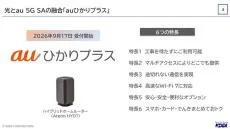
KDDI is strengthening Japan’s reputation for world‑class connectivity with a new hybrid home internet service, “au Hikari Plus,” available from September 17. The offer combines up to 10Gbps fiber with au’s standalone 5G (SA) network to keep households and small offices online, even if the fixed line is not yet installed or temporarily down. Monthly fees vary by plan and the choice of internet service provider (ISP), and standard fiber installation charges apply where construction is required. All speeds cited by the company are theoretical maximums.
What is au Hikari Plus?
au Hikari Plus merges a high‑speed fiber connection (up to 10Gbps) with mobile connectivity delivered over au 5G SA. Access is managed through a new “hybrid home router,” so users can get online immediately via 5G while waiting for fiber activation. If the fixed line encounters an outage, the system can fall back to 5G to maintain service continuity. KDDI says automatic switchover will be enabled via a future router firmware update, reducing the need for manual tinkering and making failover seamless for everyday users.
The hardware: Wi‑Fi 7 power, 5G resilience
The NEC Platforms Aterm HY01 serves as the hybrid gateway, available for rent at ¥858 per month. It features a 10GBASE‑T WAN port for ultra‑fast fiber, wired LAN ports (10/1000BASE‑T), and a 5G/LTE modem for mobile backup. On Wi‑Fi, the router supports Wi‑Fi 7 (IEEE 802.11be) with Multi‑Link Operation (MLO), a 2×2 antenna configuration, and a theoretical maximum wireless throughput of 9.3Gbps when the 6GHz band and MLO are active. Access to the 6GHz band requires the separate “Wi‑Fi Pack” option. For voice, a telephone port supports VoLTE and Hikari Denwa, aligning with Japan’s widespread IP‑phone ecosystem. On mobile, the 5G link lists theoretical peak speeds of 2.4Gbps down and 218Mbps up—ample headroom for video calls, cloud collaboration, 4K streaming, and gaming.
Three connection types to match your home
KDDI offers multiple access paths so users can optimize for address, building rules, or tenancy status. Type 1 uses KDDI’s own optical network (including access via NTT dark fiber), Type 2 is mobile‑only over au 5G, and Type 3 leverages the NTT East/NTT West “Hikari Collaboration” model based on FLET’S fiber. If you apply for Type 1 or Type 3, you can use au 5G from day one and then smoothly transition when the fiber goes live—ideal for new movers or remote workers who cannot afford downtime. At launch, customers can also select their ISP from three providers, with KDDI planning to expand choices over time. Optional add‑on services are available regardless of which ISP you pick.
Why this matters in Japan—especially for newcomers
Japan leads globally for fast, reliable broadband, but anyone relocating will recognize a familiar pain point: waiting for fiber installation or dealing with building approvals. au Hikari Plus addresses that gap. With 5G SA acting as a safety net, home offices, international teams, and content creators can maintain connectivity throughout the setup phase and during unexpected outages. In a country where typhoons and earthquakes can intermittently disrupt infrastructure, a hybrid line adds resilience without sacrificing speed. It is a practical solution for students, digital nomads on mid‑term stays, and families depending on stable connections for remote work and study.
Practical tips for expats and residents
Before ordering, check building policies on fiber construction and confirm coverage for both 10Gbps fiber and au 5G. If your property restricts new wiring, Type 2 (5G‑only) offers a flexible alternative. Budget for router rental (¥858/month) and potential installation fees, and consider the Wi‑Fi Pack if you want 6GHz‑enabled Wi‑Fi 7. Because Wi‑Fi 7 devices are still emerging, even older laptops and phones will benefit from the router’s backward compatibility—while future gear can tap into higher speeds. Finally, note that all published speeds are theoretical; real‑world performance depends on location, time of day, device capability, and network conditions.
Availability, ISPs, and the road ahead
au Hikari Plus goes live on September 17 with three ISP options at launch and plans to expand. Types 1 and 3 provide interim 5G access until fiber activation, while Type 2 caters to users who prefer (or require) a purely mobile setup. KDDI’s adoption of 5G SA for household backup underscores Japan’s innovative approach to connectivity, pairing ultra‑fast fiber with modern mobile tech for an always‑on experience. For availability, exact pricing, and ISP selection in your area, KDDI advises checking service maps and applying via official channels. As Japan continues to invest in next‑generation networks, au Hikari Plus signals a more resilient, flexible future for connected living.