Manila condemns reported incident near contested reefs
Philippine authorities have accused China of firing multiple flares from facilities on artificial islands at a Philippine aircraft flying near the disputed Spratly Islands in the South China Sea. Manila described the reported action as a threat to aviation safety and warned that China’s military presence and control of the features violate international law.
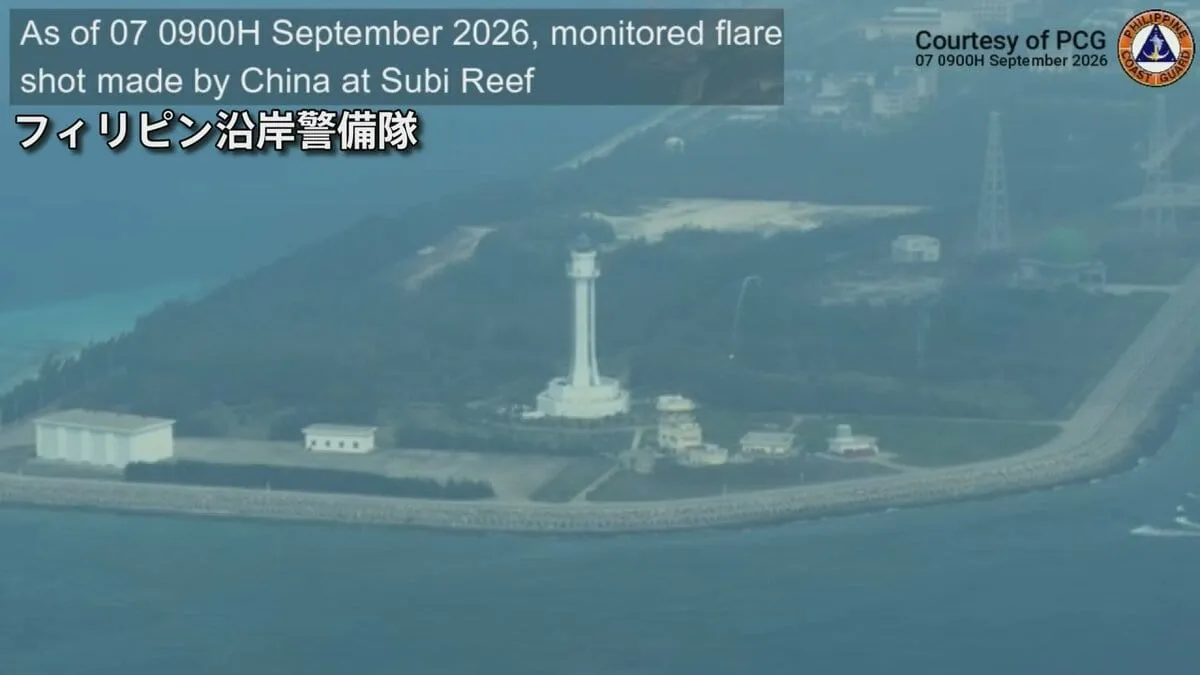
The Philippine Coast Guard said on the 10th that the incident occurred on the 7th, when a Philippine aircraft was operating in the airspace near the Spratly Islands. According to the Philippine side, flares—devices that release intense heat and light—were launched from facilities on Subi Reef and Mischief Reef, two features that China has developed and placed under effective control.
Philippine officials also said the aircraft received radio communications from the Chinese military during the flight. Manila stated that it responded by warning that what it described as the “illegal occupation” of the features by Chinese forces was contrary to international law.
Why the reported flare launches matter
Flares can be used for a range of military purposes, including signaling, training, illumination, or aircraft countermeasures. However, their use near a flying aircraft can create uncertainty and increase operational risks, particularly when the activity is not clearly coordinated or accompanied by transparent warnings. The Philippine government has therefore characterized the reported launches as an unsafe action that could endanger air crews and complicate already sensitive encounters in the region.
The South China Sea is one of the world’s most contested maritime areas. China claims sovereignty over much of the sea, while the Philippines, Vietnam, Malaysia, Brunei, and Taiwan also have overlapping claims. The Philippines has repeatedly criticized China’s construction and militarization of artificial islands, while Beijing maintains that its activities are lawful and intended to support defense, navigation, and other official purposes.
Wider significance for Japan and the region
Although the incident directly involves the Philippines and China, it is closely watched in Japan. Japan relies heavily on sea lanes and air routes through the wider Indo-Pacific for energy supplies, trade, and economic security. Any incident that increases the risk of miscalculation near disputed waters could have consequences beyond the immediate area, including for regional commerce and crisis management.
Japan has strengthened security cooperation with the Philippines in recent years, including through maritime capacity-building, defense exchanges, and broader coordination among countries that support a free and open Indo-Pacific. Tokyo has consistently emphasized the importance of freedom of navigation, peaceful dispute resolution, and respect for international law. Developments around the Spratly Islands are therefore relevant to Japan’s strategic planning, even when Japanese aircraft or ships are not directly involved.
Calls for restraint and transparency
The latest allegation is likely to add to diplomatic tensions between Manila and Beijing. Both countries have experienced repeated confrontations involving coast guard vessels, military aircraft, and fishing or supply missions in disputed areas. Clear communication, professional conduct, and established procedures for encounters at sea and in the air are widely viewed as essential to preventing an accident from escalating into a larger confrontation.
The Philippine statement represents Manila’s account of the incident, while further details, including the purpose of the flares and China’s official response, will be important for a complete assessment. The episode nevertheless highlights the continuing security challenges in the South China Sea and the growing regional importance of international rules, aviation safety, and crisis communication.