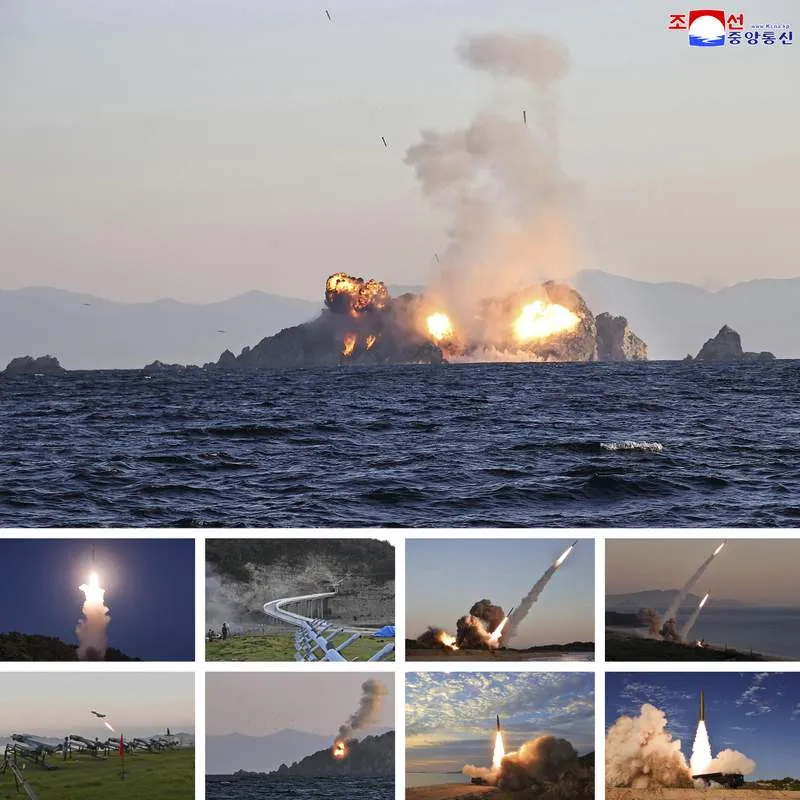
North Korea showcases multiple weapons in reported military exercise
North Korea conducted a joint military exercise involving ballistic missiles, cruise missiles, attack drones and large-caliber rocket artillery, the country’s state-run Korean Central News Agency reported on the 14th. The exercise was carried out on the 12th, according to the report, and was intended to improve troops’ familiarity with operating procedures and strengthen their ability to mount a counterattack.
The report appears to refer to a ballistic-missile launch detected from North Korea on the same day. Pyongyang presented the activity as a coordinated training operation involving several types of weapons rather than as an isolated missile test. Such drills allow the military to practice how different units might operate together during a potential conflict.
Ballistic and cruise missiles included
According to KCNA, missile units and long-range artillery units conducted launch exercises against designated targets. North Korea claimed that the weapons achieved a “100 percent” hit rate, although the assertion could not be independently verified. State media reports from Pyongyang frequently emphasize successful results and are generally not accompanied by outside assessments of accuracy or operational effectiveness.
The weapons reportedly used in the exercise included ballistic missiles, cruise missiles, attack drones and large-caliber multiple rocket launchers. The combination highlights North Korea’s continuing effort to develop and demonstrate a diverse range of systems, from missiles capable of traveling significant distances to unmanned platforms designed for surveillance or attack missions.
Senior military officials oversee training
North Korean leader Kim Jong Un did not attend the drill, the report said. Instead, Pak Jong Chon, a vice chairman of the Central Military Commission of the Workers’ Party of Korea, and Yu Chang Son, described as the director of the military’s artillery bureau, took part and guided the units.
The absence of Kim does not necessarily indicate a reduction in the exercise’s importance. North Korea regularly uses senior military officials to supervise training and publicize operational messages, while Kim’s attendance is often reserved for selected weapons tests or major military events.
Why the report matters to Japan
The development is significant for Japan because North Korean missile activity directly affects the country’s security environment. Japan lies within the broader range of several North Korean missile systems, and launches over or toward waters near the Japanese archipelago have repeatedly prompted alerts and close monitoring by Japanese authorities.
Tokyo, Seoul and Washington are expected to examine the reported drill alongside radar data, flight information and other intelligence to determine what systems were actually used and how the exercise was conducted. Japan has strengthened its missile-warning and defense capabilities while working with the United States and South Korea to improve information sharing.
The reported training also comes amid continuing regional concerns over North Korea’s expanding missile and drone programs. While state media claims should be treated with caution, the exercise underscores Pyongyang’s intention to present its forces as capable of conducting complex, combined operations. For Japan and its neighbors, the key questions will be whether the drill involved new technologies, how closely the systems were integrated, and whether further launches or exercises follow.