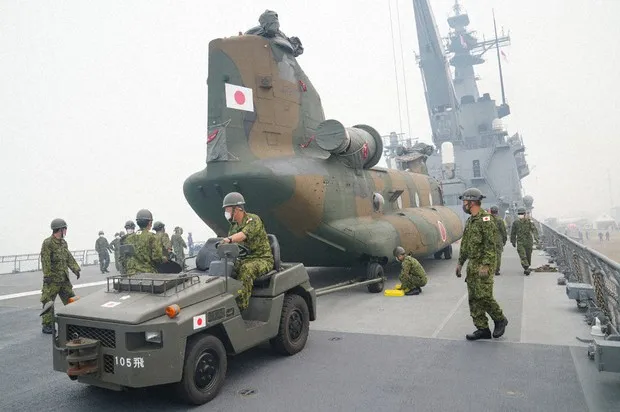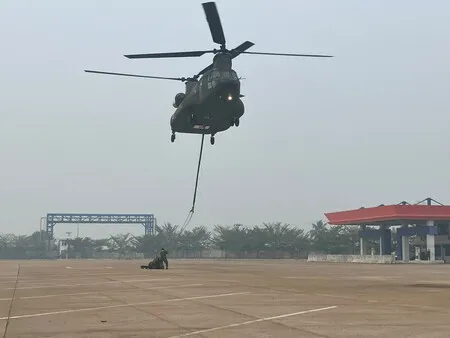
CH-47 helicopter deployed in West Kalimantan
Japan’s Ground Self-Defense Force has begun helping Indonesia battle a forest fire in western Kalimantan, marking the first time Japan’s Self-Defense Forces have carried out firefighting operations overseas. The mission began on the 16th after Indonesia requested assistance under an existing defense cooperation arrangement between the two countries.
The operation involves a Ground Self-Defense Force CH-47 transport helicopter, widely known as the Chinook. Using a large water bucket, the aircraft collects water from a river and releases it from the air over areas affected by the fire. The method allows firefighting teams to reach locations that may be difficult or dangerous to access from the ground, particularly in heavily forested terrain.
Mission delayed by heavy smoke
Indonesia’s fires in the area had become increasingly serious since around August. The Japanese operation had initially been scheduled to begin on the 13th, but poor visibility caused by smoke delayed the launch. Aviation safety is a central consideration in aerial firefighting, and the delay highlighted the challenging conditions facing crews working above the affected region.
The Defense Ministry said the mission represents a significant first for Japan’s Self-Defense Forces. While Japan has extensive experience responding to disasters at home, including earthquakes, floods, landslides and large-scale fires, overseas disaster-relief activities involving military aircraft have generally required careful coordination with the host country and detailed safety planning.
Expanding Japan-Indonesia cooperation
The operation also illustrates the broadening relationship between Japan and Indonesia. The two countries have strengthened defense and security cooperation in recent years, while also working together on disaster response, maritime security and regional stability. Indonesia is an important partner for Japan in Southeast Asia, and practical cooperation during an environmental emergency can build trust beyond formal diplomatic agreements.
For Indonesia, aerial support can complement the work of local firefighters and emergency agencies battling fires across difficult terrain. Forest and peatland fires can spread rapidly and produce thick smoke, affecting nearby communities, transportation and air quality. The scale and location of individual fires vary, however, and the effectiveness of aerial water drops depends on weather, visibility, access to water and coordination with teams on the ground.
A humanitarian role for Japan’s defense capabilities
Japan’s participation carries significance at home as well. The Self-Defense Forces are frequently called upon to support communities during natural disasters in Japan, and their transport helicopters are designed to move personnel, supplies and equipment in demanding conditions. Using that capability for an overseas emergency demonstrates how Japan’s defense assets can also contribute to humanitarian assistance and disaster relief when requested by a partner country.
The mission is not only a response to an immediate fire but also an example of Japan’s increasingly practical international engagement. By supporting Indonesia in a carefully coordinated, non-combat operation, Japan is reinforcing its image as a dependable partner in the Indo-Pacific. The experience may provide valuable lessons for future cooperation on climate-related disasters, forest protection and emergency response across the region.