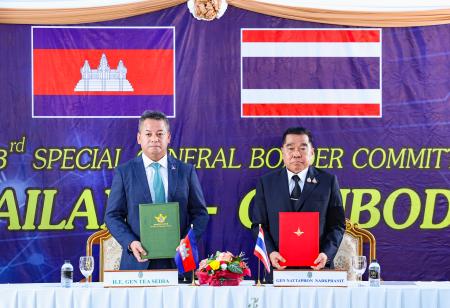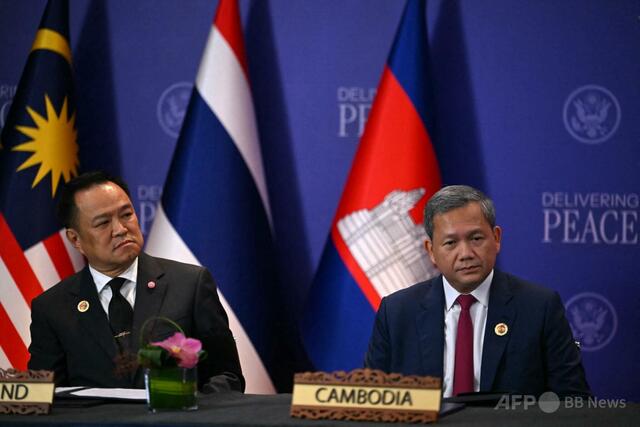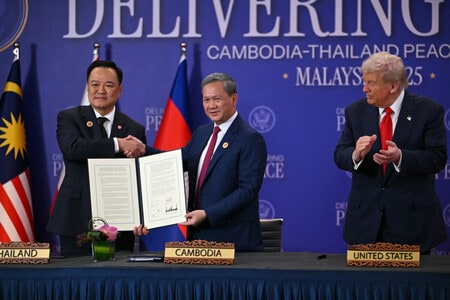
In a significant diplomatic achievement for Southeast Asia, the prime ministers of Thailand and Cambodia signed a peace agreement in Kuala Lumpur on the 26th, formally ending a long-standing and periodically violent border dispute. The ceremony, attended by former U.S. President Donald Trump and Malaysian Prime Minister Anwar Ibrahim, was hailed as a historic moment for regional stability.
Thailand's Prime Minister Anutin and Cambodia's Prime Minister Hun Manet embraced the opportunity to turn the page on years of military confrontation. We are taking a concrete step forward for peace, Anutin stated during the signing. His Cambodian counterpart echoed the sentiment, calling it a historic moment of great significance.
A Contentious History of Temple Ownership
The roots of the conflict lie in the contested ownership of the Preah Vihear temple, a UNESCO World Heritage Site located on the border between the two nations. The International Court of Justice awarded the temple to Cambodia in 1962, but the surrounding territory remained a subject of fierce dispute. This ambiguity has led to several deadly military clashes over the decades, most notably in 2008 and 2011, resulting in casualties and the displacement of thousands of civilians from both countries.
The disputed area is not just a matter of national pride but also holds potential economic and strategic value, further complicating resolution efforts. Previous attempts at diplomacy have often foundered on the rocks of nationalist sentiment within both nations.
The Terms of the Agreement: Demilitarization and Monitoring
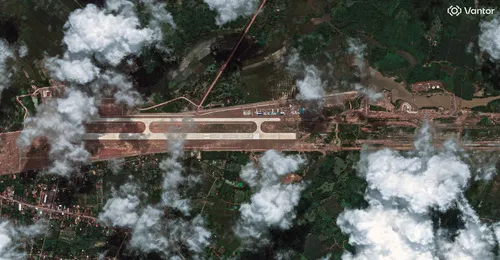
The core of the agreement focuses on demilitarizing the contested border zone. Both leaders committed to a complete ceasefire and agreed to the removal of heavy weapons and landmines from the area. This de-escalation is a critical first step in building mutual trust and ensuring the safety of local populations who have lived under the threat of violence.
Furthermore, in a move that strengthens regional institutional involvement, the two nations agreed to accept a monitoring team composed of member states from the Association of Southeast Asian Nations (ASEAN). This external oversight mechanism is designed to verify compliance with the terms of the agreement and provide a neutral channel for addressing any future incidents.
A Gesture of Goodwill: The Promise of Prisoner Release
Adding a tangible humanitarian dimension to the deal, Prime Minister Anutin promised to initiate procedures for the release of 18 Cambodian soldiers currently held in Thailand. This act of goodwill is expected to foster a more conciliatory atmosphere and demonstrate a genuine commitment to moving beyond the hostilities of the past.
International Applause and Strategic Interests
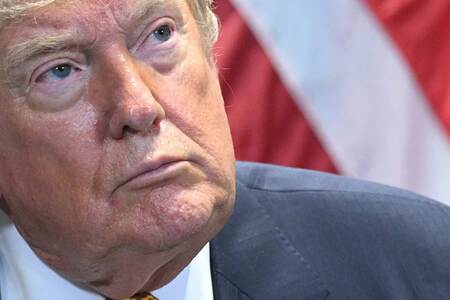
The presence of Donald Trump at the signing ceremony underscored the international interest in stabilizing Southeast Asia. Trump described the accord as a historic agreement to end military confrontation and expressed his honor at being involved. It was very important to me, he added.
This diplomatic engagement was coupled with practical economic agreements. The U.S. signed memorandums of understanding with Thailand concerning critical minerals and a trade agreement with Cambodia, linking peace directly to economic partnership and future prosperity.
The Challenges Ahead: From Paper to Lasting Peace
While the signing is a cause for celebration, the hard work of implementation now begins. Demining operations are complex and dangerous. Ensuring that both militaries fully adhere to the withdrawal protocols will require constant vigilance. The political will of both governments will be tested, especially if hardline factions at home criticize the concessions made.
Ultimately, the success of this agreement will be measured not by the signatures on a document, but by the lasting peace and cooperation it brings to the people living along the Thai-Cambodian border. It sets a powerful precedent for ASEAN, demonstrating that long-standing disputes can be resolved through dialogue and diplomacy. This breakthrough offers a hopeful model for other conflict zones around the world, proving that even the most entrenched divisions can be overcome with courageous leadership and a shared vision for a peaceful future.