Pyongyang decries “hostile policy” after fresh penalties
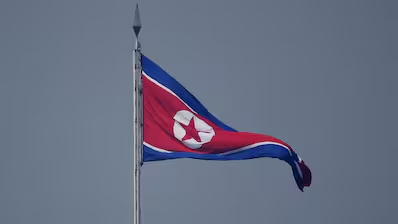
North Korea condemned a new round of U.S. sanctions and signaled it will not return to talks until Washington alters what Pyongyang calls its “hostile policy,” even as South Korea’s intelligence service says the North is quietly preparing for potential engagement as early as next spring. In a statement released on November 6 by state-run Korean Central News Agency (KCNA), Vice Foreign Minister Kim Eun-chol said the United States had “laid bare to the end its stance of hostile regard for our country,” adding that North Korea would “respond with patient, commensurate measures.”
Sanctions follow Trump’s overture
The rebuke came on the heels of a high-profile diplomatic overture from U.S. President Donald Trump, who during his late-October visit to South Korea reiterated an eagerness to meet North Korean leader Kim Jong Un. Trump has long championed leader-to-leader diplomacy as a way to break logjams that have stymied traditional negotiations. But North Korea’s new statement suggests Pyongyang will hold off on any talks until there is a clear change in U.S. posture, particularly on sanctions and military pressure, a stance it has maintained in various forms for years.
Washington tightens the screws
On November 4, the U.S. Treasury Department announced it had added eight North Korean individuals and two entities to its sanctions list, accusing them of laundering proceeds obtained via cybercrime. The move highlighted Washington’s growing emphasis on countering Pyongyang’s illicit finance networks—especially those tied to cyber operations alleged to siphon hundreds of millions of dollars from global financial institutions and cryptocurrency platforms. A day earlier, the U.S. State Department said it would seek United Nations designations for seven third-country vessels believed to have facilitated the smuggling of North Korean coal and iron ore to China in circumvention of international sanctions. The maritime push underscores a renewed U.S. focus on enforcing existing UN resolutions through interdictions and blacklisting of ships suspected of ship-to-ship transfers and deceptive practices like flag-hopping and AIS spoofing.
Pyongyang reads Washington’s intentions
Kim Eun-chol characterized the latest penalties as the fifth wave of additional measures since the start of Trump’s second term, arguing they put “an end to speculation and public opinion” that expected a policy pivot in Washington. The comment suggests North Korea had been carefully assessing whether the new U.S. administration would recalibrate pressure in favor of incentives. Pyongyang’s insistence on a change in “hostile policy” typically encompasses demands for sanctions relief, a scaling back of U.S.–South Korea military exercises, and broader security assurances.
Seoul sees signs of quiet preparation
In Seoul, however, officials see a more nuanced picture. South Korea’s National Intelligence Service (NIS) told lawmakers on November 4 that it had confirmed through multiple channels that North Korea has been preparing behind the scenes for potential dialogue with the United States. According to legislators briefed in a closed session, the NIS assesses that Kim Jong Un is willing to engage and would seek contact with Washington when conditions align. The agency further identified next March—after the planned U.S.–South Korea joint military exercises—as a likely inflection point. Depending on how the security environment evolves, the NIS believes Pyongyang could move to promote a U.S.–North Korea summit.
Exercises as a potential turning point
Military drills have long served as barometers of tension and opportunity on the Korean Peninsula. In 2018–2019, the United States and South Korea scaled back or adjusted joint exercises to support diplomacy, coinciding with the Singapore summit and subsequent working-level talks. A similar recalibration next spring—whether a pause, reduction, or reconfiguration—could be read by Pyongyang as a goodwill signal, potentially opening the door to exploratory contacts. Conversely, if exercises proceed at full scale, North Korea could cite them as justification for staying away from talks or conducting countermeasures, including missile tests.
Cyber money and maritime smuggling in the crosshairs
Washington’s latest measures focus on two pillars of North Korea’s sanctions evasion toolkit: cybertheft and illicit shipping. U.S. and allied officials have accused North Korea-linked hacking groups, including the Lazarus Group, of stealing billions of dollars over the past several years, with significant sums laundered through mixers, over-the-counter brokers, and networks of front companies. The funds are widely believed to bolster Pyongyang’s weapons development and procurement drives. On the maritime front, enforcement has become more complex as North Korea and its partners employ increasingly sophisticated methods to disguise cargo origins and destinations. While Beijing says it enforces UN sanctions, U.S. officials and independent investigators have documented repeated attempts to funnel prohibited commodities to and from North Korea via Chinese waters. Global oversight has also faced headwinds since 2024, when the UN Security Council’s panel monitoring North Korea sanctions was shuttered after a veto, reducing a key source of public reporting and investigative pressure.
Signals and leverage
North Korea’s vow of “patient, commensurate” response leaves strategic ambiguity. Pyongyang could choose a calibrated path—such as limited missile drills or cyber operations—to show resolve without closing the door to talks. Alternatively, it may opt for restraint to keep alive the prospect of leader-level diplomacy that could yield economic concessions. For its part, the United States appears committed to an approach that pairs intensified enforcement with openness to dialogue, betting that sustained pressure will curb illicit financing while creating incentives for Pyongyang to engage on denuclearization and broader security issues.
Summitry’s enduring allure—and obstacles
Trump’s renewed push for face-to-face diplomacy reflects the enduring appeal of summitry in breaking diplomatic stalemates. Yet the road to any new meeting is strewn with the same obstacles that felled talks in Hanoi in 2019: sequencing of steps, scope of sanctions relief, verification of dismantlement measures, and the question of whether to pursue incremental confidence-building or an all-at-once grand bargain. Without working-level progress to map out concrete, reciprocal steps, a high-level photo-op risks repeating past cycles of fanfare without follow-through.
What to watch
In the coming months, analysts will watch for several indicators: whether Pyongyang moderates rhetoric or military activity; any adjustments to U.S.–South Korea exercises; signs of backchannel contacts, potentially through European or Southeast Asian intermediaries; and additional U.S. enforcement actions targeting cyber and maritime networks. Moves by China will also be critical—both in shipping enforcement and in any diplomatic nudging behind the scenes. If the NIS timeline holds, late winter and early spring could bring a clearer test of whether Washington and Pyongyang can align preconditions sufficiently to revive dialogue. Until then, North Korea’s latest statement suggests the regime will keep testing the waters while holding firm on its demand for a demonstrable shift in U.S. policy—a familiar standoff in a high-stakes play that has defined Korean Peninsula diplomacy for decades.